Trinity-Bellwoods in Toronto, Ontario — Central Canada (North America)
Trinity College
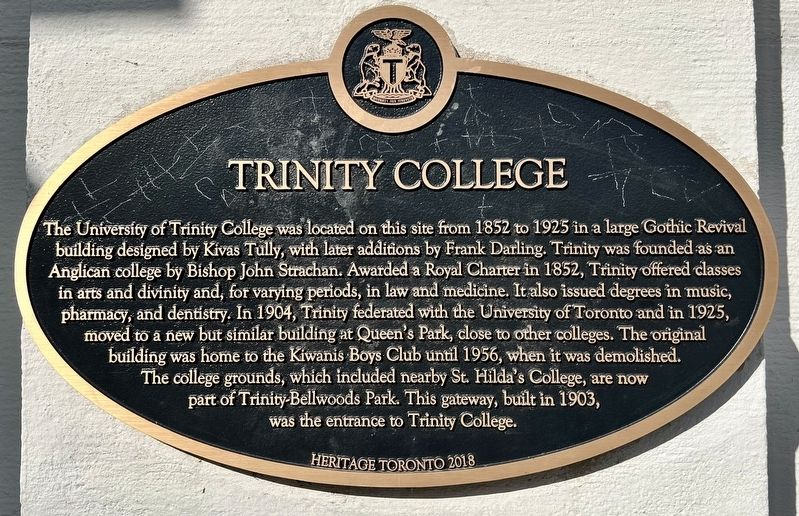
Photographed by Tim Boyd, October 24, 2024
1. Trinity College Marker
Topics. This historical marker is listed in these topic lists: Education • Parks & Recreational Areas • Religion & Religious Structures. A significant historical year for this entry is 1852.
Location. 43° 38.726′ N, 79° 24.797′ W. Marker is in Toronto, Ontario. It is in Trinity-Bellwoods. It is at the intersection of Queen Street West and Strachan Avenue, on the right when traveling west on Queen Street West.
this page online

Regionally, this marker is in Greater Toronto and on the Golden Horseshoe. It is also in Central Canada. Globally, it is in North America, on the Great Lakes, in the Western Hemisphere, in the Western World, and in the Anglosphere. Historically, it finds itself in what was once a British colony, the Viceroyalty of New France, the Haudenosaunee (Iroquois) Confederacy, and Rupert’s Land.
Other nearby markers. At least 8 other markers are within walking distance of this marker: Major-General the Hon. Aeneas Shaw (within shouting distance of this marker); Rediscovering Garrison Creek (about 150 meters away, measured in a direct line); Memorial Wall Plaques Dedicated to Patient Labourers (approx. 0.3 kilometers away); John Gibson House (approx. 0.4 kilometers away); St. Hilda’s College (approx. 0.4 kilometers away); The Church of the Good Samaritan (approx. 0.4 kilometers away); Massey-Harris Company (approx. 0.4 kilometers away); Chr. Hansen’s Laboratory (approx. half a kilometer away). Touch for a list and map of all markers in Toronto.
Also see . . .
1. Trinity College (Toronto Historical Association).
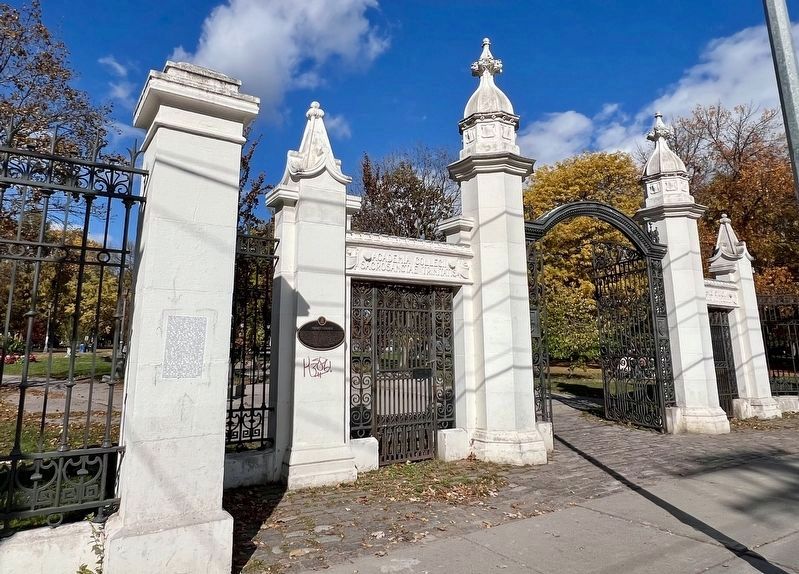
Photographed by Tim Boyd, October 24, 2024
2. Trinity College Marker
Attached to the 1903 gates
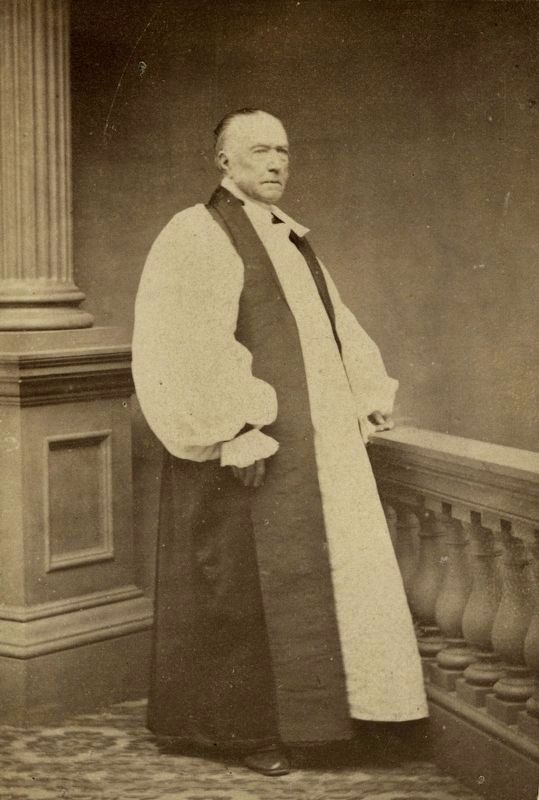
Prior to 1849, the only university in Toronto was King’s College and it was a Church of England school. On 30 May 1849, the Ontario government forbade the teaching of religion at the university. This so upset Bishop John Strachan that he went to England in 1850 to get a Royal Charter so that a new Anglican university could be formed. He took with him a petition with 11,731 signatures in support. Two years later his request was granted. The people of Toronto raised $32,000 for the building, and architect Kivas Tully was selected to design it.(Submitted on October 28, 2024, by Tim Boyd of Hamilton, Ontario.)
2. Strachan, John (Dictionary of Canadian Biography(.
Strachan has been correctly remembered as the Canadian arch tory of his era. Although he had shown some liberal or even radical tendencies as a student in Scotland, the course of the French Revolution and the circumstances of Upper Canada’s position in North America turned him into a firm and unyielding defender of inherited tradition. He believed in an ordered society, an established church, the prerogative of the crown, and prescriptive rights; he did not believe that the voice of the people was the voice of God. No man could have fought harder or more persistently for what he understood(Submitted on October 28, 2024, by Tim Boyd of Hamilton, Ontario.)to be right, but the liberal, secular, and nationalistic trends of the time were bound to bear him down.circa 19003. Trinity College Gates, no date ca 1900Source: Toronto Public Library
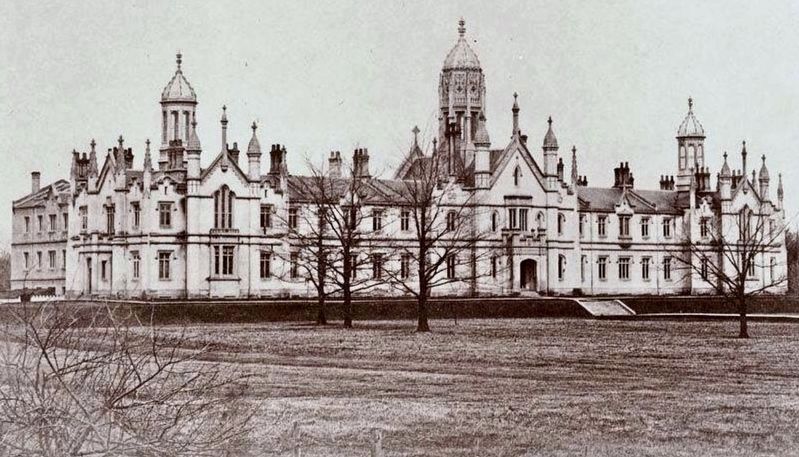
1855
4. Bishop John Strachan, founder of Trinity College, ca 1855
Source: Toronto Public Library
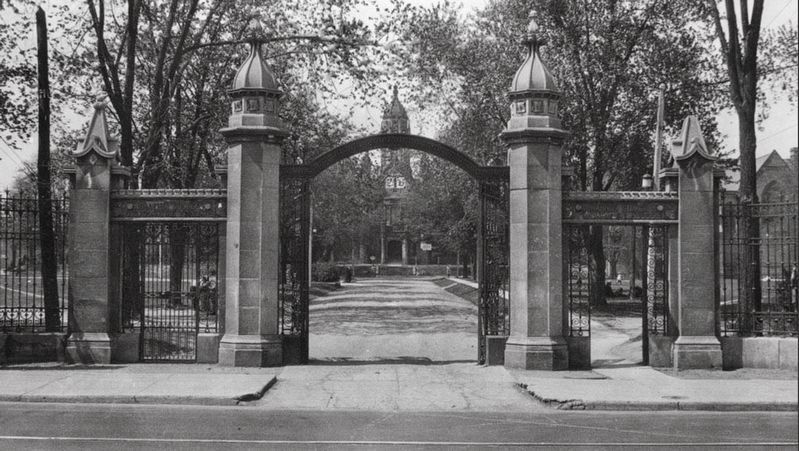
circa 1910
5. Trinity College gates, ca 1910
Source: City of Toronto Archives
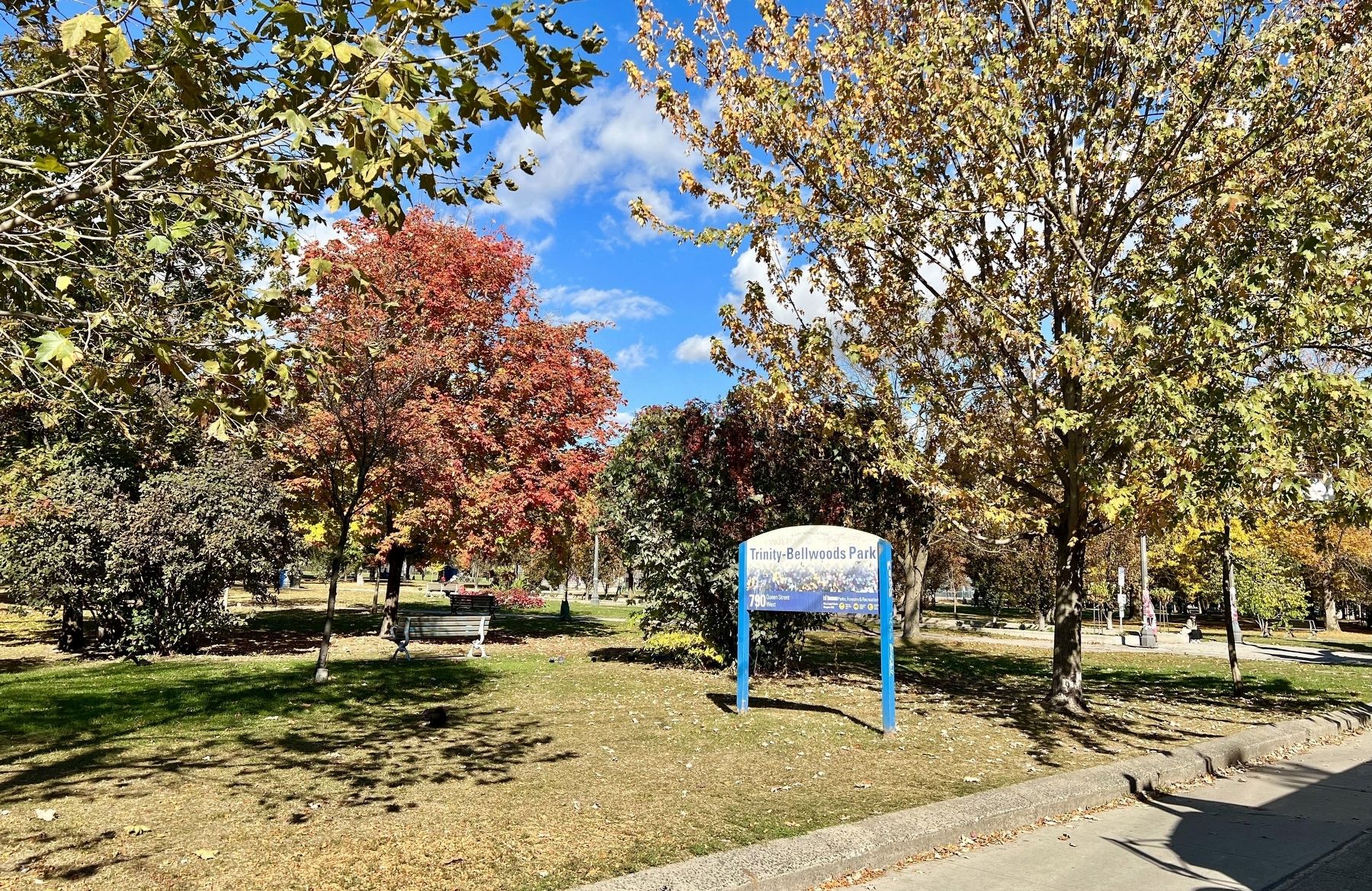
Photographed by Tim Boyd, October 24, 2024
6. Trinity-Bellwoods Park, 2024
Credits. This page was last revised on October 30, 2024. It was originally submitted on October 28, 2024, by Tim Boyd of Hamilton, Ontario. This page has been viewed 377 times since then and 33 times this year. Photos: 1, 2, 3, 4, 5, 6. submitted on October 28, 2024, by Tim Boyd of Hamilton, Ontario. • Andrew Ruppenstein was the editor who published this page.
