Greenville in Greenville County, South Carolina — The American South (South Atlantic)
The Betsy Ross Flag
Photographed by Brian Scott, August 24, 2008
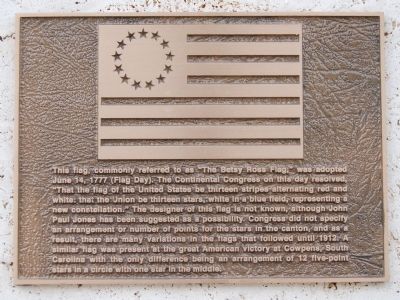
1. The Betsy Ross Flag Marker
This flag, commonly referred to as "The Betsy Ross Flag," was adopted June 14, 1777 (Flag Day). The Continental Congress on this day resolved "That the flag of the United States be thirteen stripes alternating red and white; that the Union be thirteen stars, white on a blue field, representing a new constellation." The designer of this flag is not known, although John Paul Jones has been suggested as a possibility. Congress did not specify an arrangement or number of points for the stars in the canton, and as a result, there are many variations in the flags that followed until 1912. A similar flag was present at the great American victory at Cowpens, South Carolina with the only difference being an arrangement of 12 five point stars in a circle with one star in the middle.
Topics and series. This historical marker is listed in these topic lists: Patriots & Patriotism • War, US Revolutionary • Women. In addition, it is included in the Vexillology series list. A significant historical date for this entry is June 14, 1777.
Location. Marker has been permanently removed. It was located near 34° 50.834′ N, 82° 24.009′ W. Marker
this page online
We have been informed that this marker is no longer there and will not be replaced. This page is an archival view of what was.
Regionally, this marker was in Upstate. It was also in the American South, specifically in the Deep South, in Appalachia, and specifically in Southern Appalachia. Globally, it was in North America, the Western Hemisphere, the Western World, and the Anglosphere. Historically, it found itself in what was once the original Cherokee Nation, the territory of the Mississippian Culture, one of the original Thirteen Colonies, one of the Confederate States of America, and

Photographed by Brian Scott, August 24, 2008
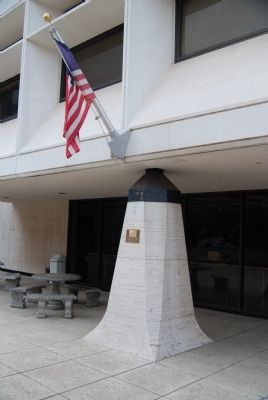
2. The Betsy Ross Flag and Marker
Other nearby markers. At least 8 other markers are within walking distance of this location: Roger Craft Peace Plaza (a few steps from this marker); Harper Plaza (within shouting distance of this marker); Spirit of Freedom (about 300 feet away, measured in a direct line); City of Greenville 9-11 Memorial (about 300 feet away); Nick Strange (about 400 feet away); Chamber of Commerce Building (about 400 feet away); Wyche Pavilion (about 500 feet away); Joel Roberts Poinsett (about 500 feet away). Touch for a list and map of all markers in Greenville.
Other markers no longer nearby. The South Carolina Flag (was a few steps from this marker but has been permanently removed); Old Glory (was a few steps from this marker but has been permanently removed); Greenville's General (was a few steps from this marker but has been permanently removed); Francis Marion (was a few steps from this marker but has been permanently removed); Thomas Sumter (was a few steps from this marker but has been permanently removed); Andrew Pickens (was a few steps from this marker but has been permanently removed); Guilford Courthouse Flag (was a few steps from this marker but has been permanently removed); The Moultrie Flag (was within shouting distance of this marker but has been permanently removed).
Also see . . .
1. The Betsy Ross Flag. During the Revolutionary War, several patriots made flags for our new nation. Among them were Cornelia Bridges, Elizabeth (Betsy) Ross, and Rebecca Young, all of whom were from Pennsylvania, and John Shaw of Annapolis, Maryland. (Submitted on August 30, 2008, by Brian Scott of Anderson, South Carolina.)
2. Betsy Ross Flag. The Betsy Ross flag is an early design of American flag popularly attributed to Betsy Ross using the common motifs of alternating red-and-white
Photographed by Brian Scott
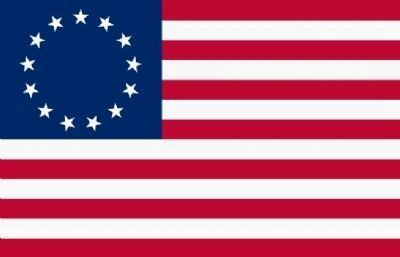
3. Betsy Ross Flag
3. Betsy Ross Flag - Fact or Fiction?. Did Betsy Ross Really Make the First American Flag? (Submitted on December 21, 2010, by Julia Hutchins of Scott City, Kansas.)
4. The Betsy Ross Homepage. While Americans recognize and celebrate collective achievements such as the writing of the Declaration of Independence, victory in the Revolutionary War, or the landing of a man on the Moon — it is individual accomplishment that is cherished the most. (Submitted on August 30, 2008, by Brian Scott of Anderson, South Carolina.)
5. Betsy Ross. Betsy Ross (January 1, 1752 – January 30, 1836), of Philadelphia, Pennsylvania, has been widely credited with making the first American flag. (Submitted on September 11, 2009, by Brian Scott of Anderson, South Carolina.)
6. Betsy Ross. Elizabeth Griscom Ross (1752-1836), was a Philadelphia seamstress, married to John Ross, an upholsterer who was killed in a munitions explosion in 1776. (Submitted on September 11, 2009, by Brian Scott of Anderson, South Carolina.)
7. The Betsy Ross House.
Photographed by Edward Percy Moran, 1917
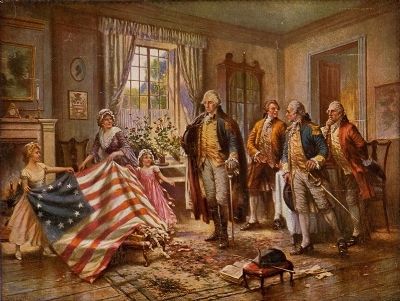
4. The Birth of Old Glory
8. John Paul Jones. John Paul Jones (July 6, 1747(1747-07-06) - July 18, 1792) was the United States' first well-known naval fighter in the American Revolutionary War. (Submitted on September 11, 2009, by Brian Scott of Anderson, South Carolina.)
9. Flag Day (United States). In the United States, Flag Day is celebrated on June 14. (Submitted on September 11, 2009, by Brian Scott of Anderson, South Carolina.)
10. Former Greenville News building demolition expected in May. Greenville News article citing the demolition of the building scheduled for 2017. Many of the markers listed at this corner were attached to the building.
The letters atop The Greenville News building have been removed, signaling the imminent end of one of Main Street's distinctive buildings for more than half a century...(Submitted on October 28, 2024, by Mark Parker of Hickory, North Carolina.)
On Tuesday, work began to remove the statue of Nathanael Greene, the Revolutionary War general credited as thenamesake of Greenville and a figure crucial in winning the South for the patriots. (Greenville News, 3/20/2017)Photographed by Mark Parker, October 25, 20245. Southeast corner of Main and BroadLocation of the former Greenville News Building, which was demolished in 2017. The entire plaza with renovated with the relocation of the Nathanael Greene statue. Previous markers attached to the building were removed.

Additional commentary.
1.
The so-called Betsy Ross Flag features 13 five-pointed stars in a ring. However, the Congressional Resolution that established the U.S. flag on June 14, 1777, did not address the number of points for the 13 stars or their arrangement. (See: "Our Flag." Joint Committee on Printing. United States Congress. H. Doc. 100-247. Washington: U.S. Government Printing Office. 1989. p. 1.) Furthermore, the first evidence for such a flag was in the early 1790s. (See: "Our Flag." p. 2.)
— Submitted January 17, 2022, by Earl P. Williams, Jr. of , .
2.
Betsy Ross was not associated with her eponymous flag until Charles Weisgerber painted "Birth of Our Nation's Flag" in 1893. (See: Harker, John Balderston. "Betsy Ross's Five Pointed Star: Elizabeth Claypoole, Quaker Flag Maker -- A Historical Perspective." Melbourne Beach, FL: Canmore Press. 2005. p. 94.) "Birth of Our Nation's Flag" was first exhibited at the Columbian Exposition in Chicago in 1893. The painting is based on "the alleged meeting of the committee of Congress with Betsy Ross." (See: Furlong, William Rea and Byron McCandless. "So Proudly We Hail: The History of the United States Flag." Washington: Smithsonian Institution Press. 1981. pp. 116 and 117.)
Submitted by Earl P. Williams, Jr., U.S. flag historian (paleovexillologist)
— Submitted January 17, 2022, by Earl P. Williams, Jr. of , .
Credits. This page was last revised on January 9, 2025. It was originally submitted on August 30, 2008, by Brian Scott of Anderson, South Carolina. This page has been viewed 3,369 times since then and 49 times this year. Last updated on October 28, 2024, by Mark Parker of Hickory, North Carolina. Photos: 1, 2. submitted on August 30, 2008, by Brian Scott of Anderson, South Carolina. 3, 4. submitted on September 11, 2009, by Brian Scott of Anderson, South Carolina. 5. submitted on October 28, 2024, by Mark Parker of Hickory, North Carolina. • Bernard Fisher was the editor who published this page.
