Rheinau in Schwetzingen in Rhein-Neckar-Kreis, Baden-Württemberg, Germany — Central Europe
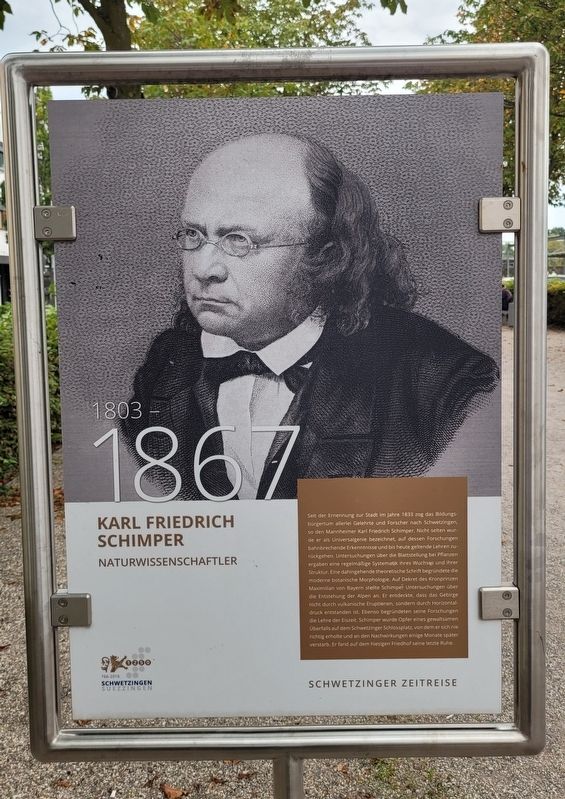
Karl Friedrich Schimper
1803-1867
Photographed by James Hulse, September 23, 2024
1. Karl Friedrich Schimper Marker

Naturwissenschaftler
Seit der Ernennung zur Stadt im Jahre 1833 zog das Bildungsbürgertum allerlei Gelehrte und Forscher nach Schwetzingen, so den Mannheimer Karl Friedrich Schimper. Nicht selten wurde er als Universalgenie bezeichnet, auf dessen Forschungen bahnbrechende Erkenntnisse und bis heute geltende Lehren zurückgehen. Untersuchungen über die Blattstellung bei Pflanzen ergaben eine regelmäßige Systematik ihres Wuchsąs und ihrer Struktur. Eine dahingehende theoretische Schrift begründete die moderne botanische Morphologie. Auf Dekret des Kronprinzen Maximilian von Bayern stellte Schimper Untersuchungen über die Entstehung der Alpen an. Er entdeckte, dass das Gebirge nicht durch vulkanische Eruptionen, sondern durch Horizontaldruck entstanden ist. Ebenso begründeten seine Forschungen die Lehre der Eiszeit. Schimper wurde Opfer eines gewaltsamen Überfalls auf dem Schwetzinger Schlossplatz, von dem er sich nie richtig erholte und an den Nachwirkungen einige Monate später verstarb. Er fand auf dem hiesigen Friedhof seine letzte Ruhe.
Natural Scientists
Since its designation
this page online
Erected by Schwetzinger Zeitreise.
Topics. This historical marker is listed in these topic lists: Horticulture & Forestry • Science & Medicine. A significant historical year for this entry is 1833.
Location. 49° 23.034′ N,
Photographed by James Hulse, September 23, 2024
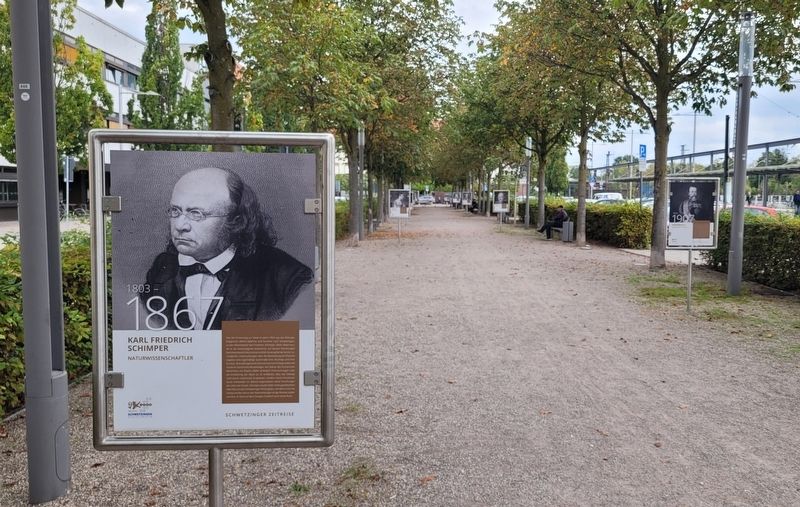
2. The view of the Karl Friedrich Schimper Marker in the park

Regionally, this marker is on the German Upper Rhine. Globally, it is in Europe, the European Union, Atlantic Europe, Central Europe, the Schengen Area, Western Europe, and the Western World. Historically, it finds itself in what was once the Roman Empire, the Holy Roman Empire, and the former West Germany.
Other nearby markers. At least 8 other markers are within walking distance of this marker: Johann Michael Zeyher (here, next to this marker); Leopold I. (a few steps from this marker); Friedrich I. (a few steps from this marker); Heinrich Tiedemann* (a few steps from this marker); Karl (Freiherr Von) Drais (a few steps from this marker); Louis Lingg (a few steps from this marker); Stéphanie de Beauharnais (a few steps from this marker); Hans Hirsch (a few steps from this marker). Touch for a list and map of all markers in Schwetzingen.
More about this marker. There is a non-related marker attached on the other side of the post.
Also see . . . Karl Friedrich Schimper. Wikipedia
Schimper pioneered research in the field of plant morphology, particularly phyllotaxis. He is perhaps best known as the originator of the theory of prehistoric hot and cold eras, and was one of the initiators of the modern theories of ice ages and climatic cycles. He was a brother of botanist Georg Wilhelm Schimper and cousin of botanist Wilhelm Philippe Schimper.(Submitted on October 29, 2024, by James Hulse of Medina, Texas.)
Credits. This page was last revised on October 29, 2024. It was originally submitted on October 28, 2024, by James Hulse of Medina, Texas. This page has been viewed 128 times since then and 14 times this year. Photos: 1, 2. submitted on October 29, 2024, by James Hulse of Medina, Texas.
