Rheinau in Schwetzingen in Rhein-Neckar-Kreis, Baden-Württemberg, Germany — Central Europe
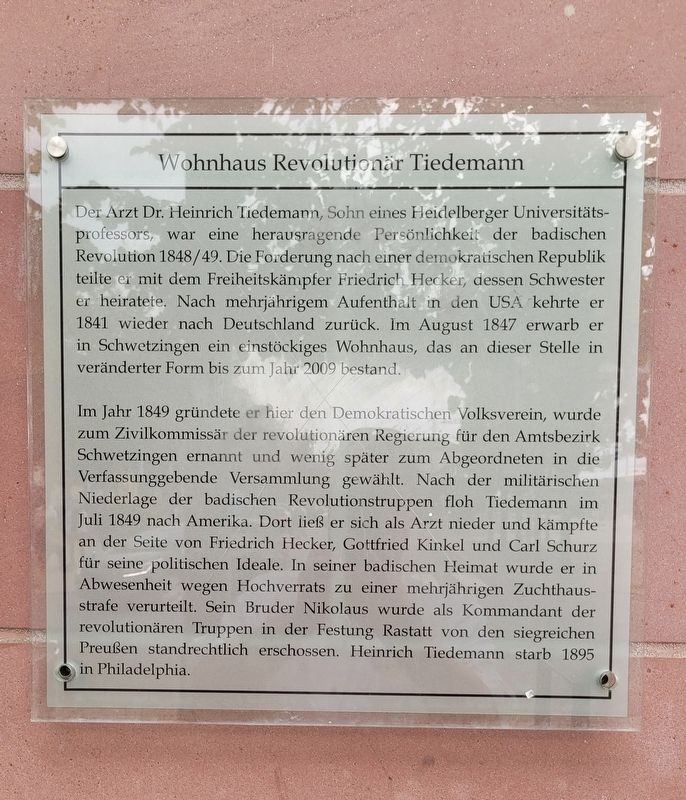
Wohnhaus Revolutionär Tiedemann
⎯⎯⎯
Revolutionary Tiedemann's House
Photographed by James Hulse, September 23, 2024
1. Wohnhaus Revolutionär Tiedemann / Revolutionary Tiedemann's House Marker

Der Arzt Dr. Heinrich Tiedemann, Sohn eines Heidelberger Universitätsprofessors, war eine herausragende Persönlichkeit der badischen Revolution 1848/49. Die Forderung nach einer demokratischen Republik teilte er mit dem Freiheitskämpfer Friedrich Hecker, dessen Schwester er heiratete. Nach mehrjährigem Aufenthalt in den USA kehrte er 1841 wieder nach Deutschland zurück. Im August 1847 erwarb er in Schwetzingen ein einstöckiges Wohnhaus, das an dieser Stelle in veränderter Form bis zum Jahr 2009 bestand.
Im Jahr 1849 gründete er hier den Demokratischen Volksverein, wurde zum Zivilkommissär der revolutionären Regierung für den Amtsbezirk Schwetzingen ernannt und wenig später zum Abgeordneten in die Verfassunggebende Versammlung gewählt. Nach der militärischen Niederlage der badischen Revolutionstruppen floh Tiedemann im Juli 1849 nach Amerika. Dort ließ er sich als Arzt nieder und kämpfte an der Seite von Friedrich Hecker, Gottfried Kinkel und Carl Schurz für seine politischen Ideale. In seiner badischen Heimat wurde er in Abwesenheit wegen Hochverrats zu einer mehrjährigen Zuchthausstrafe verurteilt. Sein
this page online
The physician Dr. Heinrich Tiedemann, son of a Heidelberg university professor, was a prominent figure in the Baden Revolution of 1848/49. He shared the demand for a democratic republic with the freedom fighter Friedrich Hecker, whose sister he married. After several years in the United States, he returned to Germany in 1841. In August 1847, he acquired a single-story residence in Schwetzingen, which stood at this location in a modified form until 2009.
In 1849, he founded the Democratic People's Association here, was appointed Civil Commissioner of the revolutionary government for the Schwetzingen district, and shortly thereafter was elected as a representative to the Constituent Assembly. Following the military defeat of the Baden revolutionary troops, Tiedemann fled to America in July 1849. There, he established himself as a doctor and fought alongside Friedrich Hecker, Gottfried Kinkel, and Carl Schurz for his political
Photographed by James Hulse, September 23, 2024
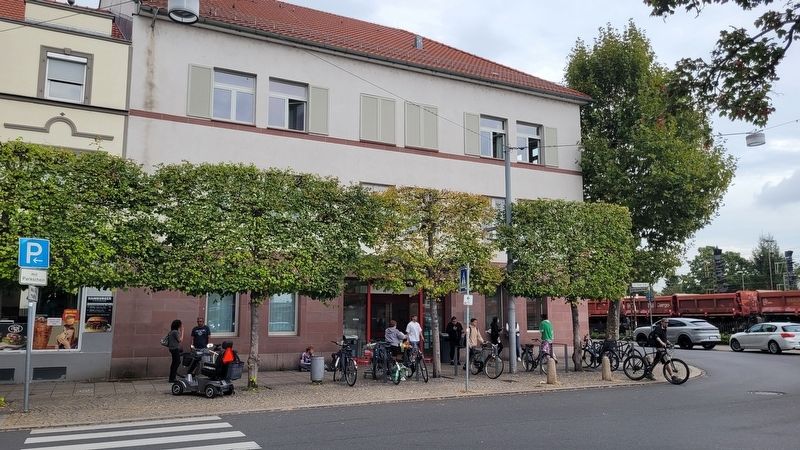
2. The Marker is located on the right side of the entrance to the building
Topics. This historical marker is listed in this topic list: Wars, Non-US. A significant historical month for this entry is July 1849.
Location. 49° 23.105′ N, 8° 34.662′ E. Marker is in Schwetzingen, Baden-Württemberg, in Rhein-Neckar-Kreis. It is in Rheinau. It is at the intersection of Carl-Theodor-Straße and Gustav-Hummel-Straße, on the left when traveling east on Carl-Theodor-Straße. The marker is located at the entrance to a store. Touch for map. Marker is at or near this postal address: Carl-Theodor-Straße 33, Schwetzingen BW 68723, Germany. Touch for directions.

Regionally, this marker is on the German Upper Rhine. Globally, it is in Europe, the European Union, Atlantic Europe, Central Europe, the Schengen Area, Western Europe, and the Western World. Historically, it finds itself in what was once the Roman Empire, the Holy Roman Empire, and the former West Germany.
Other nearby markers. At least 8 other markers are within walking distance of this marker: Jungsteinzeitliches Gräberfeld / Neolithic Burial Ground (within shouting distance of this marker); Suezzo (within shouting distance of this marker); Agana (within shouting distance of this marker); Rittergeschlecht der Erligheimer / Knightly Family of Erligheim (within shouting distance of this marker); Franziskaner-Kloster / Franciscan Monastery (within shouting distance of this marker); Elisabeth Charlotte (within shouting distance of this marker); Karl I. Ludwig (within shouting distance of this marker); Johann Wilhelm (within shouting distance of this marker). Touch for a list and map of all markers in Schwetzingen.
Also see . . . Baden Revolution. Wikipedia
As part of the popular liberal March Revolution in the states of the German Confederation the revolution in the state of Baden in what is now southwestern Germany was driven to a great extent by radical democratic influences: they were striving to create a Baden republic—subordinated to a greater Germany—under the sovereignty of the people, and aligned themselves against the ruling princes.(Submitted on October 29, 2024, by James Hulse of Medina, Texas.)
Their high points were the Hecker uprising in April 1848, the Struve Putsch of September 1848 and the rebellion as part of the Imperial Constitution campaign (Reichsverfassungskampagne) in May 1849 which assumed civil war-like proportions and was also known as the May Revolution. The rebellion ended on 23 July 1849 with the military defeat of the last revolt and the capture of Rastatt Fortress by German Federal Army troops under Prussian leadership.
Credits. This page was last revised on October 30, 2024. It was originally submitted on October 28, 2024, by James Hulse of Medina, Texas. This page has been viewed 137 times since then and 19 times this year. Photos: 1, 2. submitted on October 30, 2024, by James Hulse of Medina, Texas.
