West Queen West in Toronto, Ontario — Central Canada (North America)
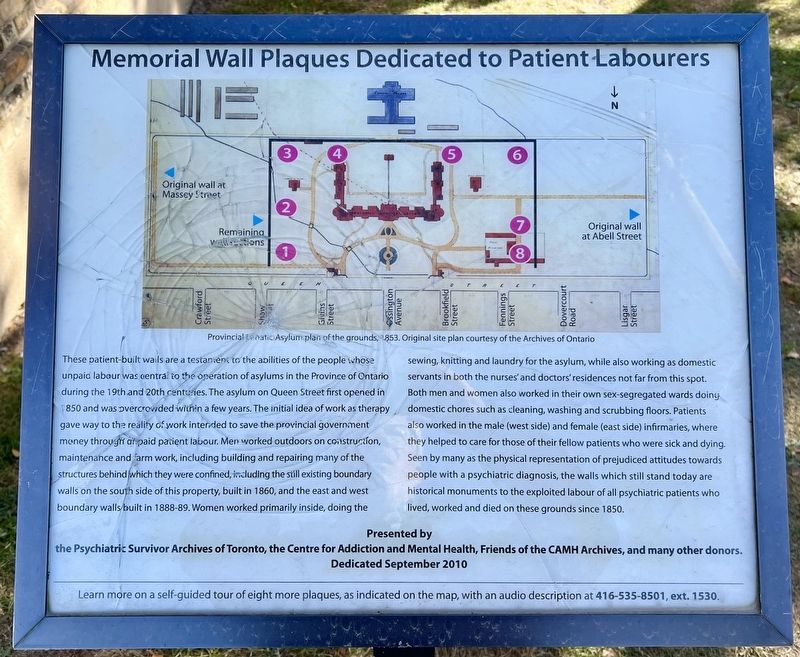
Memorial Wall Plaques Dedicated to Patient Labourers
Photographed by Tim Boyd, October 24, 2024
1. Memorial Wall Plaques Dedicated to Patient Labourers Marker
this page online
Erected 2010.
Topics. This historical marker is listed in these topic lists: Notable Buildings • Science & Medicine. A significant historical year for this entry is 1860.
Location. 43° 38.673′ N, 79° 24.981′ W. Marker is in Toronto, Ontario. It is in West Queen West. It is at the intersection of Queen Street West and Shaw Street, on the right when traveling east on Queen Street West. Touch for map. Marker is at or near this postal address: 999 Queen Street West, Toronto ON M6J 2W2, Canada. Touch for directions.

Regionally, this marker is in Greater Toronto and on the Golden Horseshoe. It is also in Central Canada. Globally, it is in North America, on the Great Lakes, in the Western Hemisphere, in the Western World, and in the Anglosphere. Historically,

Photographed by Tim Boyd, October 24, 2024
2. Memorial Wall Plaques Dedicated to Patient Labourers Marker
Some of the enclosing wall is visible
Other nearby markers. At least 8 other markers are within walking distance of this marker: Trinity College (approx. 0.3 kilometers away); Major-General the Hon. Aeneas Shaw (approx. 0.3 kilometers away); Muhammad Ali vs. George Chuvalo (approx. 0.3 kilometers away); Rediscovering Garrison Creek (approx. 0.4 kilometers away); Massey-Harris Company (approx. 0.4 kilometers away); John Gibson House (approx. 0.4 kilometers away); St. Hilda’s College (approx. 0.4 kilometers away); The Church of the Good Samaritan (approx. 0.4 kilometers away). Touch for a list and map of all markers in Toronto.
Also see . . . History of Queen Street Sight (The Centre for Addiction and Mental Health).
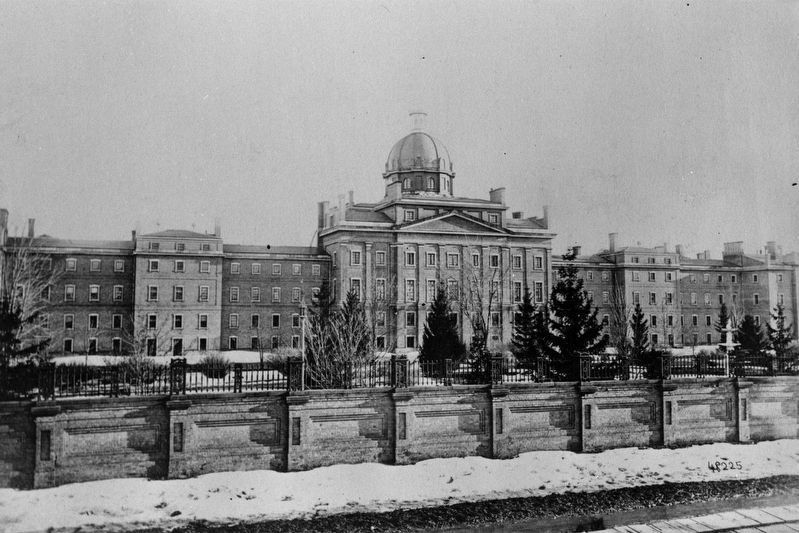
In many ways, the history of the Queen Street West site and its physical evolution are the history of mental health care in Canada. The address has been home to a mental health facility for over 160 years, since the opening of the Provincial Lunatic Asylum in 1850 to house patients in often difficult(Submitted on October 29, 2024, by Tim Boyd of Hamilton, Ontario.)conditions.circa 18903. The Asylum for the Insane, Toronto, ca 1890Toronto Public Library Archives
The changing view of mental health can be seen in the institution's various name changes over the years. Originally Provincial Lunatic Asylum, it was renamed Asylum for the Insane in 1871, Hospital for the Insane in 1905, and simply Ontario Hospital, Toronto as of 1919. In 1996, it became Queen Street Mental Health Centre and finally, Centre for Addiction and Mental Health (CAMH) in 1998.
Credits. This page was last revised on October 30, 2024. It was originally submitted on October 29, 2024, by Tim Boyd of Hamilton, Ontario. This page has been viewed 137 times since then and 26 times this year. Photos: 1, 2, 3. submitted on October 29, 2024, by Tim Boyd of Hamilton, Ontario. • Andrew Ruppenstein was the editor who published this page.
