O'Hare in Chicago in DuPage County, Illinois — The American Midwest (Great Lakes)
Resthaven Cemetery

Photographed by Sean P. Flynn, October 29, 2024
1. Resthaven Cemetery Marker
1840
Rededicated 1986
Erected 1986.
Topics. This historical marker is listed in these topic lists: Cemeteries & Burial Sites • Settlements & Settlers. A significant historical year for this entry is 1840.
Location. 41° 57.749′ N, 87° 55.318′ W. Marker is in Chicago, Illinois, in DuPage County. It is in O'Hare. It is on Access Road 0.9 miles north of Irving Park Road (Illinois Route 19), on the right when traveling north. Resthaven Cemetery is located inside the grounds of O'Hare Airport, next to the Fedex Regional Sort Operations building. The cemetery is about one-third of a mile north of Access Road on a road that Google Maps calls "Fed Ex Access Road," however, this name could not be verified either by street signs, any other official map or any other sources (including Apple Maps, which did not assign this street a name). Signs from both Irving Park and Access roads offer guidance for drivers looking for the cemetery. Touch for map. Marker is in this post office area: Franklin Park IL 60131, United States of America. Touch for directions.

Regionally, this marker
this page online
Other nearby markers. At least 25 other markers are within 4 miles of this marker, measured as the crow flies: 1944 (approx. 1.4 miles away); Bensenville Veterans Memorial (approx. 1.4 miles away); Lynn C. Huffman (approx. 1.4 miles away); Bensenville Memorial Fountain (approx. 1½ miles away); Bensenville Fire Prevention District 9/11 Memorial (approx. 1½ miles away); Oak Savanna (approx. 1.8 miles away); Breiter-Palm Park History (approx. 1.8 miles away); Breiter-Palm Prairie (approx. 1.8 miles away); The Peace Pole (approx. 1.8 miles away); Sky Haven Airport (approx. 2.1 miles away); The History of the Old Dutch Mill (approx. 2.3 miles away); Churchville School (approx. 2½ miles away); Shelton Field (approx. 2½ miles away); Former Site of Eden Inn (approx. 2.7 miles away); Horse-Shoe Inn (approx. 2.8 miles away);

Photographed by Sean P. Flynn, October 29, 2024
2. Resthaven Cemetery
The marker is in front of a sign for the cemetery. An O'Hare air traffic control tower can be seen in the background.
More about this marker. This marker in the southwestern corner of O'Hare Airport, some 18 miles northwest of downtown Chicago, is almost certainly the westernmost historical marker inside Chicago's city limits. It is also likely the only Chicago marker located inside DuPage County, where the city annexed roughly 3 square miles of land in March 1956 for the expansion of O'Hare Airport. Chicago's remaining 228 square miles of land are in Cook County.
According to several online sources, the cemetery's official documents retain its original address: 525 W. Division. (There is no remaining evidence of this Division Street, either at the cemetery

Photographed by Sean P. Flynn, October 29, 2024
3. Resthaven Cemetery
Regarding Resthaven Cemetery. O’Hare International Airport’s three-letter airport code — ORD — is a relic of the area’s origins as a community called Orchard Place. Nestled in the middle of the airport — tucked amid two runways and a FedEx processing center — is a 1½-acre rectangle of land that is one of the last physical remnants of the area around this settlement: Resthaven Cemetery. The burial ground holds the graves of about 150 people, the oldest of whom represent some of the German settlers who first came to this area west of Chicago in the 1830s and 1840s. The most recent grave spotted during an October 2024 visit was dated to 2019.
This area around Resthaven remained a largely agricultural community until World War II, when the U.S. government claimed the land for a Douglas Aircraft Company production facility and airport. Orchard
Photographed by Sean P. Flynn, October 29, 2024
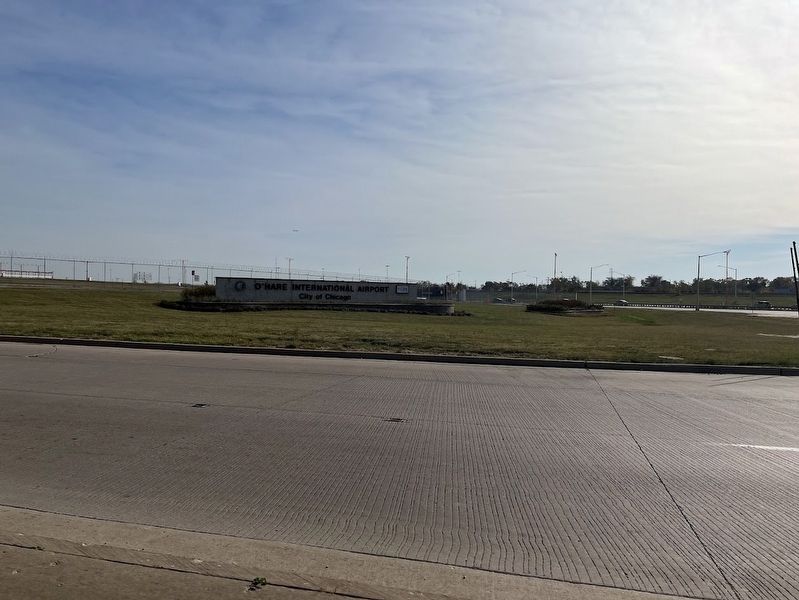
4. O'Hare Airport Sign
This sign is at the intersection of Irving Park Road and Access Road, on O'Hare's southern end. Resthaven Cemetery is about ¾ of a mile northeast of here.
Resthaven is the last remaining of at least three burial grounds that were located on the grounds of what today is O’Hare Airport. A small one on the eastern edge, called Wilmer’s Old Settler Cemetery, was seized by the federal government in the 1950s and the remains there (which included an unknown number of Native Americans) were moved elsewhere. Another cemetery, St. Johannes (or St. John's), had originally been located next to its namesake church, north of Resthaven on the road that now ends next to the cemetery. The church itself was removed during an earlier O’Hare expansion, but the cemetery had survived until 2012, when it was finally taken out to make way for a runway expansion. The City of Chicago spent $17 million to exhume the cemetery’s nearly 1,500 bodies and place them in new locations.
Yet as of 2024, Resthaven still remains in the midst of one of the world's busiest airports as one of Chicago’s most remote and

Photographed by Sean P. Flynn, October 29, 2024
5. Adella Schmidt gravesite at Resthaven Cemetery
Adella Schmidt's gravestone is in German. She was born in 1817 and died in 1894.
Also see . . .
1. Why is there a cemetery at O’Hare Airport?. Curious City, a feature by Chicago Public Radio (WBEZ), shares the peculiar history of Resthaven Cemetery, which has survived with around 300 people interred there, even as O'Hare Airport has grown around it. (Free login may be required.)
Excerpt: "The area that would become Bensenville was established by German dairy farmers in the 1830s. In 1873, the fourth railroad heading into Chicago established a station in Bensenville, transforming the settlement into a transit hub for agricultural goods headed for the city. Transit and shipping would continue to shape Bensenville, but not always for its benefit. During WWII, the federal government acquired a substantial bit of farmland from the village and set up an airfield and facility for constructing military planes."(Submitted on March 6, 2026, by Sean P. Flynn of Oak Park, Illinois.)
2. Exploring the cemetery at Chicago's O'Hare International Airport (Video). (Submitted on October 29, 2024, by Sean P. Flynn of Oak Park, Illinois.)
3. St. Johannes and Rest Haven Cemeteries. This article on graveyards.com was written sometime before 2003, when St. Johannes was still in existence north of Resthaven. The City of Chicago removed St. Johannes in 2012 during an O'Hare Airport runway expansion.
Excerpt: "St. Johannes and Rest Haven Cemeteries were surrounded by orchards when they were begun in 1837 and 1840, respectively. St. Johannes (alternately, St. John's) was once a churchyard; the church was removed years ago."(Submitted on October 29, 2024, by Sean P. Flynn of Oak Park, Illinois.)
4. 13 year old Laura Elfring — buried in the middle of O’Hare Airport!. From the Chicago and Cook County Cemeteries blog, the story of Laura Elfring, a teenager who was struck by a morning milk train and killed on April 10, 1898, in Bensenville, a couple of miles from this cemetery.
Excerpt: "The legal address for the cemetery on land records remains 525 West Division St. but is currently called FedEx access road. It is located in the E 1/2 NE 1/4 of section 13, Township 40 Range: 11 of Dupage County."(Submitted on February 17, 2025, by Sean P. Flynn of Oak Park, Illinois.)
Credits. This page was last revised on June 15, 2026. It was originally submitted on October 29, 2024, by Sean P. Flynn of Oak Park, Illinois. This page has been viewed 5,195 times since then and 1,225 times this year. Photos: 1, 2, 3, 4, 5. submitted on October 29, 2024, by Sean P. Flynn of Oak Park, Illinois.
