Amsterdam-Centrum , North Holland, Netherlands — Northwestern Europe
Ben Polak
Photographed by Andrew Ruppenstein, October 29, 2024
1. Ben Polak Marker

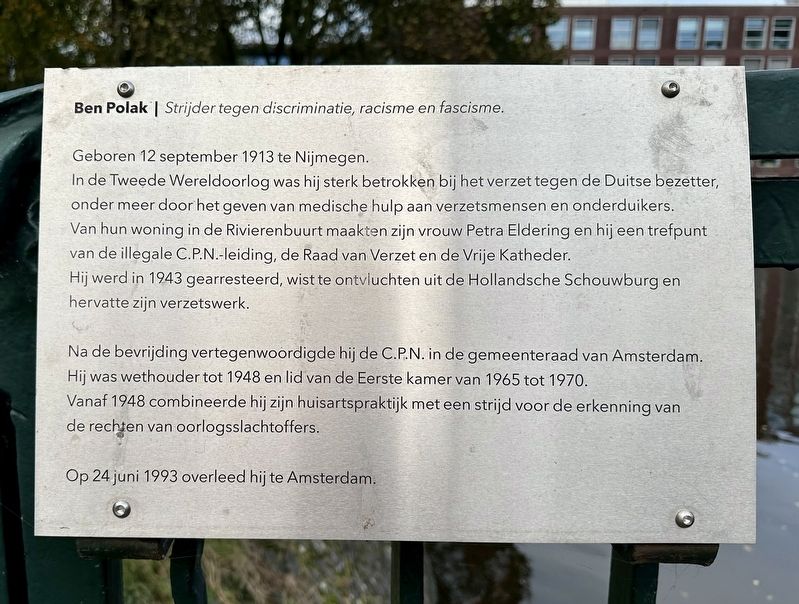
Geboren 12 september 1913 te Nijmegen.
In de Tweede Wereldoorlog was hij sterk betrokken bij het verzet tegen de Duitse bezetter, onder meer door het geven van medische hulp aan verzetsmensen en onderduikers. Van hun woning in de Rivierenbuurt maakten zijn vrouw Petra Eldering en hij een trefpunt van de illegale C.P.N.-leiding, de Raad van Verzet en de Vrije Katheder. Hij werd in 1943 gearresteerd, wist te ontvluchten uit de Hollandsche Schouwburg en hervatte zijn verzetswerk.
Na de bevrijding vertegenwoordigde hij de C.P.N. in de gemeenteraad van Amsterdam. Hij was wethouder tot 1948 en lid van de Eerste kamer van 1965 tot 1970. Vanaf 1948 combineerde hij zijn huisartspraktijk met een strijd voor de erkenning van de rechten van oorlogsslachtoffers.
Op 24 juni 1993 overleed hij te Amsterdam.
Ben Polak | Fighter against discrimination, racism and fascism.
Born 12 September 1913 in Nijmegen.
During the Second World War he was strongly involved in the resistance against the German occupier, among other things by
this page online
After the liberation he represented the C.P.N. on the city council of Amsterdam. He was an alderman until 1948 and a member of the First Chamber from 1965 to 1970. From 1948 he combined his general practice with a fight for the recognition of the rights of war victims.
He died in Amsterdam on 24 June 1993.
Topics. This historical marker is listed in these topic lists: Government & Politics • Science & Medicine • War, World II. A significant historical date for this entry is September 12, 1913.
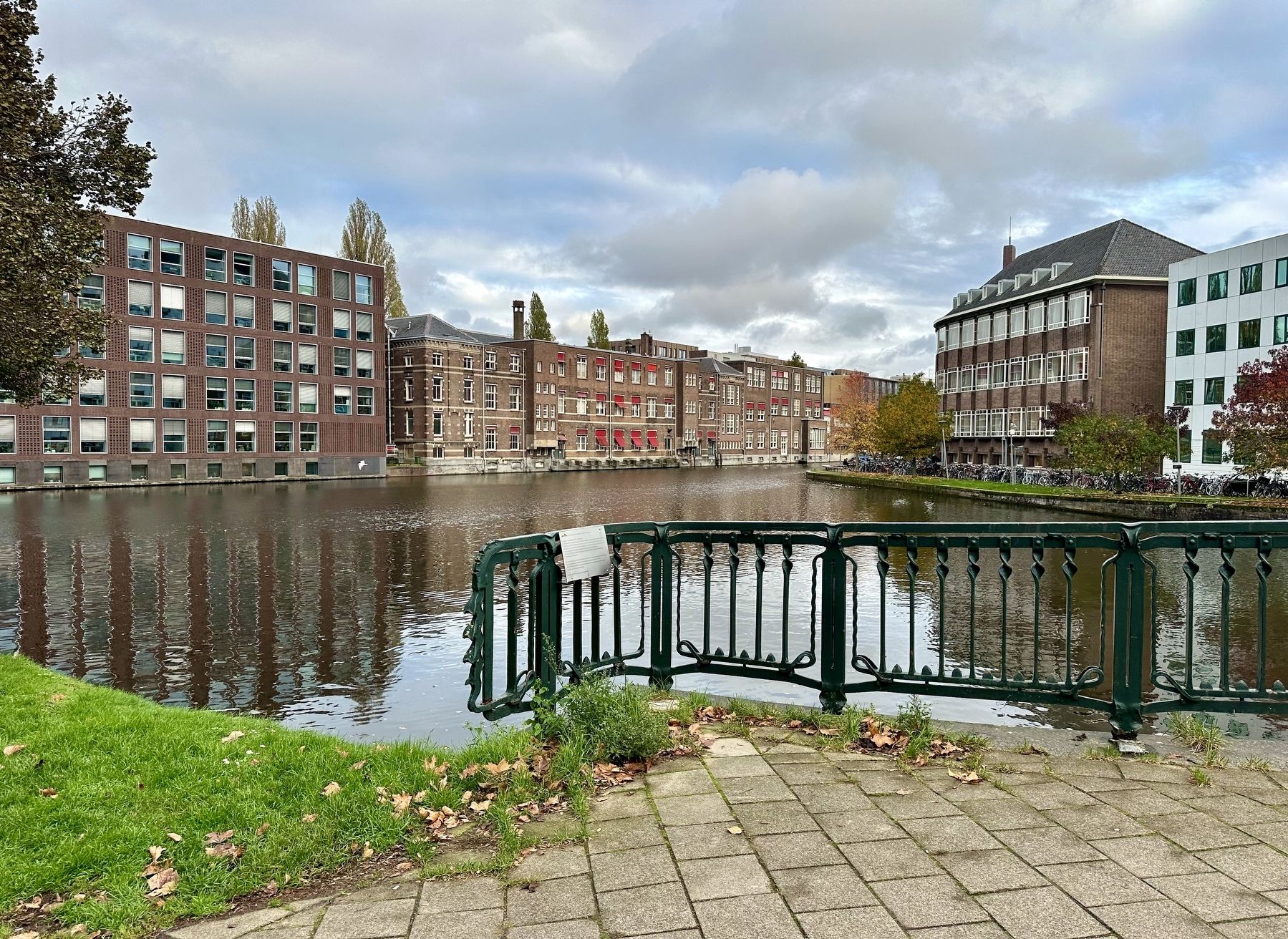
Location. 52° 21.872′ N, 4° 54.66′ E. Marker is in Amsterdam, Noord-Holland (North Holland). It is in Amsterdam-Centrum. It is at the intersection of Ben Polakbrug and Roetersstraat, on the right when traveling north on Ben Polakbrug. The marker is mounted
Photographed by Andrew Ruppenstein, October 29, 2024
2. Ben Polak Marker - wide view

Regionally, it is in Europe, the European Union, Atlantic Europe, the Benelux Low Countries, the Schengen Area, Western Europe, and the Western World. Historically, it finds itself in what was once the Holy Roman Empire.
Other nearby markers. At least 8 other markers are within walking distance of this marker: Ramses Shaffy (within shouting distance of this marker); Esther Frank-de Rooij (about 150 meters away, measured in a direct line); Femma Sara Frank (about 150 meters away); Alida van Kollem (about 210 meters away); Sellien van Kollem (about 210 meters away); Levie Snijders (about 210 meters away); Judith Snijders-Mullem (about 210 meters away); Rosenthal-May zusterhuis / Rosenthal-May Nurses’ Residence (about 210 meters away). Touch for a list and map of all markers in Amsterdam.
Also see . . .
1. Ben Polak (Wikipedia, in Dutch). Overview (in translation):
Benjamin Sally (Ben) Polak (Nijmegen, September 12, 1913 – Amsterdam, July 24, 1993) was a Dutch physician, politician and professor of general medicine of Jewish descent.(Submitted on October 29, 2024.)
2. Ben Polak Brug Amsterdam (Traces of War, in Dutch). Excerpt (in translation):
On 9 July 1941, Polak was the last Dutch Jew to graduate as a doctor during the occupation. Thanks to his mixed marriage, he was able to move around freely for some time. Polak and Eldering's house on the Rivierenlaan in Amsterdam became a command post for resistance activities. The board of the banned CPN met there, as did the top of the Council of Resistance. The left-wing resistance magazine De Vrije Katheder was also edited there. Eldering - who had joined the CPN in the meantime - took a seat on the editorial board of this magazine.(Submitted on October 29, 2024.)
As a doctor, Polak was only allowed to treat Jewish patients during the occupation, but he also helped resistance fighters and people in hiding. When it became known in 1943 that he had advised a Jewish woman to flee from the Netherlands Israelite Hospital - he knew that the Germans were about to evacuate this hospital - he was arrested and locked up in the Hollandsche Schouwburg. There, Polak was allowed to continue providing medical care as a doctor. He escaped the Schouwburg in spectacular fashion by climbing out through a skylight. During the last two years of occupation, he wandered from one hiding place to another and resumed his illegal medical care.
Credits. This page was last revised on October 29, 2024. It was originally submitted on October 29, 2024, by Andrew Ruppenstein of Lamorinda, California. This page has been viewed 138 times since then and 31 times this year. Photos: 1, 2. submitted on October 29, 2024, by Andrew Ruppenstein of Lamorinda, California.
