Chevy Chase in Northwest Washington in Washington, District of Columbia — The American Northeast (Mid-Atlantic)
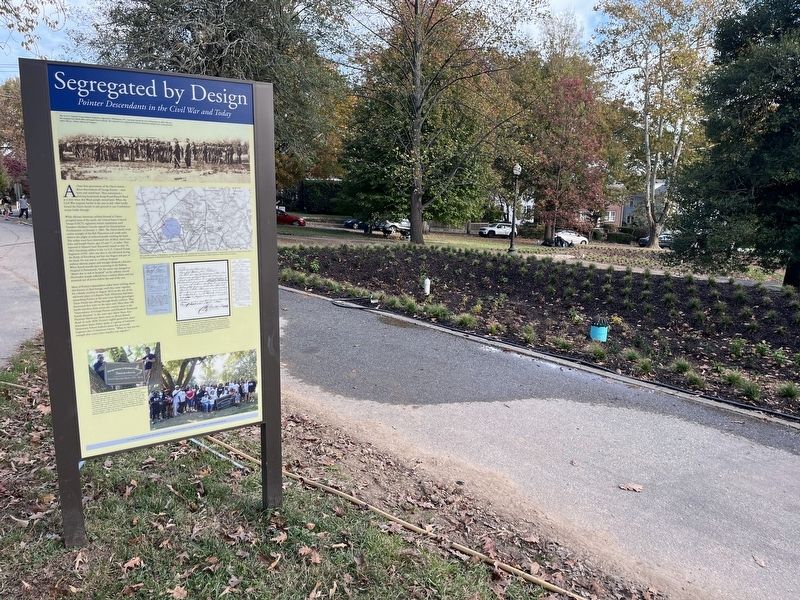
Segregated by Design
![Segregated by Design Marker [front] image. Click for full size.](Photos8/826/Photo826733.jpg?1029202460300PM "Segregated by Design Marker [front]. Click for full size.")
While African-American militias formed in Union-occupied areas of the south, the United States Colored Troops (USCT) regiments weren't established until President Abraham Lincoln signed the Emancipation Proclamation on January 1, 1863. The Harris family lived within eyesight of the Belt Plantation and could easily observe the plight of enslaved people working the land. This reality must have motivated two of Mary Ann's sons, John and Joseph Harris, ages 23 and 17, to enlist. They reported to mason's (now Roosevelt) Island on July 10, 1863, becoming soldiers in the 1st U.S. Colored Troops Regiment of DC. John was shot in the left hand during the Battle of Petersburg and lost two fingers and part of his hand.
this page online
Most of Pointer's descendants today knew nothing about this history of their lineage until they came together for a family reunion in August 2015 on the site of the old home place at Lafayette Park. Historians had been researching Pointer at the same time family genealogist Tanya Hardy was sifting through family archives. They discovered they were on the same trail. More than 100 family members from across the country came to the "Descendants of George Pointer and Elizabeth Townsend Family Reunion" at the exact spot where Mary Ann Plummer Harris put down roots on Broad Branch Road. In early 2020, Pointer's eighth-generation direct descendant James Fisher spoke to a group of Lafayette Elementary School students about this previously forgotten slice of American history. "What
![Segregated by Design Marker [back] image. Click for full size.](Photos8/826/Photo826744.jpg?1029202460400PM "Segregated by Design Marker [back]. Click for full size.")
[Captions:]
The 1st U.S. Colored Troops Infantry Regiment, organized in Washington, DC, is pictured around the time of formation in 1863. This was the company into which John and Joseph Harris enlisted. The regiment was composed of African-American enlisted men commanded by white officers. (Photo, Library of Congress).
The Civil War Defenses of Washington, erected between 1861-1865, included 68 forts and 93 detached batteries. This map shows the location of Battery Smead, close to the Harris property on Broad Branch Road. The arrow points to the Broad Branch community of Black landowners. (Map, Library of Congress.)
Before the Emancipation Proclamation was signed on January 1, 1863, free Black people in Washington, DC, had to certify their freedom or risk being captured into slavery. This letter is a copy of a document belonging to John Harris from the Justice of the Peace in Washington, DC, showing his status as a "Free Colored Person" since birth. At left and right are copies of USCT military service documents for brothers John Harris and Joseph Harris who were George Pointer's great-grandsons and lived on Broad Branch Road. (Documents, National Archives)
More than 100 people attended the August 2015 of the Pointer Descendants Family Reunion right here at Lafayette Park, their original homeplace. Traced through genealogy, many who attended the reunion had no previous knowledge that they were related to George Pointer or that 100 years ago their forebears were well-established landowners in Chevy Chase DC. The reunion brought together relatives from all over the District of Columbia and as far away as New York to Georgia to Oklahoma. The oldest was a seventh-generation direct descendant of George and Elizabeth Pointer, and the youngest, a baby boy, was an 11th-generation direct descendant. ((Reunion Photos courtesy of Tanya Hardy)
In 1928 their land was claimed by the federal government under eminent domain to build a school and park for white children whose families populated the burgeoning community of Chevy Chase DC. Even at market rate, the sum paid for their land was not enough to re-create what they had spent decades building — a safe and spacious family home place where they could build wealth and prosper. The families dispersed, many to Southeast DC. They lost more than the land. They lost each other.
In this 1919 Baist Atlas, the six-acre tract of Black-owned land is highlighted in purple. It is surrounded by the modern street grid laid down by the Chevy Chase Land Company, which had its own ideas about who should live here. The five northernmost lots on Broad Branch Road total 2.3 acres. Mary Ann Plummer Harris (1820 - c. 1923), a free Black woman, bought this land in the early 1850s from the previous Black landowner George Milburn. Harris raised eight children here, eventually dividing it into five lots. She was the granddaughter of Capt. George Pointer in whose honor Lafayette-Pointer Park and Recreation Center is now named.
Who Was George Pointer?
Born enslaved on Oct. 11, 1773, on a plantation near Potomac, MD (then part of Frederick County), Capt. George Pointer went on to become an educated and respected man. He wrote about his life in elegant script in an 1829 letter that resides in the National Archives. At 13, he was rented out to work for George Washington's Patowmack Company, a precursor to the Chesapeake & Ohio Canal, which was a promising gateway to the nation's abundant natural resources. Many people at the time feared that Spain and France would send their boats down the Mississippi River and plunder those resources before the new nation could claim them as its own. The international race was on!
The adolescent Pointer was put in charge of the volatile blasting powder used to build the canal, which needed safeguarding and careful transport. He was given a cabin near the stone ordnance building in the vicinity of Lock 6, where he would live for the next 40 years as he rose through the ranks to Superintendent Engineer. He emancipated himself at age 19 with $300 he was allowed to keep from his slave wages. Shortly after, he married Elizabeth Townsend, a free woman of color traced in family stories as part Native American and part African American. They raised three children and several grandchildren in the cottage, including Mary Ann Plummer Harris.
It was young Mary Ann, reared on the canal who took the tiller of her grandfather's boat to ferry President John Quincy Adams to the official groundbreaking of the C&O Canal on July 4, 1828. A $13 honorarium was paid to Pointer two weeks later, presumably for this service.
Much of what is known about Pointer comes from his 11-page letter that he wrote a year later asking C&O officials to spare his "humble little cottage" during the building of the canal. While no records exist documenting an answer to his petition, the cottage still stood years after he died. It was referred to as the "Pointer Cottage." Pointer and his wife are believed to have perished in the early 1830s in a cholera pandemic on the canal.
[Captions:]
This 1919 Baist Atlas shows the 12.5-acre footprint of Lafayette School and Park before they were built in 1932. About half of this land had been owned by Black families (see the area highlighted in purple) who had lived and worked the land since before the Civil War. Just a few blocks west, within easy sight of this community, was the Belt Plantation where enslaved men and women had toiled. (Map courtesy of David S. Rotenstein)
The only known photograph of the two-story Harris/Moten farmhouse appeared in the June 2, 1928, Washington Post in connection with the celebration of the 100th anniversary of the groundbreaking of the C&O Canal. The image of Mary Ann Plummer Harris, who lived to be 103, was superimposed in the top right of the newspaper photo. The property was taken by eminent domain to build a whites-only school and park. The families were evicted and their houses destroyed only months after this photograph was taken.
(Photo used with permission from The Washington Post)
This rendering by Chevy Chase DC artist Richard Swartz depicts the July 4, 1828 groundbreaking of the Chesapeake & Ohio Canal. Here, eight-year-old Mary Ann Plummer Harris, under the watchful eye of her grandfather Capt. George Pointer, pilots the boat that carried President John Quincy Adams to the groundbreaking. Family lore has it that Mary Ann, who grew up on the canal and knew the waterways well, piloted the boat on a wager. The full drawing can be seen on a second historic sign on Broad Branch Road.
The volatile blasting powder that George Pointer managed when he was a 13-year-old enslaved boy was stored near the site of Lock 6 on the C&O Canal in a stone building. An 1864 map labels the site "U.S. Magazine" and the photo here shows the remains of what is believed to be that stone structure where blasting powder was likely kept in wooden barrels. Pointer's cabin, where he lived for 40 years, no longer exists but was near this site.
(Photo courtesy of Tanya Hardy)
Gentlemen:A remarkable 11-page letter that Capt. George Pointer wrote to officials of the C&O Canal in 1829 asks them to spare his "humble cottage" where he'd lived for 40 years while working for George Washington's canal project. The letter, in elegant script and formal prose, is preserved in the National Archives. Its existence is how we know of Pointer's life and accomplishments. This is a transcription of the first page.
I pray you to read the memorial and mumble petition of an old and obscure citizen. I was born in the year A.D. 1773, 11th of October in Frederick County Maryland. I was born a slave and continued one for 19 years, a part of which time I had the honor of being with the engineer and directors of the old Potomack Canal Company.
During that period, I had the good fortune to get in the good graces of my master, the engineer and the Company. Having been well recommended by the engineer and the directors for the faithful service rendered them by me, my master told me that if I would pay him $300 in a given time that I would be my own man. Which I did out of the hard earnings I received from the Company.
I at that period occupied the place where my little humble cottage now stands, it being given to me by the directors and....
Erected by Historic Chevy Chase DC.
Topics. This historical marker is listed in these topic lists: African Americans • Industry & Commerce • Settlements & Settlers • War, US Civil. A significant historical date for this entry is January 1, 1863.
Location. 38° 58.053′ N, 77° 4.02′ W. Marker is in Northwest Washington in Washington, District of Columbia. It is in Chevy Chase. It is at the intersection of 33rd Street Northwest and Patterson Street Northwest, on the right when traveling south on 33rd Street Northwest. Touch for map. Marker is at or near this postal address: 5900 Quesada St NW, Washington DC 20015, United States of America. Touch for directions.

Regionally, this marker is in the Washington Metropolitan Area. It is also in the American Northeast, in the Upper South, in the Mid-Atlantic, in the Tidewater, and in the Chesapeake Bay Region. Globally, it is in North America, the Western Hemisphere, the Western World, and the Anglosphere.
Other nearby markers. At least 8 other markers are within walking distance of this marker: A different marker also named Segregated by Design (about 500 feet away, measured in a direct line); Walter Tobriner (approx. 0.2 miles away); Broad Branch Market (approx. 0.2 miles away); A Man's Recollection (approx. half a mile away); Chevy Chase Theatre (approx. half a mile away); Rock Creek Railway Streetcar (approx. half a mile away); Colonel Joseph Belt (approx. half a mile away in Maryland); Francis Griffith Newlands (approx. half a mile away). Touch for a list and map of all markers in Northwest Washington.
Another marker is no longer nearby. What's in a Name? (was approx. half a mile away but has been permanently removed).
Credits. This page was last revised on October 29, 2024. It was originally submitted on October 29, 2024, by Devry Becker Jones of Washington, District of Columbia. This page has been viewed 343 times since then and 27 times this year. Photos: 1, 2, 3. submitted on October 29, 2024, by Devry Becker Jones of Washington, District of Columbia.
