Minesing in Simcoe County, Ontario — Central Canada (North America)
Willow Creek Depot
Photographed by Cosmos Mariner, June 6, 2024
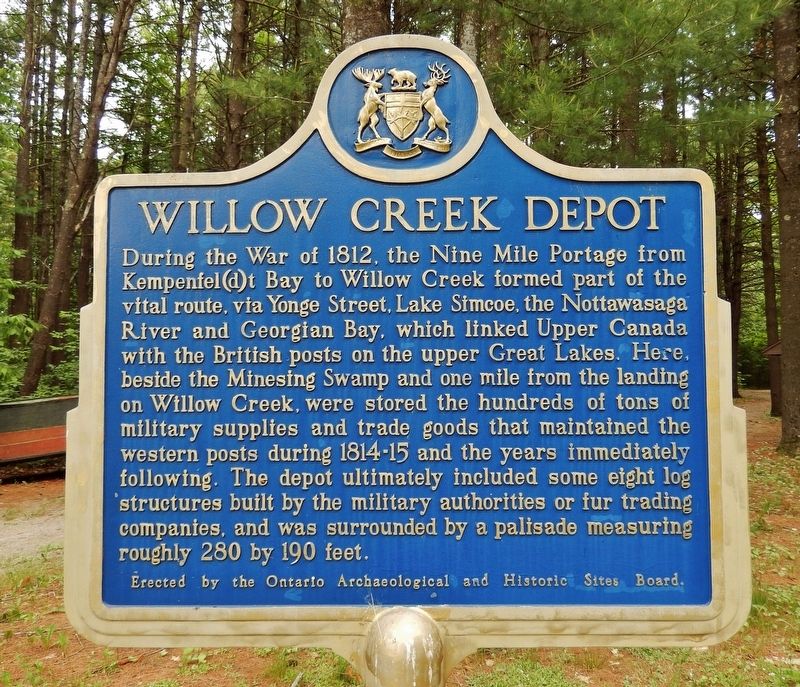
1. Willow Creek Depot Marker
During the War of 1812, the Nine Mile Portage from Kempenfel(d)t Bay to Willow Creek formed part of the vital route, via Yonge Street, Lake Simcoe, the Nottawasaga River and Georgian Bay, which linked Upper Canada with the British posts on the upper Great Lakes. Here, beside the Minesing Swamp and one mile from the landing on Willow Creek, were stored the hundreds of tons of military supplies and trade goods that maintained the western posts during 1814-15 and the years immediately following. The depot ultimately included some eight log structures built by the military authorities or fur trading companies, and was surrounded by a palisade measuring roughly 280 by 190 feet.
Erected by Ontario Archaeological and Historic Sites Board.
Topics and series. This historical marker is listed in these topic lists: Forts and Castles • Industry & Commerce • Roads & Vehicles • War of 1812. In addition, it is included in the Canada, Ontario Heritage Trust series list. A significant historical year for this entry is 1814.
Location. 44° 23.709′ N, 79° 49.285′ W. Marker is in Minesing, Ontario, in Simcoe County. It can
this page online

Regionally, this marker is in Central Ontario Cottage Country and specifically in Georgian Bay Country. It is also in Central Canada. Globally, it is in North America, on the Great Lakes, in the Western Hemisphere, in the Western World, and in the Anglosphere. Historically, it finds itself in what was once a British colony, the Viceroyalty of New France, the Haudenosaunee (Iroquois) Confederacy, and Rupert’s Land.
Other nearby markers. At least 8 other markers are within walking distance of this marker: Nine Mile Portage and Willow Depot / Portage Nine Mile et Dépôt Willow (here, next to this marker); Batteaux (a few steps from this marker); The Royal Newfoundland Regiment (a few steps from this marker); Dedicated to the Men of the Royal Newfoundland Regiment of Fencible Infantry
Photographed by Cosmos Mariner, June 6, 2024
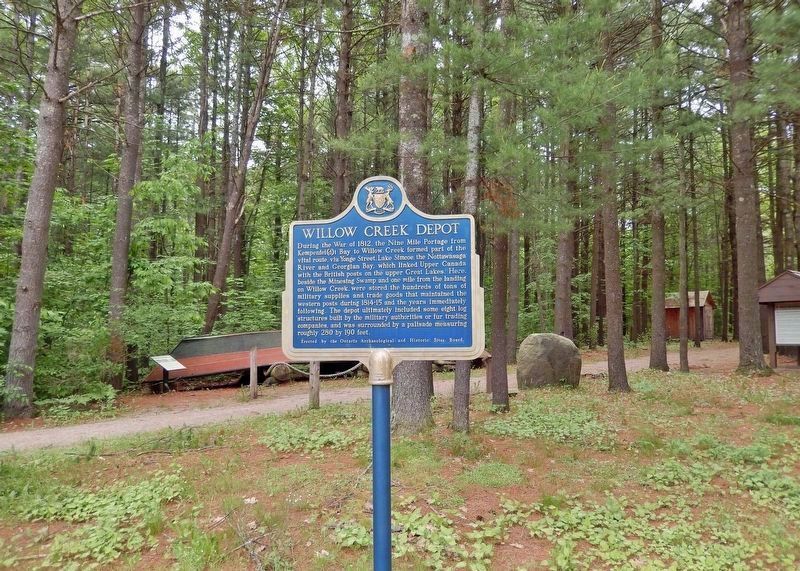
2. Willow Creek Depot Marker (west side)
Looking east along the 9 Mile Portage Heritage Trail; the Fort Willow Conservation Area parking lot is just out of sight in the background.
More about this marker. Both sides of this marker have the same English inscription.
Related markers. Click here for a list of markers that are related to this marker. Historic Fort Willow
Also see . . .
1. Fort Willow (Wikipedia).
Excerpt: Fort Willow or Willow Depot was a fortified British supply depot in Upper Canada during the War of 1812. The depot was built near the strategically important Nine Mile Portage, a pre-existing portage route used by First Nations people, as well as by the French in conducting the fur trade. After archaeological research, the area of Fort Willow has been partially reconstructed. Restorations and archaeological investigations have located and outlined the former buildings used by the soldiers.(Submitted on October 31, 2024, by Cosmos Mariner of Cape Canaveral, Florida.)
2. The History of Fort Willow.
Photographed by Cosmos Mariner, June 6, 2024
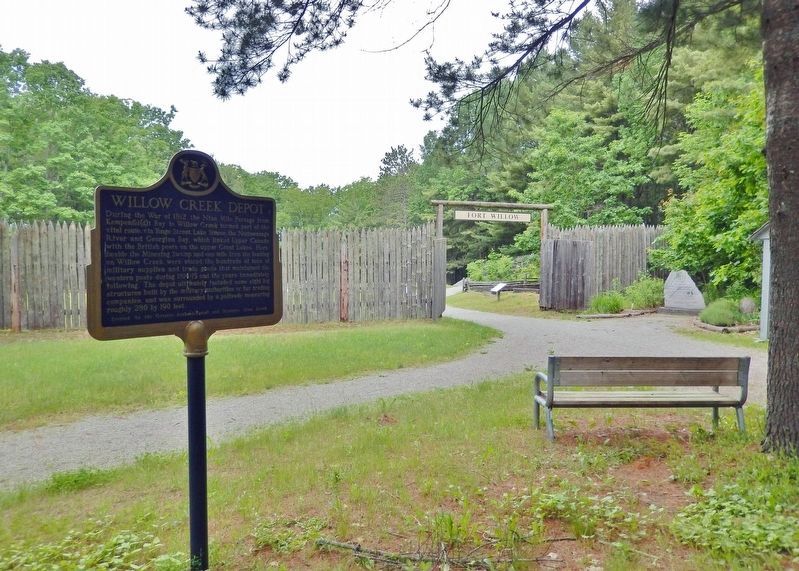
3. Willow Creek Depot Marker (east side)
Looking west; the reconstructed Fort Willow palisade and gate are in the background.
Excerpt: The history of Fort Willow is closely linked to the Nine Mile Portage from Kempenfelt Bay to the Willow Creek, for which it was the northwestern terminus. Originally developed by the First Nations as a travel and trade route, the portage was used by the French explorers and missionaries and was employed extensively by the fur trade. Long-used as a trading route by First Nations people and then serving as a critical supply depot during the War of 1812, Willow Depot, present day Fort Willow, played a significant role in the development of both our region and our nation. Fort Willow and the Nine Mile Portage have been recognized by the Ontario Heritage Trust as a site of provincial historical significance, and by Parks Canada as a National Historic Site.(Submitted on October 31, 2024, by Cosmos Mariner of Cape Canaveral, Florida.)
Photographed by Cosmos Mariner, June 6, 2024
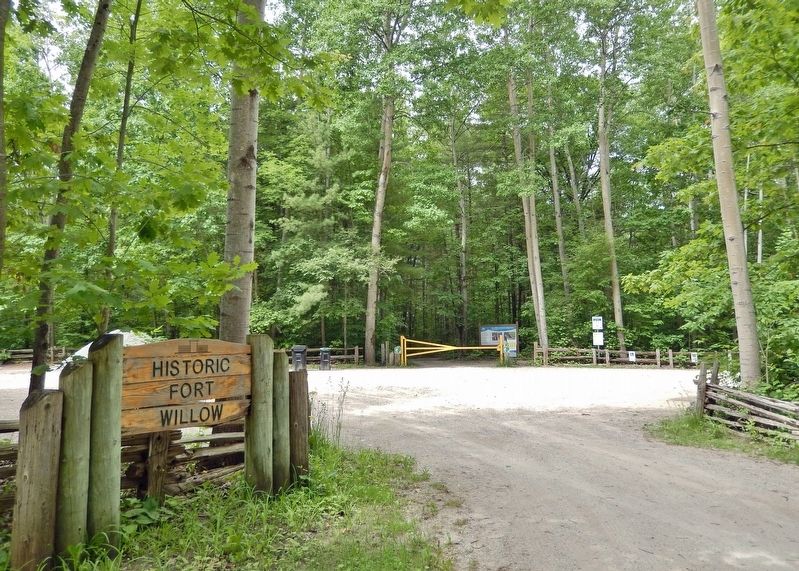
4. Historic Fort Willow Conservation Area
Turn west here from Grenfel Road to access Fort Willow.
Credits. This page was last revised on June 7, 2025. It was originally submitted on October 31, 2024, by Cosmos Mariner of Cape Canaveral, Florida. This page has been viewed 279 times since then and 26 times this year. Photos: 1, 2, 3, 4. submitted on October 31, 2024, by Cosmos Mariner of Cape Canaveral, Florida.
