New Britain in Capitol Region, Connecticut — The American Northeast (New England)
Central Park
Central to the community
⎯⎯⎯
Early Industries
The origins of manufacturing in New Britain
| — | New Britain Historic Walking Trail | — |
Photographed by Duane and Tracy Marsteller, September 29, 2024
1. Central Park side of marker
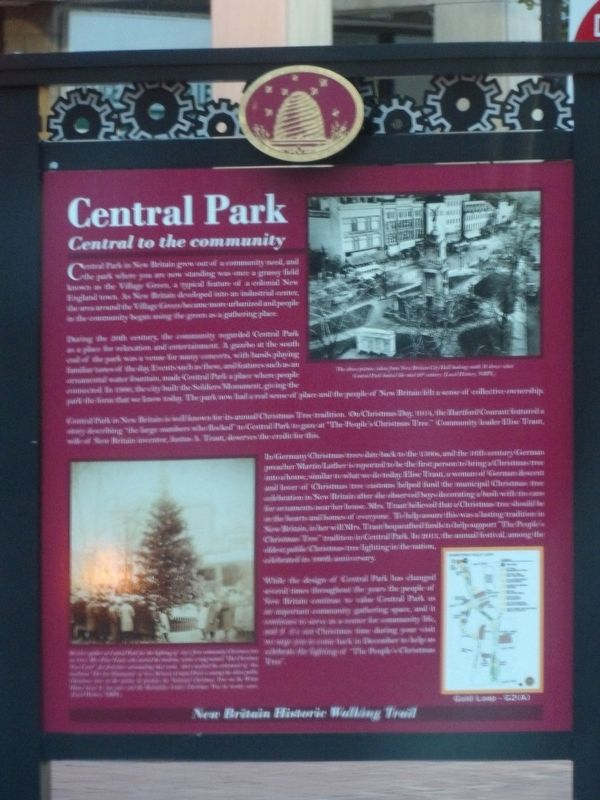
Central Park in New Britain grew out of a community need, and the park where you are now standing was once a grassy field known as the Village Green, a typical feature of a colonial New England town. As New Britain developed into an industrial center, the area around the Village Green became more urbanized and people in the community began using the green as a gathering place.
During the 20th century, the community regarded Central Park as a place for celebration and entertainment. A gazebo at the south end of the park was a venue for many concerts, with bands playing familiar tunes of the day. Events such as these, and features such as an ornamental water fountain, made Central Park a place where people connected. In 1900, the city built the Soldiers Monument, giving the park the form that we know today. The park now had a real sense of place and the people of New Britain felt a sense of collective ownership.
Central Park in New Britain is well-known for its annual Christmas Tree tradition. On Christmas Day, 1914, the Hartford Courant featured a story describing “the large numbers who flocked” to Central
this page online
In Germany Christmas trees date back to the 1500s, and the 16th century German preacher Martin Luther is reported to be the first person to bring a Christmas tree into a house, similar to what we do today. Elise Traut, a woman of German descent and lover of Christmas tree customs, helped fund the municipal Christmas tree celebration in New Britain after she observed boys decorating a bush with tin cans for ornaments near her house. Mrs. Traut believed that a Christmas tree should be in the hearts and homes of everyone. To help assure this was a lasting tradition in New Britain, in her will Mrs. Traut bequeathed funds to help support “The People's Christmas Tree” tradition in Central Park. In 2013 the annual festival, among the oldest public Christmas tree lightings in the nation, celebrated its 100th anniversary.
While the design of Central Park has changed several times throughout the years, the people of New Britain continue to value Central Park as an important community gathering
Photographed by Duane and Tracy Marsteller, September 29, 2024
2. Early Industries side of marker
[Captions (top to bottom)]
• The above picture, taken from New Britain City Hall looking south (l), shows what Central Park looked like mid-20th century. (Local History, NBPL)
• [unreadable in photograph]
Early Industries
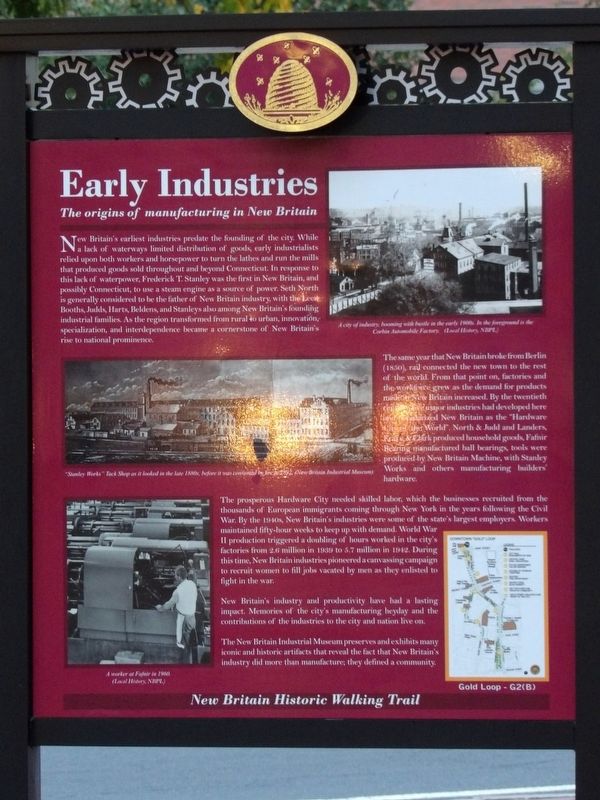
Nest industries predate the founding of the city. While a lack of waterways limited distribution of goods, early industrialists relied upon both workers and horsepower to turn the lathes and run the mills that produced goods sold throughout and beyond Connecticut. In response to this lack of waterpower, Frederick T. Stanley was the first in New Britain, and possibly Connecticut, to use a steam engine as a source of power. Seth North is generally considered to be the father of New Britain industry, with the Lees, Booths, Judds, Harts, Beldens, and Stanleys also among New Britain's founding industrial families. As the region transformed from rural to urban, innovation, specialization, and interdependence
Photographed by Duane and Tracy Marsteller, September 29, 2024
3. Central Park / Early Industries Marker
The same year that New Britain broke from Berlin (1850), rail connected the new town to the rest of the world. From that point on, factories and the workforce grew as the demand for products made in New Britain increased. By the twentieth century, four major industries had developed here and popularized New Britain as the “Hardware Capitol of the World”. North & Judd and Landers, Frary & Clark produced household goods, Fafnir Bearing manufactured ball bearings, tools were produced by New Britain Machine, with Stanley Works and others manufacturing builders' hardware.
The prosperous Hardware City needed skilled labor, which the businesses recruited from the thousands of European immigrants coming through New York in the years following the Civil War. By the 1940s, New Britain's industries were some of the state's largest employers. Workers maintained fifty-hour weeks to keep up with demand. World War II production triggered a doubling of hours worked in the city's factories from 2.6 million in 1939 to 5.7 million in 1942. During this time, New Britain industries pioneered a canvassing campaign to recruit women to fill jobs vacated by men as they enlisted to fight in the war.
New Britain's industry and productivity have had a lasting impact. Memories of the city's manufacturing heyday and the contributions of the industries to the city and nation live on.
The New Britain Industrial Museum preserves and exhibits many iconic and historic artifacts that reveal the fact that New Britain's industry did more than manufacture; they defined a community.
[Captions (top to bottom)]
• A city of industry, booming with bustle in the early 1900s. In the foreground is the Corbin Automobile factory. (Local History, NBPL)
• “Stanley Works” Tack Shop as it looked in the late 1880s, before it was consumed by fire in 1892. (New Britain Industrial Museum)
• A worker at Fafnir in 1960. (Local History, NBPL)
Erected by City of New Britain, CT. (Marker Number G2.)
Topics. This historical marker is listed in these topic lists: Industry & Commerce • Parks & Recreational Areas. A significant historical year for this entry is 1939.
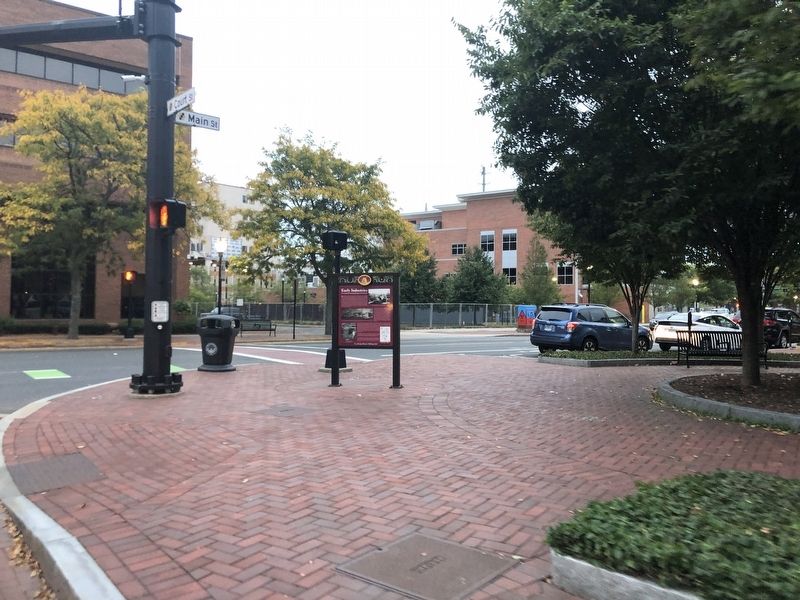
Location. 41° 40.001′ N, 72° 46.918′ W. Marker is in New Britain in Capitol Region, Connecticut. It is at the intersection of Main Street and Court Street, on the left when traveling north on Main Street. Touch for map. Marker is in this post office area: New Britain CT 06051, United States of America. Touch for directions.

Regionally, this marker is in the Connecticut River Valley, in Greater Hartford, and in the Knowledge Corridor. It is also in the American Northeast and in New England. Globally, it is in North America, the Western Hemisphere, the Western World, and the Anglosphere. Historically, it finds itself in what was once Hartford County and also one of the original Thirteen Colonies.
Other nearby markers. At least 8 other markers are within walking distance of this marker: New Britain Veterans Memorial (within shouting distance of this marker); New Britain Soldiers' Monument (about 300 feet away, measured in a direct line); New Britain (about 400 feet away); City Hall / Monuments of War (about 400 feet away); Burritt Hotel (about 600 feet away); 1st Sgt. Henry J. Szczesny (about 600 feet away); Leo A. Milewski Park (about 700 feet away); Laying the Urban Fabric / Normal School (about 700 feet away). Touch for a list and map of all markers in New Britain.
Credits. This page was last revised on May 19, 2026. It was originally submitted on November 1, 2024, by Duane and Tracy Marsteller of Murfreesboro, Tennessee. This page has been viewed 182 times since then and 27 times this year. Photos: 1, 2, 3. submitted on November 1, 2024, by Duane and Tracy Marsteller of Murfreesboro, Tennessee.
Editor’s want-list for this marker. Clear closeup photographs of the marker • Complete text of the marker • Can you help?
