Huntersville in Pocahontas County, West Virginia — The American South (Appalachia)
Huntersville
Loring's Camp
| — | The First Campaign | — |
Photographed by Mark P Brock-Cancellieri, July 19, 2024
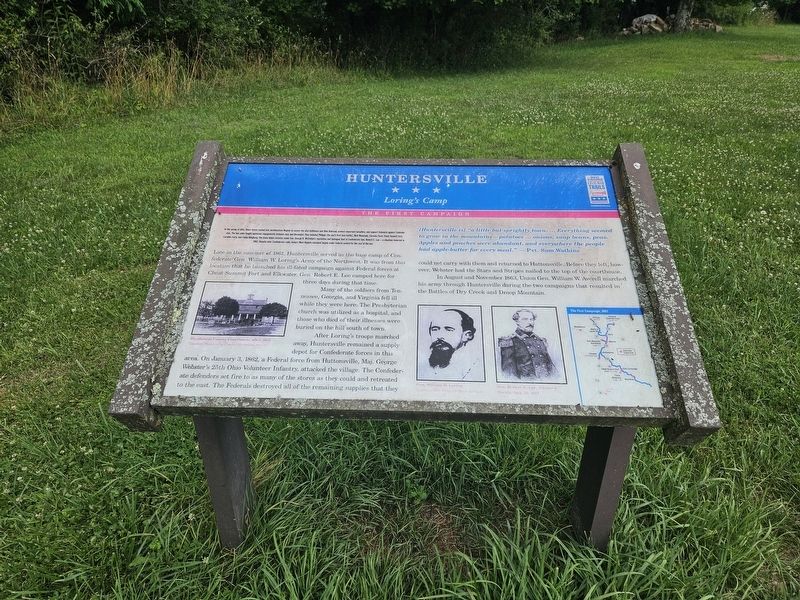
1. Huntersville Marker
In the spring of 1861, Union forces rushed into northwestern Virginia to secure the vital Baltimore and Ohio Railroad, protect important turnpikes, and support Unionists against Confederates. The two sides fought numerous engagements between June and December. They included Philippi (the war's first land battle), Rich Mountain, Corricks Ford, Cheat Summit Fort, Carnifex Ferry, and Camp Allegheny. The many Union victories made Gen. George B. McClellan's reputation and damaged that of Confederate Gen. Robert E. Lee—a situation reversed in 1862. Despite later Confederate raids, today's West Virginia remained largely under Federal control for the rest of the war.
Late in the summer of 1861, Huntersville served as the base camp of Confederate Gen. William W. Loring's Army of the Northwest. It was from this location that he launched his ill-fated campaign against Federal forces at Cheat Summit Fort and Elkwater. Gen. Robert E. Lee camped here for three days during that time.
Many of the soldiers from Tennessee, Georgia, and Virginia fell ill while they were here. The Presbyterian church was utilized as a hospital, and
this page online
After Loring's troops marched away, Huntersville remained a supply depot for Confederate forces in this area. On January 3, 1862, a Federal force from Huttonsville, Maj. George Webster's 25th Ohio Volunteer Infantry, attacked the village. The Confederate defenders set fire to as many of the stores as they could and retreated to the east. The Federals destroyed all of the remaining supplies that they could not carry with them and returned to Huttonsville. Before they left, however, Webster had the Stars and Stripes nailed to the top of the courthouse.
In August and November 1863, Union Gen. William W. Averell marched his army through Huntersville during the two campaigns that resulted in the Battles of Dry Creek and Droop Mountain.
[Huntersville is] "a little but sprightly town.… Everything seemed to grow in the mountains—potatoes … onions, snap beans, peas. Apples and peaches were abundant, and everywhere the people had apple-butter for every meal." —Pvt. Sam Watkins
(captions)
Pocahontas County Courthouse, after 1865 Courtesy Pocahontas County Historical Society
Gen. William W. Loring Courtesy West Virginia State Archives
Gen. Robert E. Lee, Harper's Weekly, Aug. 24, 1861
Erected by West
Photographed by Mark P Brock-Cancellieri, July 19, 2024
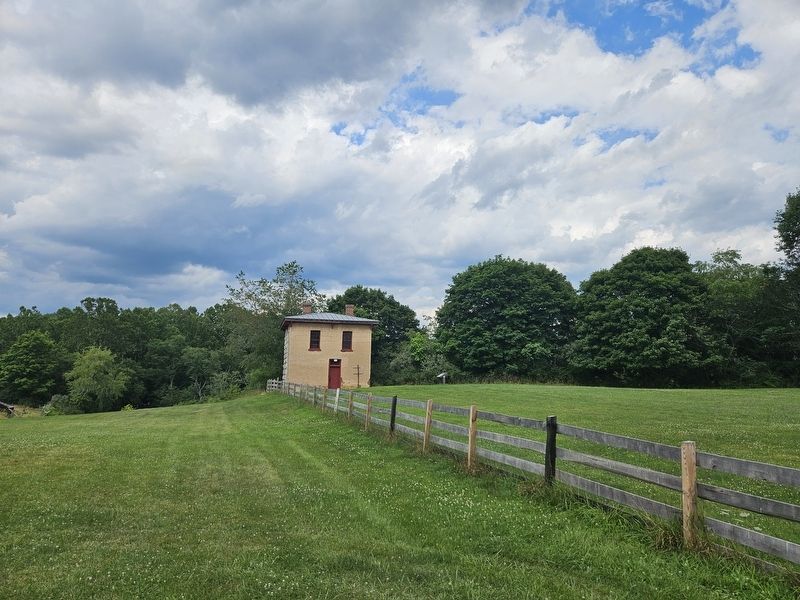
2. Huntersville Jail with Marker visible to the right.
Topics and series. This historical marker is listed in this topic list: War, US Civil. In addition, it is included in the West Virginia Civil War Trails series list. A significant historical date for this entry is January 3, 1862.
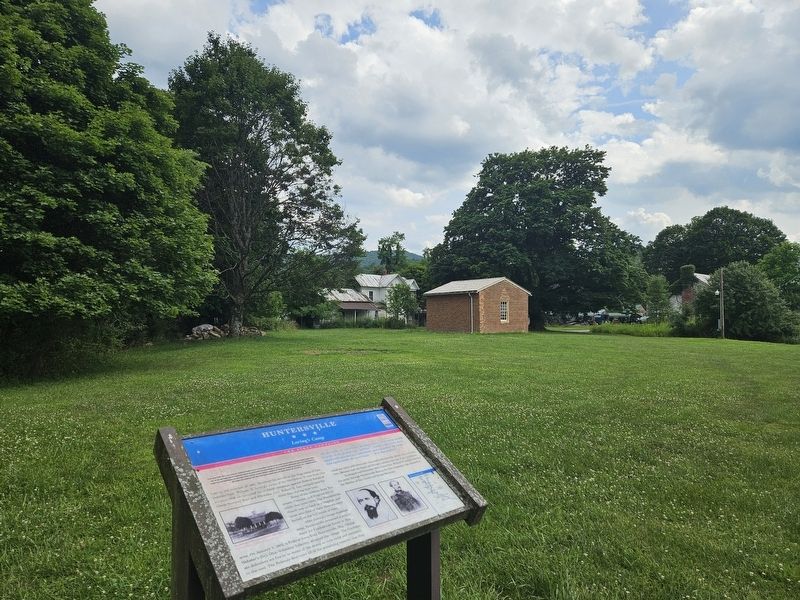
Location. 38° 11.467′ N, 80° 1.005′ W. Marker is in Huntersville, West Virginia, in Pocahontas County. It can be reached from Barlow Lane Road 0.1 miles north of Huntersville Road (West Virginia Route 39), on the right when traveling north. The marker is difficult to spot: it is against the tree-line in a field, next to the historic Huntersville Jail, which is itself set-back off the road. Touch for map. Marker is at or near this postal address: 74 Barlow Lane Rd, Marlinton WV 24954, United States of America. Touch for directions.

Regionally, this marker is in the Potomac Highlands. It is also in the American South, specifically in the Upper South, in Appalachia, and specifically in Southern Appalachia. Globally, it is in North America, the Western Hemisphere, the Western World, and the Anglosphere. Historically, it finds itself in what was once the territory of the Mississippian Culture.
Photographed by Mark P Brock-Cancellieri, July 19, 2024
3. Huntersville Marker
Other nearby markers. At least 8 other markers are within 5 miles of this marker, measured as the crow flies: Huntersville Jail (here, next to this marker); Huntersville Jail / Presbyterian Church (about 500 feet away, measured in a direct line); Raid on Huntersville (about 800 feet away); a different marker also named Huntersville (approx. 0.2 miles away); Tuscarora (Clinton) Sand (approx. 0.9 miles away); Camp Northwest (approx. 2.6 miles away); A Hidden History (approx. 4.7 miles away); History of Welcoming (approx. 4.7 miles away). Touch for a list and map of all markers in Huntersville.
Credits. This page was last revised on July 23, 2026. It was originally submitted on November 2, 2024, by Mark P. Brock-Cancellieri of Baltimore, Maryland. This page has been viewed 181 times since then and 32 times this year. Photos: 1, 2, 3. submitted on November 2, 2024, by Mark P. Brock-Cancellieri of Baltimore, Maryland. • Bernard Fisher was the editor who published this page.
