Shanty Bay in Simcoe County, Ontario — Central Canada (North America)
Black Pioneers Memorial
Photographed by Cosmos Mariner, June 6, 2024
1. Black Pioneers Memorial
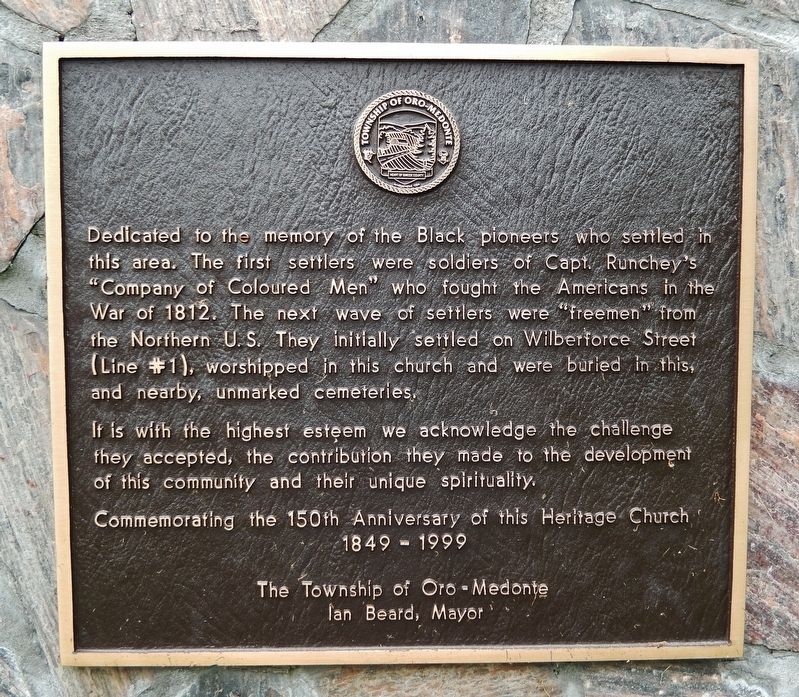
Dedicated to the memory of the Black pioneers who settled in this area. The first settlers were soldiers of Capt. Runchey’s “Company of Coloured Men” who fought the Americans in the War of 1812. The next wave of settlers were “freemen” from the Northern U.S. They initially settled on Wilberforce Street (Line # 1), worshipped in this church and were buried in this, and nearby, unmarked cemeteries.
It is with the highest esteem we acknowledge the challenge they accepted, the contribution they made to the development of this community and their unique spirituality.
1849-1999
The township of Oro-Medonte
Ian Beard, Mayor
Erected 1999 by The township of Oro-Medonte.
Topics. This historical marker and memorial is listed in these topic lists: Cemeteries & Burial Sites • Religion & Religious Structures • Settlements & Settlers • War of 1812. A significant historical year for this entry is 1849.
Location. 44° 30.157′ N, 79° 38.184′ W. Marker is in Shanty Bay, Ontario, in Simcoe County. It is at the intersection of Line 3 North and Old Barrie Road West (County
this page online

Regionally, this marker and memorial is in Central Ontario Cottage Country and in Georgian Bay Country. It is also in Central Canada. Globally, it is in North America, on the Great Lakes, in the Western Hemisphere, in the Western World, and in the Anglosphere. Historically, it finds itself in what was once a British colony, the Viceroyalty of New France, the Haudenosaunee (Iroquois) Confederacy, and Rupert’s Land.
Other nearby markers. At least 8 other markers are within 13 kilometers of this marker, measured as the crow flies: Between 1830 & 1850 some 24 Negro Families Settled in Oro (here, next to this marker); The African Methodist Episcopal Church of Oro / L'Église African Methodist Episcopal d'Oro (here, next to this marker); War of 1812 Veteran / Vétéran de la guerre de 1812 (here, next to this marker); Hon. Ernest Charles Drury

Photographed by Cosmos Mariner, June 6, 2024
2. Black Pioneers Memorial
Looking north; the African Methodist Episcopal Church of Oro is in the background.
Related markers. Click here for a list of markers that are related to this marker. The African Methodist Episcopal Church of Oro
Also see . . .
1. Oro African Methodist Episcopal Church (Atlas Obscura).
Excerpt: The land in this region formed the backbone of British supply lines between the Great Lakes during the War of 1812. In order to secure the main supply route between Lake Simcoe and Georgian Bay, a rough-hewn path was cut through the wilderness. It was decided by the government of then Upper Canada that the best way to discourage any attempt at invasion would be to populate that area along that Road with veteran militiamen.(Submitted on November 2, 2024, by Cosmos Mariner of Cape Canaveral, Florida.)
In the years between 1819 and 1831, land along concessions fronting either side of the Penetanguishene Road were granted to Black veterans of theprevious war. Chief among those first to be granted lands in the Oro area were the men of Captain Runche’s “Company of Coloured Men.” All along Concession Line II (known as Wilberforce Street, named after British abolitionist William Wilberforce), and later along Concessions III and IV, some 60 black settlers and their families—a total population of approximately 100 people—were incorporated upon land that had yet to be cleared or settled by European farmers. It was to this area that passengers on the Underground Railroad might have found their way. As the northernmost terminus of that network, most former slaves who had escaped their captivity had settled in communities nearer to the border.Photographed by Cosmos Mariner, June 6, 20243. African Methodist Episcopal Church of Oro (southwest elevation)The Black Pioneers Memorial is mounted on the south [right] side of the stone monument in the right foreground.

2. The Black Settlement in Oro Township.
Excerpt: Arriving as early as they did, the Black families who settled along Wilberforce Street were among the first permanent agricultural settlers in the area. The very first will probated in Simcoe District, in 1843, was that of George A. Darkman, who was granted Lot 24 Concession II, Oro Township. By 1900, the Wilberforce Street Black settlement had virtually disappeared. The last descendent of the original settlers, James Thompson, left Oro Township in 1949. Descendants of some of the first Black settlers remained in Oro for nearly 130 years, and in other parts of Simcoe County to the present day.(Submitted on November 2, 2024, by Cosmos Mariner of Cape Canaveral, Florida.)
Credits. This page was last revised on November 3, 2024. It was originally submitted on November 2, 2024, by Cosmos Mariner of Cape Canaveral, Florida. This page has been viewed 123 times since then and 14 times this year. Photos: 1, 2, 3. submitted on November 2, 2024, by Cosmos Mariner of Cape Canaveral, Florida.
