“Tigress” — “Scorpion”
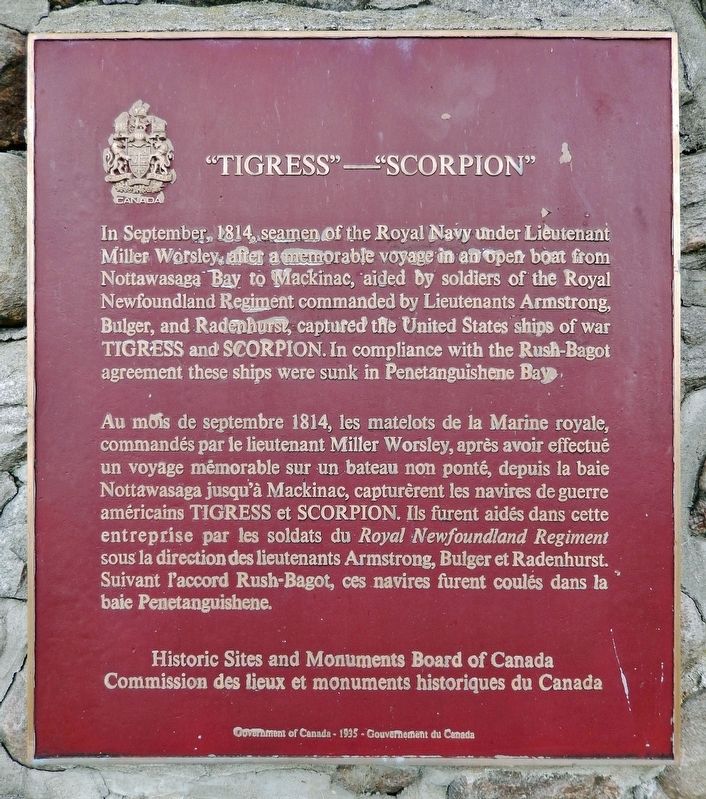

Erected 1935 by Historic Sites and Monuments Board of Canada/Commission des lieux et monuments historiques du Canada.
Topics and series. This historical marker
this page online
Location. 44° 47.456′ N, 79° 56.034′ W. Marker is in Penetanguishene, Ontario, in Simcoe County. It is on Fox Street half a kilometer south of Broad Street, on the right when traveling south. The marker is located in Huronia Park, overlooking Penetang Harbour. Touch for map. Marker is at or near this postal address: 250 Fox Street, Penetanguishene ON L9M 1E9, Canada. Touch for directions.

Regionally, this marker is in Central Ontario Cottage Country and specifically in Georgian Bay Country. It is also in Central Canada. Globally, it is in North America, on the Great Lakes, in the Western Hemisphere, in the Western World, and in the Anglosphere. Historically, it finds itself in what was once a British colony, the Viceroyalty of New France, the Haudenosaunee (Iroquois) Confederacy, and Rupert’s Land.
Other nearby markers. At least 8 other markers are within 3 kilometers of this marker, measured as the crow flies:

Related markers. Click here for a list of markers that are related to this marker. Capture of the “Tigress” and “Scorpion”
Also see . . .
1. Engagements on Lake Huron: Capture of the Gunboats “Tigress” & “Scorpion” (Wikipedia).
Excerpt: In the early hours of 4 September, Worsley's four boats approached Tigress silently. The crew of the gunboat (thirty-one sailors and soldiers under Sailing Master Stephen Champlain) spotted them too late, and their fire missed. Before they could reload, Worsley's and Armstrong's boats were alongside the starboard side of the gunboat, and Bulger's and Raderhorst's boats were to port. The Newfoundlanders and Worsley's sailors swarmed on board the gunboat and overpowered the Americans after a sharp struggle.(Submitted on November 4, 2024, by Cosmos Mariner of Cape Canaveral, Florida.)At dawn on 6 September, Worsley set sail towards Scorpion in Tigress, under American colours and with most of his men below decks or concealed under their greatcoats. The unsuspecting crew of Scorpion could be seen scrubbing the deck. Worsley approached to within few yards of the Scorpion and then fired a volley of muskets and Tigress's 24-pounder cannon. As the vessels came into contact, Worsley's men swarmed aboard the American vessel. The surprised Americans made little resistance.
2. The Capture of USS Tigress and USS Scorpion in 1814.
(by Coleman Carlstein) Excerpt: On the dismally cloudy night of September 3, 1814, Lieutenant Worsely, along with many British men and Indian allies and led by Lieutenant Bulger, approached the anchored USS Tigress silently using oar boats. Once the party reached their target, they boarded the ship and fought for her control, leaving several American men killed and wounded, including the American commander Champlain, who did not surrender until he himself was severely injured. After the USS Tigress was captured, Lieutenant Bulger retained a majority of the boarding party aboard the ship. Lieutenant Worsely had another plan, for which he needed these men and kept the American flag flying above USS Tigress.(Submitted on November 4, 2024, by Cosmos Mariner of Cape Canaveral, Florida.)The USS Tigress, now in the hands of the Royal Navy, approached USS Scorpion two days later on September 5, 1814. Receiving signals from USS Scorpion but returning none, USS Tigress quickly sailed alongside USS Scorpion, allowing the British boarding party to move aboard USS Scorpion. The USS Scorpion was ill-prepared for an engagement at the early hour when this took place, as the crew of USS Scorpion was scrubbing her decks. No American officers were on the deck of USS Scorpion when USS Tigress approached, giving an advantage the British controlled ship. Lieutenant Turner, the leading officer aboard USS Scorpion, was only notified of the attack moments before it was over and USS Scorpion was captured.
Credits. This page was last revised on November 9, 2024. It was originally submitted on November 2, 2024, by Cosmos Mariner of Cape Canaveral, Florida. This page has been viewed 149 times since then and 35 times this year. Photos: 1, 2. submitted on November 4, 2024, by Cosmos Mariner of Cape Canaveral, Florida.
