
Fergus Falls in Otter Tail County, Minnesota — The American Midwest (Upper Plains)
Otter Tail Dams
Going With the Flow
| — | Otter Trail Scenic Byway Site A | — |
October 24, 2024
1. Otter Tail Dams Marker
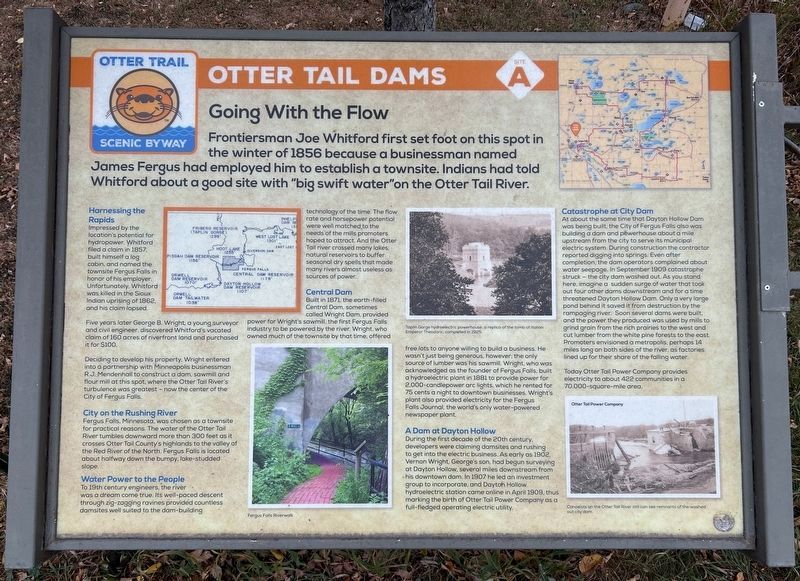
Frontiersman Joe Whitford first set foot on this spot in the winter of 1856 because a businessman named James Fergus had employed him to establish a townsite. Indians had told Whitford about a good site with "big swift water"on the Otter Tail River.
Harnessing the Rapids
Impressed by the location's potential for hydropower, Whitford filed a claim in 1857, built himself a log cabin, and named the townsite Fergus Falls in honor of his employer. Unfortunately, Whitford was killed in the Sioux Indian uprising of 1862, and his claim lapsed.
Five years later George B. Wright, a young surveyor and civil engineer, discovered Whitford's vacated claim of 160 acres of riverfront land and purchased it for $100.
Deciding to develop his property, Wright entered into a partnership with Minneapolis businessman R.J. Mendenhall to construct a dam, sawmill and flour mill at this spot, where the Otter Tail River's turbulence was greatest – now the center of the City of Fergus Falls.
City on the Rushing River
Fergus Falls, Minnesota, was chosen as a townsite for practical reasons. The water of the Otter Tail River tumbles downward more than 300 feet as it crosses Otter Tail County's highlands to the valley of the Red River of the North. Fergus Falls is located
this page online
Water Power to the People
To 19th century engineers, the river was a dream come true. Its well-paced descent through zig-zagging ravines provided countless damsites well suited to the dam-building technology of the time. The flow rate and horsepower potential were well matched to the needs of the mills promoters hoped to attract. And the Otter Tail river crossed many lakes, natural reservoirs to buffer seasonal dry spells that made many rivers almost useless as sources of power.
Central Dam
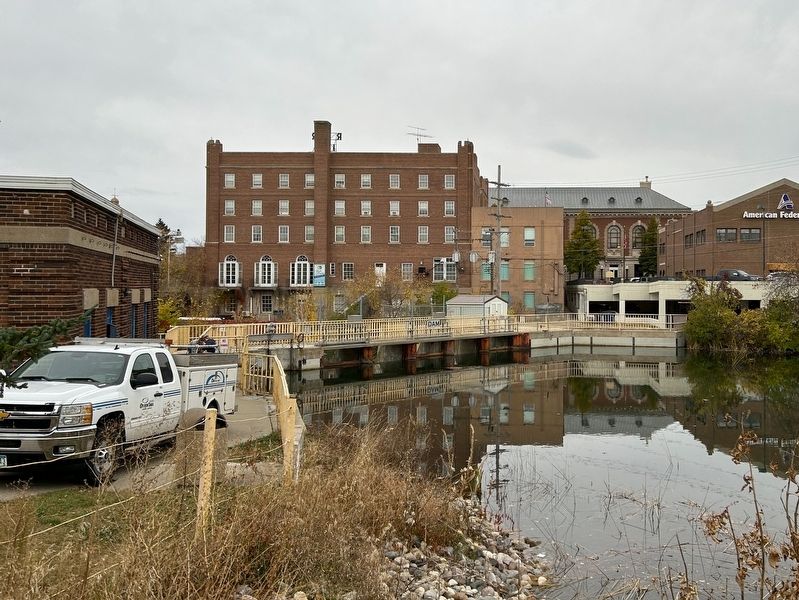
Built in 1871, the earth-filled Central Dam, sometimes called Wright Dam, provided power for Wright's sawmill, the first Fergus Falls industry to be powered by the river. Wright, who owned much of the townsite by that time, offered free lots to anyone willing to build a business. He wasn't just being generous, however; the only source of lumber was his sawmill. Wright, who was acknowledged as the founder of Fergus Falls, built a hydroelectric plant in 1881 to provide power for 2,000-candlepower arc lights, which he rented for 75 cents a night to downtown businesses. Wright's plant also provided electricity for the Fergus Falls Journal, the world's only water-powered newspaper plant.
A Dam at Dayton Hollow
During the first decade of the 20th century,
October 24, 2024
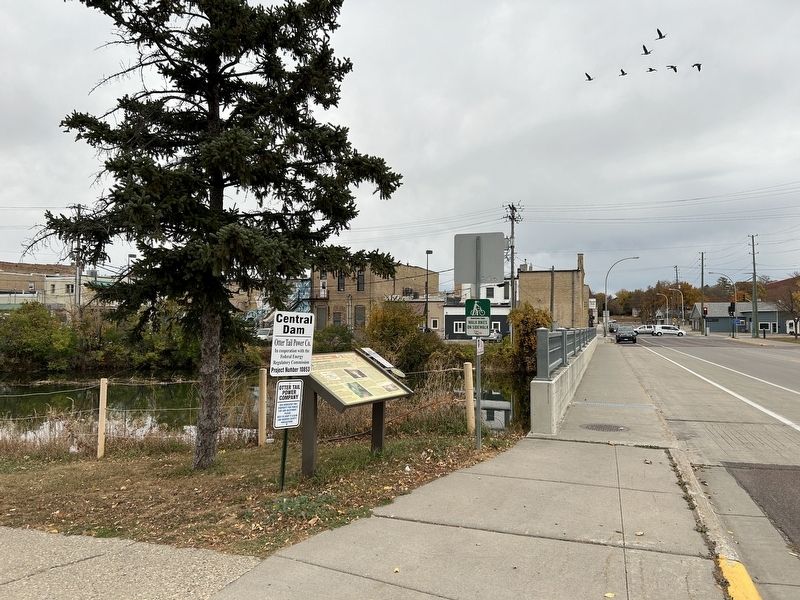
2. Otter Tail Dams Marker, from the south
Catastrophe at City Dam
At about the same time that Dayton Hollow Dam was being built, the City of Fergus Falls also was building a dam and powerhouse about a mile upstream from the city to serve its municipal electric system. During construction the contractor reported digging into springs. Even after completion, the dam operators complained about water seepage. In September 1909 catastrophe struck — the city dam washed out. As you stand here, imagine a sudden surge of water that took out four other dams downstream and for a time threatened Dayton Hollow Dam. Only a very large pond behind it saved it from destruction by the rampaging river. Soon several dams were built, and the power they produced was used by mills to grind grain from the rich prairies to the west and cut lumber from the white pine forests to the east. Promoters envisioned a metropolis, perhaps 14 miles long on both sides of the river, as factories lined up
October 24, 2024
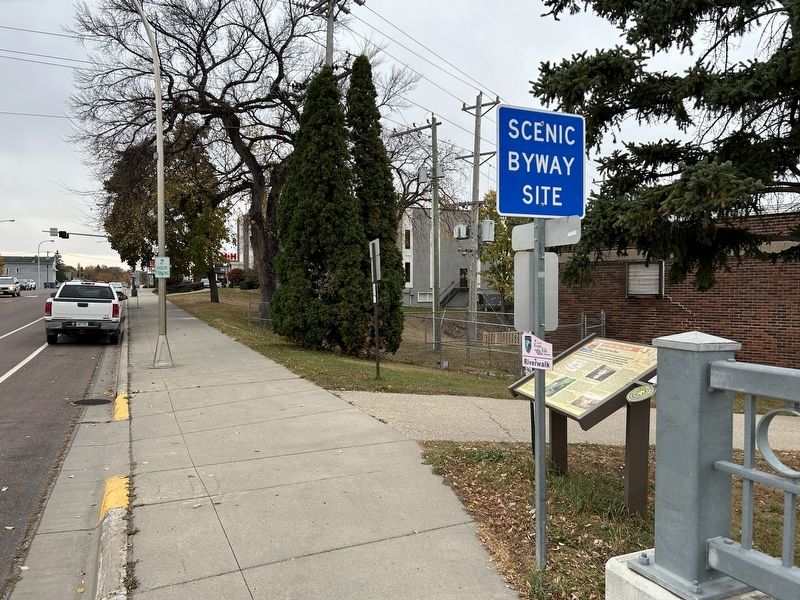
3. Otter Tail Dams Marker, from the north
Today Otter Tail Power Company provides electricity to about 422 communities in a 70,000-square-mile area.
Captions:
Fergus Falls Riverwalk
Taplin Gorge hydroelectric powerhouse, a replica of the tomb of Italian Emperor Theodoric, completed in 1925.
Otter Tail Power Company
Canoeists on the Otter Tail River still can see remnants of the washed out city dam.
Erected by Otter Tail Lakes Country Association.
Topics. This historical marker is listed in these topic lists: Industry & Commerce • Settlements & Settlers • Waterways & Vessels. A significant historical year for this entry is 1871.
Location. 46° 16.955′ N, 96° 4.353′ W. Marker is in Fergus Falls, Minnesota, in Otter Tail County. It is on South Cascade Street south of East Lincoln Avenue, on the right when traveling south. Touch for map. Marker is in this post office area: Fergus Falls MN 56537, United States of America. Touch for directions.

Regionally, this marker is in the American Midwest and in the Corn Belt. Globally, it is in North America, the Western Hemisphere, the Western World, and the Anglosphere. Historically, it finds itself in what was once Rupert’s Land, the territory of the Mississippian Culture, and the Louisiana Purchase.
Other nearby markers. At least 8 other markers are within walking distance of this marker: Bridges (within shouting distance of this marker); Water Power (within shouting distance of this marker); Fergus Falls Woolen Mill (about 300 feet away, measured in a direct line); The Coming City (about 400 feet away); Federal Building / River Inn / City Hall
October 24, 2024
4. View of Central Dam from Marker
Also see . . .
1. Broken Down Dam - Wikipedia. (Submitted on November 3, 2024.)
2. The ruins of a massive dam collapse attract visitors across Minnesota - CBS Minnesota. (Submitted on November 3, 2024.)
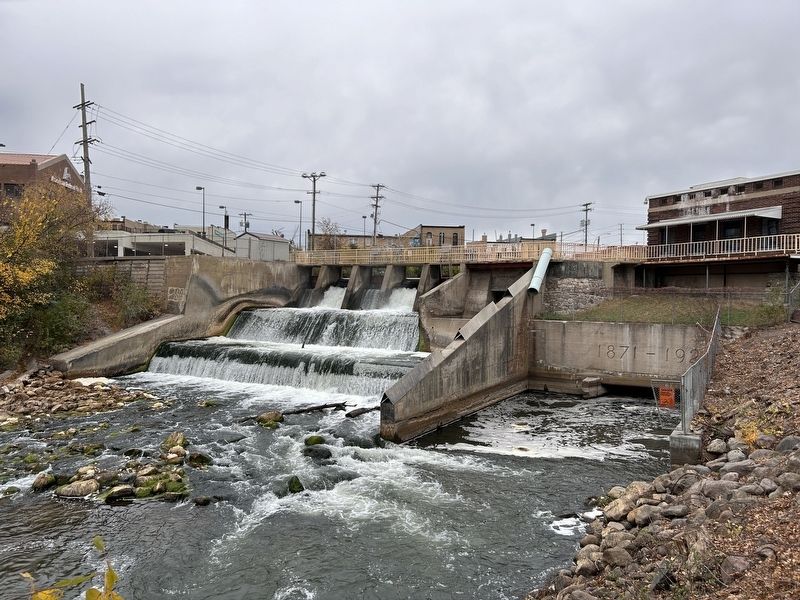
October 24, 2024
5. Central Dam & Spillway
Credits. This page was last revised on November 4, 2024. It was originally submitted on November 3, 2024. This page has been viewed 387 times since then and 66 times this year. Photos: 1, 2, 3, 4, 5. submitted on November 3, 2024.
