East Side in San Antonio in Bexar County, Texas — The American South (West South Central)
John Inman Fighter for Human Rights
Photographed by James Hulse, October 29, 2024
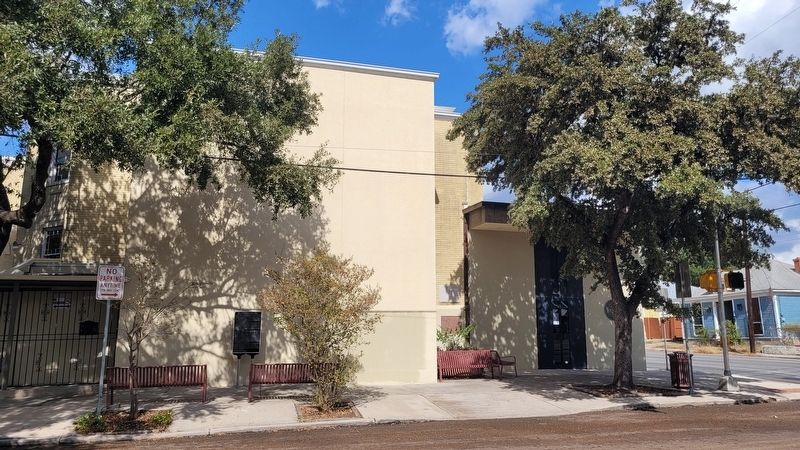
1. John Inman Fighter for Human Rights Marker
Inscription.
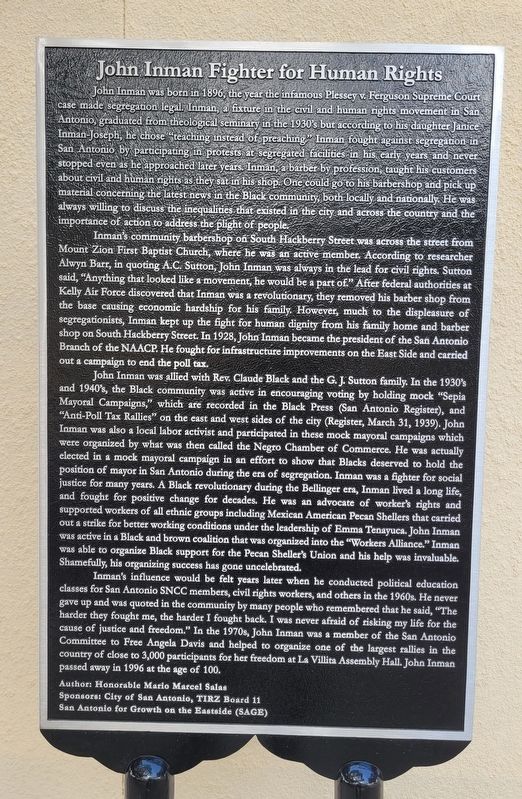
John Inman Fighter for Human Rights. . John Inman was born in 1896, the year the infamous Plessey v. Ferguson Supreme Court case made segregation legal. Inman, a fixture in the civil and human rights movement in San Antonio, graduated from theological seminary in the 1930's but according to his daughter Janice Inman-Joseph, he chose "teaching instead of preaching. Inman fought against segregation in San Antonio by participating in protests at segregated facilities in his early years and never stopped even as he approached later years. Inman, a barber by profession, taught his customers about civil and human rights as they sat in his shop. One could go to his barbershop and pick up material concerning the latest news in the Black community, both locally and nationally. He was always willing to discuss the inequalities that existed in the city and across the country and the importance of action to address the plight of people., Inman's community barbershop on South Hackberry Street was across the street from Mount Zion First Baptist Church, where he was an active member. According to researcher Alwyn Barr, in quoting A.C. Sutton, John Inman was always in the lead for civil rights. Sutton said, "Anything that looked like a movement, he would be a part of." After federal authorities at Kelly Air Force discovered that Inman was a revolutionary, they removed his barber shop from the base causing economic hardship for his family. However, much to the displeasure of segregationists, Inman kept up the fight for human dignity from his family home and barber shop on South Hackberry Street. In 1928, John Inman became the president of the San Antonio Branch of the NAACP. He fought for infrastructure improvements on the East Side and carried out a campaign to end the poll tax., John Inman was allied with Rev. Claude Black and the G. J. Sutton family. In the 1930's and 1940's, the Black community was active in encouraging voting by holding mock "Sepia Mayoral Campaigns," which are recorded in the Black Press (San Antonio Register), and "Anti-Poll Tax Rallies" on the east and west sides of the city (Register, March 31, 1939). John Inman was also a local labor activist and participated in these mock mayoral campaigns which were organized by what was then called the Negro Chamber of Commerce. He was actually elected in a mock mayoral campaign in an effort to show that Blacks deserved to hold the position of mayor in San Antonio during the era of segregation. Inman was a fighter for social justice for many years. A Black revolutionary during the Bellinger era, Inman lived a long life, and fought for positive change for decades. He was an advocate of worker's rights and supported workers of all ethnic groups including Mexican American Pecan Shellers that carried out a strike for better working conditions under the leadership of Emma Tenayuca. John Inman was active in a Black and brown coalition that was organized into the "Workers Alliance." Inman was able to organize Black support for the Pecan Sheller's Union and his help was invaluable. Shamefully, his organizing success has gone uncelebrated., Inman's influence would be felt years later when he conducted political education classes for San Antonio SNCC members, civil rights workers, and others in the 1960s. He never gave up and was quoted in the community by many people who remembered that he said, "The harder they fought me, the harder I fought back. I was never afraid of risking my life for the cause of justice and freedom." In the 1970s, John Inman was a member of the San Antonio Committee to Free Angela Davis and helped to organize one of the largest rallies in the country of close to 3,000 participants for her freedom at La Villita Assembly Hall. John Inman passed away in 1996 at the age of 100., Author: Honorable Mario Marcel Salas
John Inman was born in 1896, the year the infamous Plessey v. Ferguson Supreme Court case made segregation legal. Inman, a fixture in the civil and human rights movement in San Antonio, graduated from theological seminary in the 1930's but according to his daughter Janice Inman-Joseph, he chose "teaching instead of preaching. Inman fought against segregation in San Antonio by participating in protests at segregated facilities in his early years and never stopped even as he approached later years. Inman, a barber by profession, taught his customers about civil and human rights as they sat in his shop. One could go to his barbershop and pick up material concerning the latest news in the Black community, both locally and nationally. He was always willing to discuss the inequalities that existed in the city and across the country and the importance of action to address the plight of people.
Inman's community barbershop on South Hackberry Street was across the street from Mount Zion First Baptist Church, where he was an active member. According to researcher Alwyn Barr, in quoting A.C. Sutton, John Inman was always in the lead for civil rights. Sutton said, "Anything that looked like a movement, he would be a part of." After federal authorities at Kelly Air Force discovered that Inman was a revolutionary, they removed his barber shop from the base causing economic hardship for his family. However, much to the displeasure of segregationists, Inman kept up the fight for human dignity from his family home and barber shop on South Hackberry Street. In 1928, John Inman became the president of the San Antonio Branch of the NAACP. He fought for infrastructure improvements on the East Side and carried out a campaign to end the poll tax.
John Inman was allied with Rev. Claude Black and the G. J. Sutton family. In
Click or scan to see this page online
the 1930's and 1940's, the Black community was active in encouraging voting by holding mock "Sepia Mayoral Campaigns," which are recorded in the Black Press (San Antonio Register), and "Anti-Poll Tax Rallies" on the east and west sides of the city (Register, March 31, 1939). John Inman was also a local labor activist and participated in these mock mayoral campaigns which were organized by what was then called the Negro Chamber of Commerce. He was actually elected in a mock mayoral campaign in an effort to show that Blacks deserved to hold the position of mayor in San Antonio during the era of segregation. Inman was a fighter for social justice for many years. A Black revolutionary during the Bellinger era, Inman lived a long life, and fought for positive change for decades. He was an advocate of worker's rights and supported workers of all ethnic groups including Mexican American Pecan Shellers that carried out a strike for better working conditions under the leadership of Emma Tenayuca. John Inman was active in a Black and brown coalition that was organized into the "Workers Alliance." Inman was able to organize Black support for the
Photographed by James Hulse, October 29, 2024
2. The John Inman Fighter for Human Rights Marker along the church wall
Pecan Sheller's Union and his help was invaluable. Shamefully, his organizing success has gone uncelebrated.
Inman's influence would be felt years later when he conducted political education classes for San Antonio SNCC members, civil rights workers, and others in the 1960s. He never gave up and was quoted in the community by many people who remembered that he said, "The harder they fought me, the harder I fought back. I was never afraid of risking my life for the cause of justice and freedom." In the 1970s, John Inman was a member of the San Antonio Committee to Free Angela Davis and helped to organize one of the largest rallies in the country of close to 3,000 participants for her freedom at La Villita Assembly Hall. John Inman passed away in 1996 at the age of 100.
Author: Honorable Mario Marcel Salas
Erected by City of San Antonio, TIRZ Board 11 San Antonio for Growth on the Eastside (SAGE).
Topics. This historical marker is listed in these topic lists: African Americans • Civil Rights. A significant historical date for this entry is March 31, 1896.
Location. 29° 24.804′ N, 98° 28.41′ W. Marker is in San Antonio, Texas, in Bexar County. It is in the East Side. It is at the intersection of Martin Luther King Drive and South Hackberry Street, on the right when traveling west on Martin Luther King Drive. The marker is located at the entrance to the Mt Zion First Baptist Church. Touch for map. Marker is at or near this postal address: 333 Martin Luther King Dr, San Antonio TX 78203, United States of America. Touch for directions.

Regionally, this marker is in South Texas. It is also in the American South. Globally, it is in North America, a Gulf of Mexico state, the Western Hemisphere, the Western World, and the Anglosphere. Historically, it finds itself in what was once New Spain, the Republic of Texas, and one of the Confederate States of America.
Credits. This page was last revised on November 5, 2024. It was originally submitted on November 4, 2024, by James Hulse of Medina, Texas. This page has been viewed 191 times since then and 22 times this year. Photos:1, 2. submitted on November 5, 2024, by James Hulse of Medina, Texas.