Sydney in Cape Breton Region, Nova Scotia — The Atlantic Provinces (North America)
The Big Fiddle
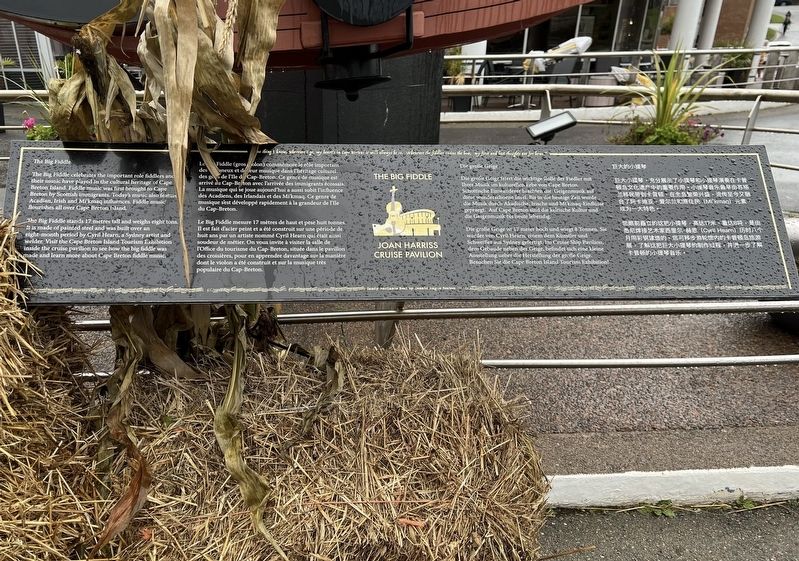
Photographed by Sandra Hughes Tidwell, October 14, 2024
1. The Big Fiddle Marker

The Big Fiddle celebrates the important role the fiddlers and their music have played in the cultural heritage of Cape Breton Island. Fiddle music was first brought to Cape Breton by Scottish Immigrants. Today’s music also features Acadian Irish and Mi’kmaq influences. Fiddle Music flourishes all over Cape Breton Island.
The Big Fiddle stands 17 meters tall and weighs eight tons. It is made of painted steel and was built over an eight-month period by Cyril Hearn, a Sydney artist and welder. Visit the Cape Breton Island Tourism Exhibition inside the cruise pavilion to see how the big fiddle was made and learn more about Cape Breton fiddle music.
Le Big Fiddle (gros colon) commémore le rôle important des [??]neaux et de leur musique dans l’héritage cultural des gens de l’Île d Cap-Breton. Ce genre de musique est arrivé du Cap-Breton avec l’arrivée des immigrants ècossais. La Musique qui se joue aujourd’hui a aussi suit l’influence des Acadiens, des Irlandais et des Mi’kamaq. Ce genre de musique s’est développé rapidement à la grandeur de l’Ile du Cap-Breton.
Le Big Fiddle mesure 17
this page online
Die große Geige
Die große Geige feiert die wichtige Rolle der Fiedler mit Ihrer Musik im kulturellen Erbe von Cape Breton. Schottische Einwanderer brachten die Geigenmusik auf diese wunderschoene Insel. Bis in die heutige Zeit wurde die Musik durch Akadische, Irish und Mi`kmaq-Einflüsse gepraegt. Auf Cape Breton Sind die keltische Kultur und die Geigenmusik bis heute lebendig.
Die große Geige ist 17 meter hoch und wiegt 8 Tonnen. Sie wurder von Cyril Hearn, einem dem Künstler und Schweitzer aus Sydney gefertigt. Im Cruise Ship Pavilion, dem Gebaude neben der Geige, befindet sich eine kleine Ausstellung ueber die Herstellung der große Geige. Besuchen Sie die Cape Breton Island Tourism Exhibition!
Topics.
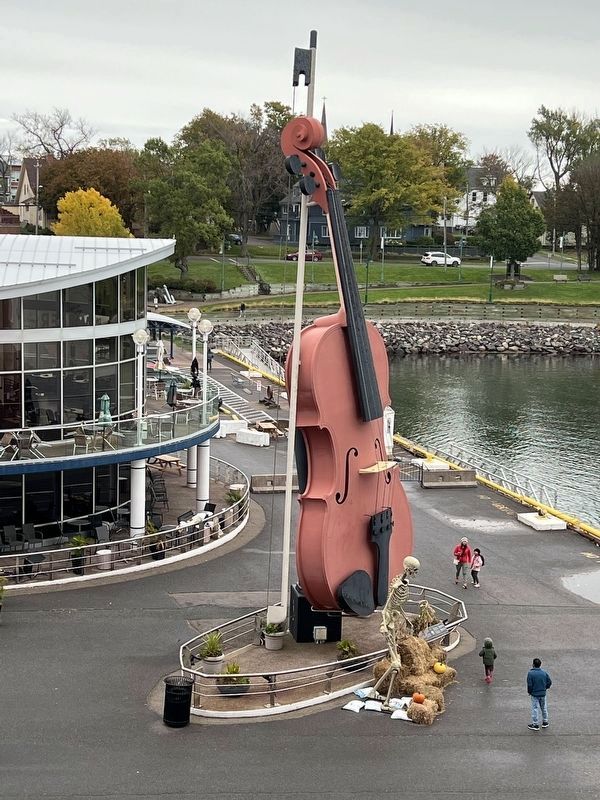
Photographed by Sandra Hughes Tidwell, October 14, 2024
2. The Big Fiddle and Marker
Location. 46° 8.491′ N, 60° 11.984′ W. Marker is in Sydney, Nova Scotia, in Cape Breton Region. It can be reached from Esplanade. The Big Fiddle is located next to the visitor information center. Touch for map. Marker is at or near this postal address: 74 Esplanade, Sydney NS B1P 6P4, Canada. Touch for directions.

Regionally, this marker is on Cape Breton Island. It is also in the Maritimes and in Atlantic Canada. Globally, it is in the North Atlantic Region, North America, the Western Hemisphere, the Western World, and the Anglosphere. Historically, it finds itself in what was once a British colony, the Viceroyalty of New France, and Acadia.
Other nearby markers. At least 8 other markers are within walking distance of this marker: Royal Bank Lion (about 120 meters away, measured in a direct line); Joseph Frederick Wallet DesBarres (about 150 meters away); Sir John George Bourinot (about 150 meters away); "Northern Friends" (about 180 meters away); Sir Peter D. Macdonald (about 180 meters away); Cossit House (approx. 0.2 kilometers away); Canadian Merchant Navy (approx. 0.2 kilometers away); St. George's Church (approx. 0.3 kilometers away). Touch for a list and map of all markers in Sydney.
Also see . . . Cape Breton fiddling. Cape Breton fiddling is a regional violin style which falls within the Celtic music idiom. The more predominant style in Cape Breton Island's fiddle music was brought to North America by Scottish immigrants during the Highland Clearances. These Scottish immigrants were primarily from Gaelic-speaking regions in the Scottish Highlands and the Outer Hebrides. Although fiddling has changed considerably since this time in Scotland, it is widely held that the tradition of Scottish fiddle music has been better preserved in Cape Breton. While there is a similar tradition from the Irish-style fiddling, that style is largely overlooked as a result of the strong Scottish presence in the area. (Submitted on November 4, 2024, by Sandra Hughes Tidwell of Killen, Alabama, USA.)
Credits. This page was last revised on November 13, 2024. It was originally submitted on November 4, 2024, by Sandra Hughes Tidwell of Killen, Alabama, USA. This page has been viewed 519 times since then and 112 times this year. Photos: 1, 2. submitted on November 4, 2024, by Sandra Hughes Tidwell of Killen, Alabama, USA. • Andrew Ruppenstein was the editor who published this page.
