Penetanguishene in Simcoe County, Ontario — Central Canada (North America)
Penetanguishene Tercentenary Polar Sea Expedition
1615-1921

Photographed by Cosmos Mariner, June 7, 2024
1. Penetanguishene Tercentenary Polar Sea Expedition Marker
In 1825 the artic explorer Sir John Franklin, under orders from the British Government set out from here with Francois Forcier, Enfant Lavallee and Maluoin to find a northern passage by sea from Atlantic to Pacific.
Topics. This historical marker is listed in these topic lists: Exploration • Waterways & Vessels. A significant historical year for this entry is 1825.
Location. 44° 46.36′ N, 79° 56.253′ W. Marker is in Penetanguishene, Ontario, in Simcoe County. It is on Main Street just north of Brock Street, on the left when traveling north. The marker is located near the north end of Penetanguishene Rotary Park. Touch for map. Marker is in this post office area: Penetanguishene ON L9M 1S6, Canada. Touch for directions.

Regionally, this marker is in Central Ontario Cottage Country and specifically in Georgian Bay Country. It is also in Central Canada. Globally, it is in North America, on the Great Lakes, in the Western Hemisphere, in the Western World, and in the Anglosphere. Historically, it finds itself in what was once a British colony, the Viceroyalty of New France, the Haudenosaunee (Iroquois) Confederacy,
this page online
Other nearby markers. At least 8 other markers are within walking distance of this marker: Penetanguishene/Pénétanguishene (within shouting distance of this marker); C. Beck Manufacturing Company / la société C. Beck Manufacturing Co. Ltd. (approx. 0.3 kilometers away); “Bound Together” (Huron Wendat Canoe) / Étroitement liés (canot huron-wendat) (approx. 0.3 kilometers away); The Meeting / La rencontre (approx. 0.3 kilometers away); Champlain in Ontario, 1615 (approx. 0.3 kilometers away); The Wendat (approx. 0.3 kilometers away); Brûlé (approx. 0.4 kilometers away); Joseph Le Caron (approx. 0.4 kilometers away). Touch for a list and map of all markers in Penetanguishene.
Also see . . .
1. John Franklin (Wikipedia).
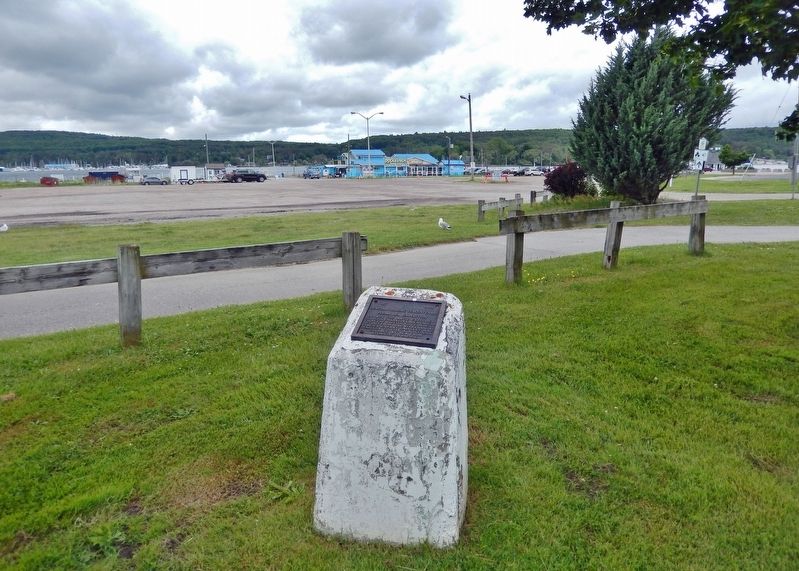
Excerpt: Sir John Franklin (1786–1847) was a British Royal Navy officer, explorer and colonial administrator. After serving in the Napoleonic Wars and the War of 1812, he led two expeditions into the Canadian Arctic and through the islands of the Arctic Archipelago, during the Coppermine expedition of 1819 and the Mackenzie River expedition of 1825, and served as Lieutenant-Governor(Submitted on November 5, 2024, by Cosmos Mariner of Cape Canaveral, Florida.)of Van Diemen's Land from 1837 to 1843. During his third and final expedition, an attempt to traverse the Northwest Passage in 1845, Franklin's ships became icebound off King William Island in what is now Nunavut, where he died in June 1847. The icebound ships were abandoned ten months later, and the entire crew died from causes such as starvation, hypothermia, and scurvy.Photographed by Cosmos Mariner, June 7, 20242. Penetanguishene Tercentenary Polar Sea Expedition MarkerThe marker is mounted atop this waist-high concrete pedestal in Penetanguishene Rotary Park.
2. Mackenzie River Expedition (Wikipedia).
Excerpt: The Northwest Passage, a supposed sea route to the Pacific Ocean by way of the Arctic Ocean, had long been sought by European explorers as a possible trade route to East Asia and the East Indies. During the Age of Exploration, the presupposed existence of the passage motivated much of European exploration in North America. Beginning in the early 19th century, the Royal Navy, having expanded to unprecedented proportions during the Napoleonic Wars, turned much of its attention to the passage's discovery.(Submitted on November 5, 2024, by Cosmos Mariner of Cape Canaveral, Florida.)The Mackenzie River expedition of 1825–1827 was the second of three Arctic expeditions led by explorer John Franklin
and organized by the Royal Navy. Franklin and the other naval officers, including Back and Richardson, departed Liverpool on 16 February 1825. Landing in New York City on 15 March, they then followed standard travelling routes through the state of New York, across the Niagara River and Lake Ontario, then through Upper Canada to Fort William on the shores of Lake Superior. After traversing numerous lakes and river systems, the party arrived at Cumberland House on the Saskatchewan River on 15 June...
Credits. This page was last revised on November 5, 2024. It was originally submitted on November 4, 2024, by Cosmos Mariner of Cape Canaveral, Florida. This page has been viewed 117 times since then and 19 times this year. Photos: 1. submitted on November 4, 2024, by Cosmos Mariner of Cape Canaveral, Florida. 2. submitted on November 5, 2024, by Cosmos Mariner of Cape Canaveral, Florida.
