Penetanguishene in Simcoe County, Ontario — Central Canada (North America)
John Graves Simcoe (1752-1806)

Photographed by Cosmos Mariner, June 7, 2024
1. John Graves Simcoe (1752-1806) Marker

British military officer and first Lieutenant-Governor of Upper Canada (1791-1796)
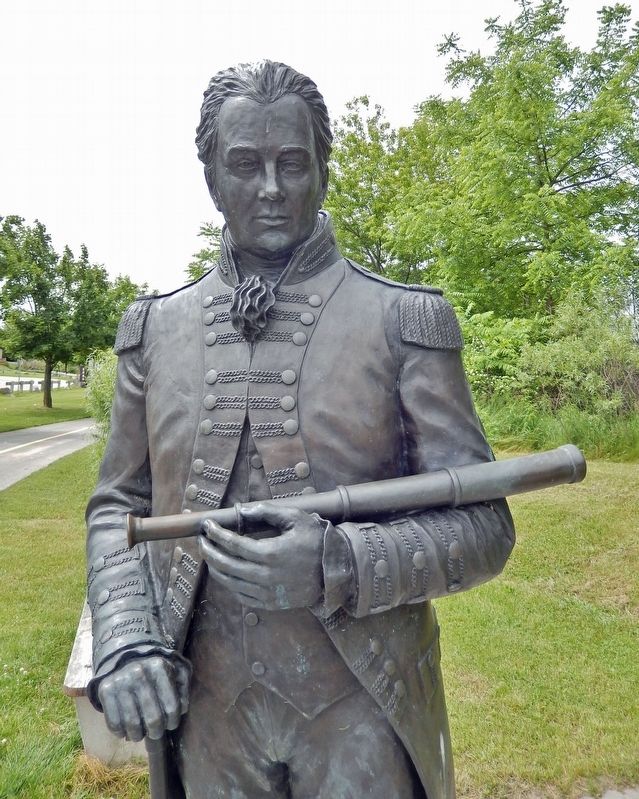
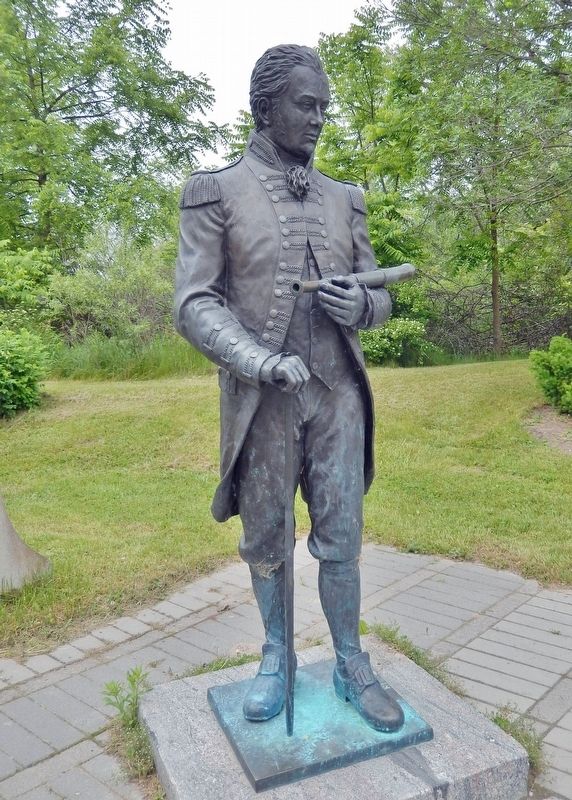
With vision and enthusiasm, he set about developing the new world wilderness London sent him to oversee. Simcoe established York (Toronto) as the capital of Upper Canada, and deeply influenced the early society, roads, laws and governance of Ontario. In 1793, he foresaw Penetanguishene's strategic value as a naval base. In fact, the Penetanguishene Naval Establishment later proved to be a key development in the Town's history. Sculpted in clay and cast in bronze, the monument was created by Canadian sculptor Tyler Fauvelle, an artist inspired by Canada's natural and cultural heritage. He invites you to look through the telescope...
Officier militaire britannique et premier lieutenant-gouverneur du Haut-Canada (1791-1796).
Guidé par sa vision et son enthousiasme, il entreprend le développement du Nouveau Monde dont le mandat de surveillance lui avait été confié par Londres. Simcoe a établi York (Toronto) comme capitale du Haut-Canada et il a profondément influencé les débuts de la société, des routes, des lois et de
this page online
Topics. This historical marker is listed in these topic lists: Arts, Letters, Music • Colonial Era • Settlements & Settlers. A significant historical year for this entry is 1752.
Location. 44° 46.164′ N, 79° 56.326′ W. Marker is in Penetanguishene, Ontario, in Simcoe County. It can be reached from Owen Street just north of Water Street. The marker and sculpture are located along the Trans-Canada Trail in Penetanguishene Rotary Champlain Wendat Park. Touch for map. Marker is at or near this postal address: 8 Owen Street, Penetanguishene ON L9M 1M8, Canada. Touch for directions.

Regionally, this marker is in Central Ontario Cottage Country and specifically in Georgian Bay

Photographed by Cosmos Mariner, June 7, 2024
2. John Graves Simcoe (1752-1806) Marker
Looking southwest; the Trans-Canada Trail and parking lot are in the background.
Other nearby markers. At least 8 other markers are within walking distance of this marker: Athol Murray (a few steps from this marker); Father Laboureau (a few steps from this marker); Métis (within shouting distance of this marker); Joseph Le Caron (within shouting distance of this marker); The Wendat (within shouting distance of this marker); Brûlé (within shouting distance of this marker); Huron-Wendat Circle of Nations / Cercle des Nations huronnes-wendat (within shouting distance of this marker); Champlain in Ontario, 1615 (about 90 meters away, measured in a direct line). Touch for a list and map of all markers in Penetanguishene.
Also see . . .
1. John Graves Simcoe (Wikipedia).
Excerpt: Lieutenant-General John Graves Simcoe was a British Army general and the first lieutenant(Submitted on November 5, 2024, by Cosmos Mariner of Cape Canaveral, Florida.)governor of Upper Canada from 1791 until 1796 in southern Ontario and the watersheds of Georgian Bay and Lake Superior. He founded York, which is now known as Toronto, and was instrumental in introducing institutions such as courts of law, trial by jury, English common law, freehold land tenure, and also in the abolition of slavery in Upper Canada.Photographed by Cosmos Mariner, June 7, 20243. John Graves Simcoe sculpture
2. Penetanguishene, Ontario (Wikipedia).
Excerpt: In 1793, John Graves Simcoe, the first Lieutenant Governor of Upper Canada, visited the area and saw the location's potential as a Royal Navy naval base. He wanted to use the bay to shelter warships to protect Upper Canada, which had coasts on lakes Huron, Erie and Michigan opposite the Northwest Territory and New York State of the United States of America, from American military aggression and territorial expansion.(Submitted on November 5, 2024, by Cosmos Mariner of Cape Canaveral, Florida.)
Photographed by Cosmos Mariner, June 7, 2024
4. John Graves Simcoe sculpture
Credits. This page was last revised on November 7, 2024. It was originally submitted on November 5, 2024, by Cosmos Mariner of Cape Canaveral, Florida. This page has been viewed 227 times since then and 62 times this year. Photos: 1, 2, 3, 4. submitted on November 5, 2024, by Cosmos Mariner of Cape Canaveral, Florida.
