Vincennes in Knox County, Indiana — The American Midwest (Great Lakes)
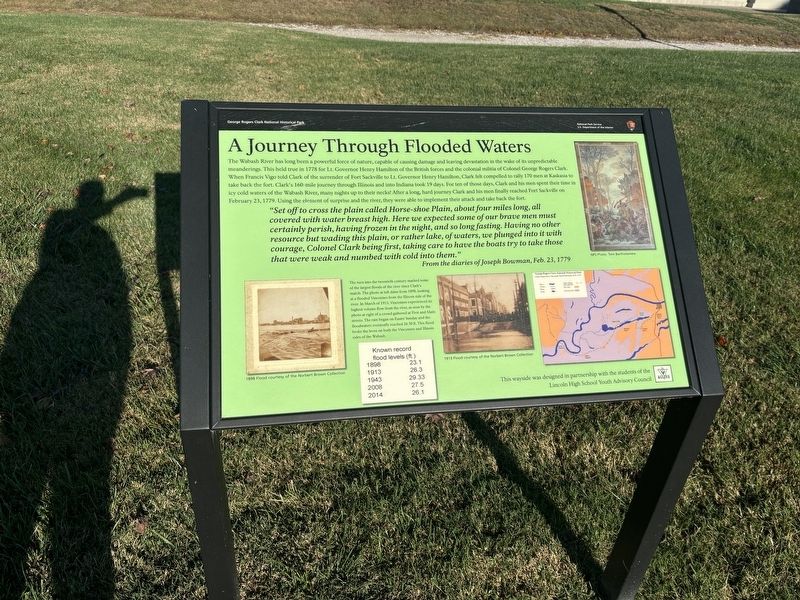
A Journey Through Flooded Waters
Photographed by Connor Olson, November 2, 2024
1. A Journey Through Flooded Waters Marker
"Set off to cross the plain called Horse-shoe Plain, about four miles long, all covered with water breast high. Here we expected some of our brave men must certainly perish, having frozen in the night, and so long fasting. Having no other resource but wading this plain, or rather lake, of waters, we plunged into it with courage, Colonel Clark being first, taking care to have the boats try to take those that were weak and numbed with cold into them."
From
this page online
Captions:
1898 Flood courtesy of the Norbert Brown Collection
The turn into the twentieth century marked some of the largest floods of the river since Clark's march. The photo at left dates from 1898, looking at a flooded Vincennes from the Illinois side of the river. In March of 1913, Vincennes experienced its highest volume flow from the river, as seen by the photo at right of a crowd gathered at First and Main streets. The rain began on Easter Sunday and the floodwaters eventually reached 26.30 ft. This flood broke the levee on both the Vincennes and Illinois sides of the Wabash.
1913 Flood courtesy of the Norbert Brown Collection
Erected by National Park Service; Lincoln High School Youth Advisory Council.
Topics. This historical marker is listed in these topic lists: Disasters • War, US Revolutionary • Waterways & Vessels. A significant historical date for this entry is February 23, 1779.
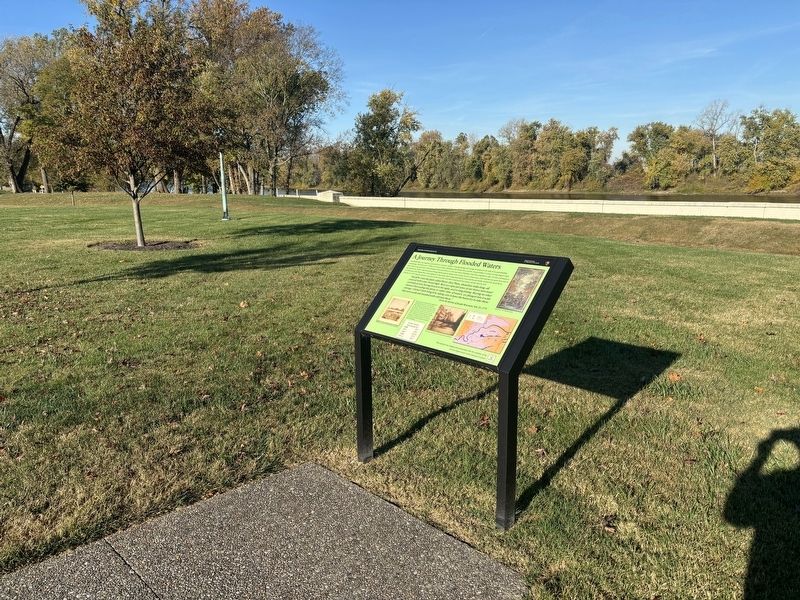
Location. 38° 40.748′ N, 87° 32.182′ W. Marker is in Vincennes, Indiana, in Knox County. It can be reached from South 2nd Street. The marker is located in George Rogers Clark National Historical
Photographed by Connor Olson, November 2, 2024
2. A Journey Through Flooded Waters Marker

Regionally, this marker is in the Tri-State Region, in Southern Indiana, and in the Wabash Valley. It is also in the American Midwest and in the Corn Belt. Globally, it is in North America, the Western Hemisphere, the Western World, and the Anglosphere. Historically, it finds itself in what was once the Viceroyalty of New France, the territory of the Mississippian Culture, and the Northwest Territory.
Other nearby markers. At least 8 other markers are within walking distance of this marker: The Wabash River (within shouting distance of this marker); The Northwest Ordinance of 1787 (within shouting distance of this marker); Clark after Vincennes (within shouting distance of this marker); The George Rogers Clark Memorial (within shouting distance of this marker); Francis Vigo (within shouting distance of this marker); Site of Fort Sackville (about 300 feet away, measured in a direct line); Fort Sackville (about 300 feet away); The American Revolution on the Frontier (about 400 feet away). Touch for a list and map of all markers in Vincennes.
Another marker is no longer nearby. Fort Sackville in 1779 (was about 300 feet away but has been permanently removed).
Credits. This page was last revised on November 22, 2024. It was originally submitted on November 5, 2024, by Connor Olson of Menomonee Falls, Wisconsin. This page has been viewed 192 times since then and 32 times this year. Photos: 1, 2. submitted on November 5, 2024, by Connor Olson of Menomonee Falls, Wisconsin. • Andrew Ruppenstein was the editor who published this page.
