South End in Halifax in Halifax Region, Nova Scotia — The Atlantic Provinces (North America)
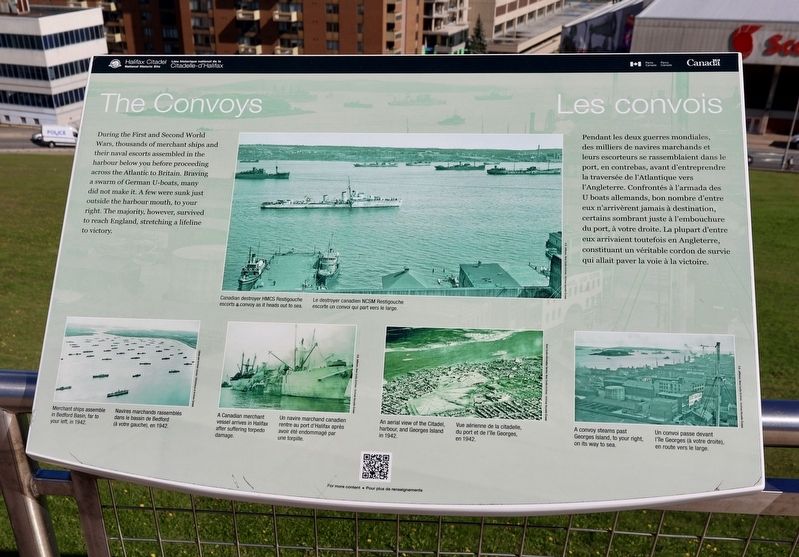
The Convoys
⎯⎯⎯
Les convois
Halifax Citadel National Historic Site/Lieu historique national de la Citadelle-d'Halifax
Photographed by Sandra Hughes Tidwell, October 15, 2024
1. The Convoys / Les convois Marker

Captions: Canadian destroyer HCS Restigouche escorts a convoy as it heads out to sea.
Le destroyer canadien NCSM Restigouche escorte un convoi qui part vers le large.
Merchant ships assembled in Bedford Basin, far to your left, in 1942.
Naviers marchands rassemble`s dans le bassin de Bedford (a` voter gauche), en 1942.
A Canadian
this page online
Un navire Marchand canadien rentre au port d'Halifax aprés avoir été endommagé par une torpille.
An aerial view of the Citadel, harbour, and Georges Island in 1942.
Vue aérienne de la citadelle, du port et de l’île Georrges en 1942.
A convoy steams past Georges Island to your right on its way to sea.
Un convoi passe devant l’île Georges (à voter droite), en route vers la large.
Erected by Parks Canada.
Topics. This historical marker is listed in these topic lists: War, World I • War, World II • Waterways & Vessels. A significant historical year for this entry is 1942.
Location. 44° 38.864′ N, 63° 34.733′ W. Marker is in Halifax, Nova Scotia, in Halifax Region. It is in South End. It is on Ta13 Road. This marker is located at the front entrance of the Citadel. Touch for map. Marker is at or near this postal address: Ta13 Road, Halifax NS B3J 3Y3, Canada. Touch for directions.

Regionally, this marker is in the Maritimes and in Atlantic Canada. Globally, it is in the North Atlantic Region, North America, the Western Hemisphere,
Photographed by Sandra Hughes Tidwell, October 15, 2024
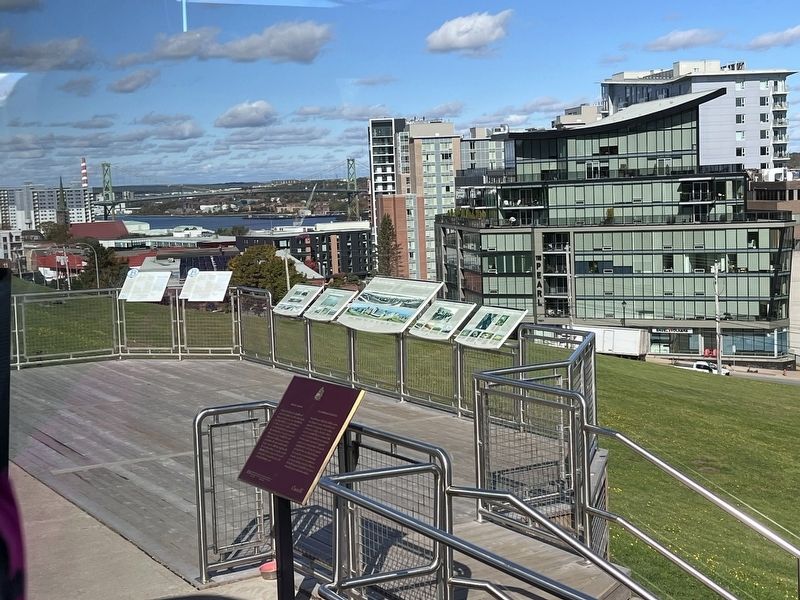
2. The Convoys/Les convois Marker
Other nearby markers. At least 8 other markers are within walking distance of this marker: The Saluting Battery / La batterie de salut (here, next to this marker); The Acadians on George Island / Les Acadiens sur l'Île Georges (here, next to this marker); Fortress Halifax/La forteresse Halifax (here, next to this marker); The Jamaican Maroons/Les Marrons de la Jamaique (here, next to this marker); The Halifax Explosion/L'explosion d'Halifax (a few steps from this marker); Citadel Hill/La Colline de la Citadelle/Kuowaqe'jk (a few steps from this marker); Halifax Citadel / La Citadelle d’Halifax (within shouting distance of this marker); D-Day/Jour J (within shouting distance of this marker). Touch for a list and map of all markers in Halifax.
Also see . . . U-boat. When the US entered the war, the focus of U-boat operations shifted to the Atlantic coast of the United States and Canada, where no convoys were organized and anti-submarine measures were inadequate. There followed a Second Happy Time when U-boats could extend their successful operation to the Gulf of Mexico and the Caribbean Sea.[45] By mid 1942 an adequate defense was organized in these regions and then U-boats returned to their original and crucial hunting grounds on the North Atlantic convoy lanes.[46] The renewed offensive against convoys reached its climax in March 1943, when two-thirds of all ships sunk, were ships sailing in convoys.[47] But the Allies put effective countermeasures into effect and only two months later on 24 May Dönitz had to stop the campaign due to heavy losses.[48] (Submitted on November 6, 2024, by Sandra Hughes Tidwell of Killen, Alabama, USA.)
Credits. This page was last revised on November 19, 2024. It was originally submitted on November 6, 2024, by Sandra Hughes Tidwell of Killen, Alabama, USA. This page has been viewed 181 times since then and 43 times this year. Photos: 1, 2. submitted on November 6, 2024, by Sandra Hughes Tidwell of Killen, Alabama, USA. • Andrew Ruppenstein was the editor who published this page.
