
Downtown Halifax in Halifax Region, Nova Scotia — The Atlantic Provinces (North America)
from Barometer Rising
by Hugh MacLenna
| — | Project Bookmark Canada/Read It Here | — |
Photographed by Sandra Hughes Tidwell, October 15, 2024
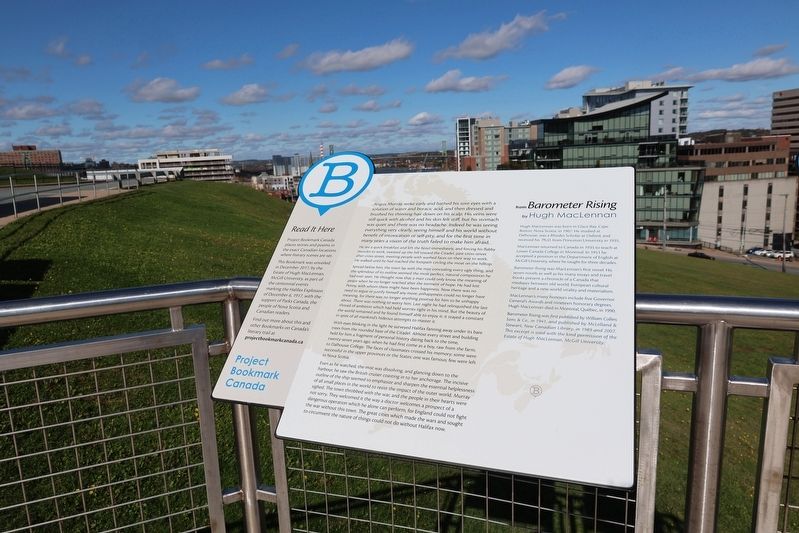
1. from Barometer Rising Marker
Read it Here
Project Bookmark Canada
places stories and poems in the exact Canadian locations where literary scenes are set.
This bookmark was unveiled in December 2017, by the Estate of Hugh MacLennan, McGill University, as part of the centennial events marking the Halifax Explosion of December 7, 1917, with the support of Parks Canada the people of Nova Scotia and Canadian readers.
Find out more about this and other Bookmarks on Canada's literary trail at projectbookmarkcanada.co. Project Bookmark Canada
Hugh MacLennan was born in Glace Bay, Cape Brenton, Nova Scotia, in 1907. He studied at Dalhousie, was a Rhode Scholar at Oxford, and received his Ph. D from Princeton University in 1935.
MacLennan returned to Canada in 1935 to teach at Lower Canada College in Montreal. In 1951 he accepted a position in the Department of English at McGill University, where he taught for three decades.
Barometer Rising was MacLennan's first novel. His seven novels as well as his many essays and travel books present a chronicle of a Canda that mediates between the old world, European cultural heritage and a new world,
this page online
MacLennan's many honors include five Governor General's Awards and nineteen honorary degrees. Hugh MacLennan died in Montreal, in 1990.
Barometer Rising was first published by William Collins Son & Co., in 1941, and published by McLelland & Stewart, New Canadian Library, in 1989 and 2007. this excerpt is used with the kind permission of the Estate of Hugh MacLennan, McGill University.
Angus Murray woke early and bathed his sore eye with a solution of water and boracic acid, and then dressed and brushed his thinning hair down on his scalp. His veins were still quick with alcohol and his skin felt stiff, but his stomach was quiet and there was no headache. Indeed he was seeing everything very clearly, seeing himself and his world without the benefit of intoxication or self-pity, and for the first time in many years a vision of the truth failed to make him afraid.
He ate a quick breakfast and left the hotel immediately, and forcing his flabby muscles to work, sweated up the hill toward the Citadel, past cross street after cross street, meeting people
Photographed by Sandra Hughes Tidwell, October 15, 2024
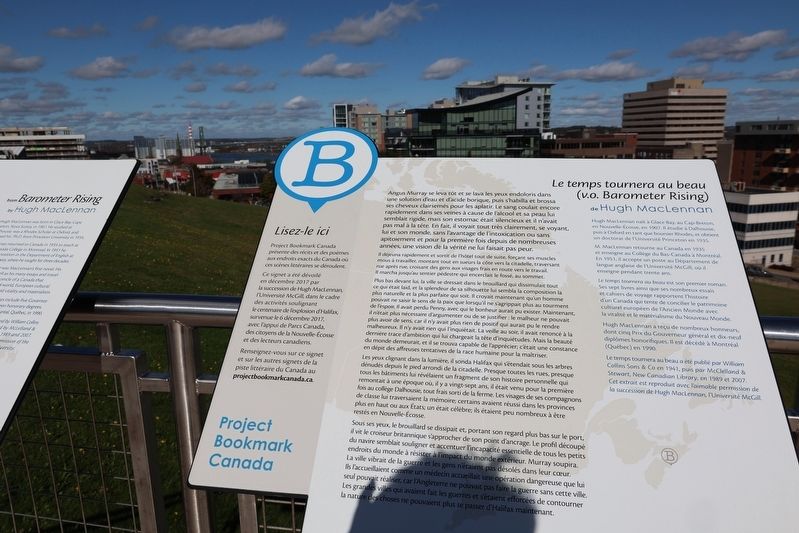
2. French Version:rom Barometer Rising Marker
Spread below him, the town lay with the mist concealing every ugly thing, and the splendor of its outline seemed the most perfect, natural composition he had ever seen. He thought now that a man could only know the meaning of peach when he no longer reached after the torment of hope. He had lost Penny, with whom there might have been happiness. Now there was no need to argue or justify himself anymore: unhappiness could no longer have meaning, for there was no longer anything positive for him to be unhappy about. There was nothing to worry him. Last night he had relinquished the last thread of ambition which had held worries tight in his mind. But the beauty of the world remained and he found himself able to enjoy it; it stayed a constant in spite of all Makind's hideous attempts to master it.
With eyes blinking in the light he surveyed Halifax fanning away under its bare trees from the rounded base of the Cidatel. Almost every street and building held for him a fragment of personal history dating back to the
Photographed by Sandra Hughes Tidwell, October 15, 2024
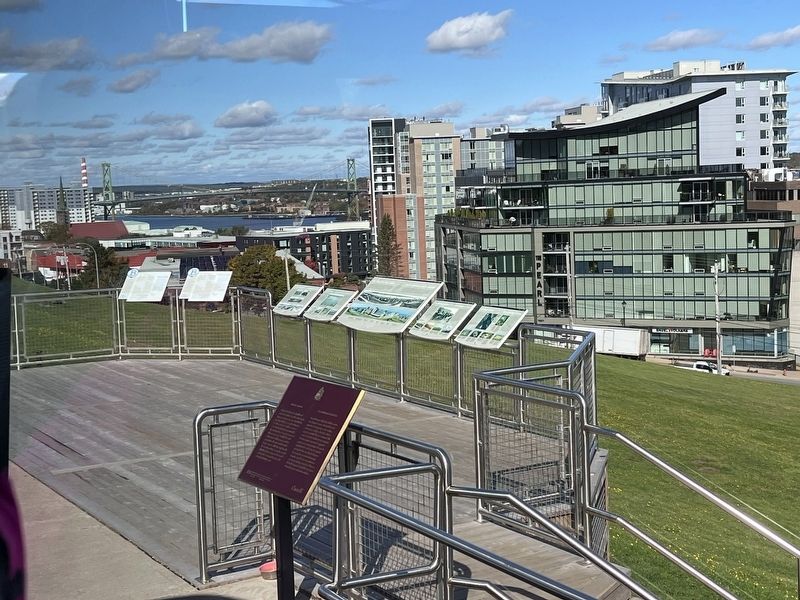
3. from Barometer Rising Marker
Even as he watched, the mist was dissolving, and glancing down to the harbour, he saw the British cruiser coasting into her anchorage. The incisive outline of the ship seemed to emphasize and sharpen the essential helplessness of all small places in the world to resist the impact of the outer world. Murray sighed. The town throbbed with the war, and the people in their hearts were not sorry. They welcomed it the way a doctor welcomes the prospect of a dangerous operation which he alone can perform, for England could not fight the war without this town. The great cities which made the wars and sought to circumvent the nature of things could not do without Halifax now.
Topics. This historical marker is listed in these topic lists: Disasters • Waterways & Vessels. A significant historical month for this entry is December 2017.
Location. 44° 38.853′ N, 63° 34.808′ W. Marker is in Halifax, Nova Scotia, in Halifax Region. It is in Downtown Halifax. It is on Sackville Street. This marker is located at the front entrance of the Citadel. Touch for map. Marker is in this post office area: Halifax NS B3J 3Y3, Canada. Touch for directions.

Regionally, this marker is in the Maritimes and in Atlantic Canada. Globally, it is in the North Atlantic Region, North America, the Western Hemisphere, the Western World, and the Anglosphere. Historically, it finds itself in what was once a British colony, the Viceroyalty of New France, and Acadia.
Other nearby markers. At least 8 other markers are within walking distance of this marker: The View from the Citadel / Le panorama vu de la citadelle (within shouting distance of this marker); The Halifax Explosion/L'explosion d'Halifax (about 90 meters away, measured in a direct line); The Jamaican Maroons/Les Marrons de la Jamaique (about 90 meters away); Halifax Citadel / La Citadelle d’Halifax (about 90 meters away); Citadel Hill/La Colline de la Citadelle/Kuowaqe'jk (about 90 meters away); The Saluting Battery / La batterie de salut (about 90 meters away); The Convoys / Les convois (about 90 meters away); Fortress Halifax/La forteresse Halifax (about 90 meters away). Touch for a list and map of all markers in Halifax.
Credits. This page was last revised on March 13, 2025. It was originally submitted on November 6, 2024, by Sandra Hughes Tidwell of Killen, Alabama, USA. This page has been viewed 223 times since then and 12 times this year. Photos: 1, 2, 3. submitted on November 6, 2024, by Sandra Hughes Tidwell of Killen, Alabama, USA. • Bill Pfingsten was the editor who published this page.
