West Town in Chicago in Cook County, Illinois — The American Midwest (Great Lakes)
East Village
Chicago Landmark District
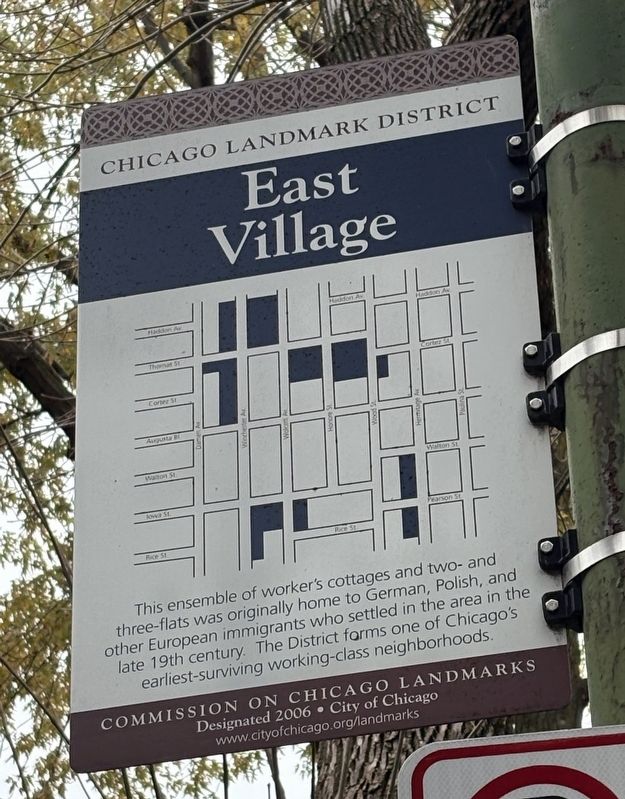
Photographed by Sean P. Flynn, November 6, 2024
1. East Village Marker
Erected by Commission on Chicago Landmarks; City of Chicago.
Topics and series. This historical marker is listed in these topic lists: Architecture • Immigration. In addition, it is included in the Illinois, Chicago Landmarks Commission, and the National Register of Historic Places (NRHP) series lists. A significant historical year for this entry is 1883.
Location. 41° 53.812′ N, 87° 40.558′ W. Marker is in Chicago, Illinois, in Cook County. It is in West Town. It is on Winchester Avenue north of Chicago Avenue, on the left when traveling north. The marker is on a lamppost on the left (west) side of the street. Touch for map. Marker is at or near this postal address: 832 North Winchester Avenue, Chicago IL 60622, United States of America. Touch for directions.

Regionally, this marker is on Chicago’s West Side. It is also in the American Midwest. Globally,
this page online
Other nearby markers. At least 8 other markers are within walking distance of this marker: Ukrainian Village (approx. ¼ mile away); a different marker also named Ukrainian Village (approx. ¼ mile away); a different marker also named Ukrainian Village (approx. ¼ mile away); a different marker also named East Village (approx. 0.3 miles away); a different marker also named Ukrainian Village (approx. 0.3 miles away); a different marker also named Ukrainian Village (approx. 0.3 miles away); 1036 North Hoyne Avenue (approx. 0.3 miles away); a different marker also named Ukrainian Village (approx. 0.3 miles away). Touch for a list and map of all markers in Chicago.
More about this marker. The sign includes a map of the East Village Historic District. Per this style of Chicago Landmark District marker, both sides have identical text.
Regarding East Village. The
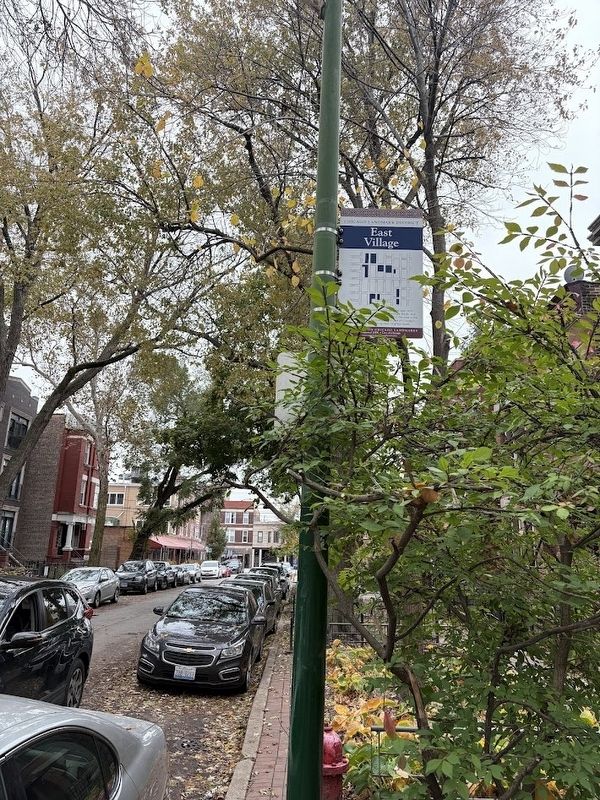
Photographed by Sean P. Flynn, November 6, 2024
2. East Village Marker
Also see . . .
1. Chicago Landmark Designation Report: East Village. A 2005 report by the City of Chicago about the East Village neighborhood. (Submitted on November 7, 2024, by Sean P. Flynn of Oak Park, Illinois.)
2. Neighborhoods.com: East Village.
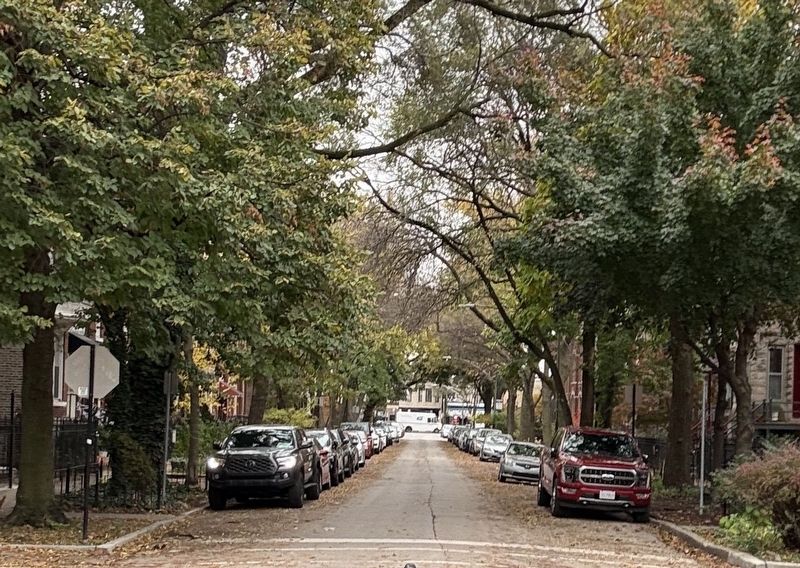
Excerpt: "This tiny neighborhood is a residential haven, outlined by the bustling streets it shares with its neighbors. While Division Street may be known for bars and restaurants and Chicago Avenue is home to trendy nightclubs and local eateries, the less-than-a-mile stretch of streets between them are celebrated for their relative peace and quiet. The neighborhood has maintained its distinction in the West area thanks to the unique offerings of its local businesses(Submitted on November 7, 2024, by Sean P. Flynn of Oak Park, Illinois.)and its proliferation of single family homes and attached condos. Sandwiched between Noble Square, Ukrainian Village, West Town, and Wicker Park, East Village is the perfect launching pad for those looking to explore the West's trendier neighborhoods while still carving out a distinct place to call home."Photographed by Sean P. Flynn, November 6, 20243. Winchester AvenueThe East Village Marker can be seen about halfway down the block.
3. Hanna and Mrowka v. City of Chicago: A Long-Awaited Victory for Chicago’s Landmarks Ordinance. Landmarks Illinois, a historic preservation advocacy organization, looks at litigation by East Village property owners against the constitutionality of the Chicago Landmarks Ordinance. In 2025, the Illinois Supreme Court rejected the property owners' claims, leaving the ordinance intact.
Excerpt: "In 2006, the City of Chicago adopted the East Village Historic District in West Town. The Arlington-Deming Historic District, a four-block historic district in Chicago’s Lincoln Park neighborhood, followed in 2007. Both districts are largely residential and reflect Chicago’s growth during the late 19th and early 20th centuries. Albert C. Hanna and Carol Mrowka, who owned properties in these districts, sued the city, arguing that the Landmarks Ordinance was unconstitutionally vague, leaving landmark designation subject to misapplication. They also argued that the ordinance improperly delegated the authority of Chicago’s City Council to the Commission on Chicago Landmarks and that it violated their substantive due process and equal protection rights by designating some areas of the city as historic districts while not designating other areas with similar characteristics. Ultimately, the court rejected all of these claims."(Submitted on January 27, 2026, by Sean P. Flynn of Oak Park, Illinois.)
Credits. This page was last revised on January 27, 2026. It was originally submitted on November 7, 2024, by Sean P. Flynn of Oak Park, Illinois. This page has been viewed 344 times since then and 56 times this year. Photos: 1, 2, 3. submitted on November 7, 2024, by Sean P. Flynn of Oak Park, Illinois.
