
Weststadt in Nürnberg, Bavaria, Germany — Central Europe
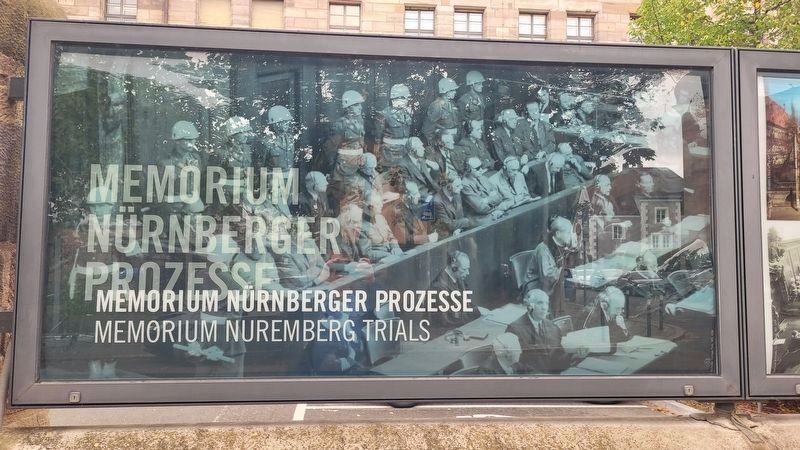
Memorium Nürnberger Prozesse
⎯⎯⎯
Memorium Nuremberg Trials
Photographed by James Hulse, September 30, 2024
1. Memorium Nürnberger Prozesse / Memorium Nuremberg Trials Marker - Left Panel

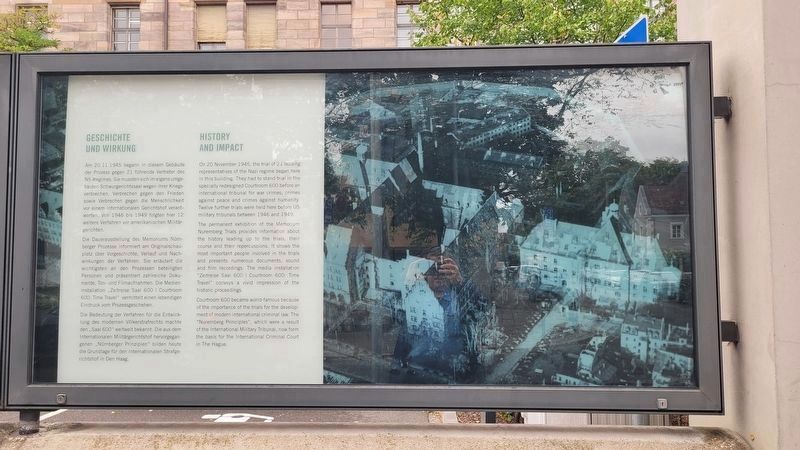
Geschichte und Wirkung
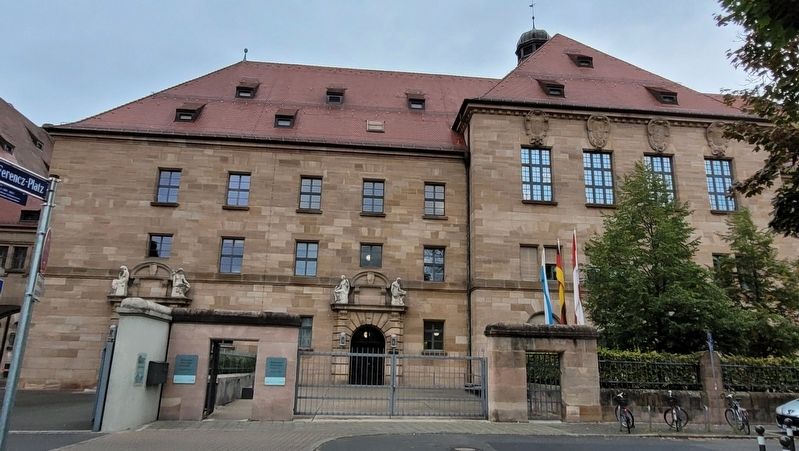
Am 20.11.1945 begann in diesem Gebäude der Prozess gegen 21 führende Vertreter des NS-Regimes. Sie mussten sich im eigens umgebauten Schwurgerichtssaal wegen ihrer Kriegsverbrechen, Verbrechen gegen den Frieden sowie Verbrechen gegen die Menschlichkeit vor einem internationalen Gerichtshof verantworteri. Von 1946 bis 1949 folgten hier 12. weitere Verfahren vor amerikanischen Militärgerichten.
Die Daverausstellung des Memoriums Nürnberger Prozesse Informiert am Originalschauplatz über Vorgeschichte, Verlauf und Nachwirkungen der Verfahren. Sie erläutert die wichtigsten an den Prozessen beteiligten Personen und präsentiert zahlreiche Dokumente, Ton- und Filmaufnahmen. Die Medieninstallation Zeitreise Saal 600 | Courtroom. 600: Time Travel" vermittelt einen lebendigen Eindruck vom Prozessgeschehen,
Die Bedeutung der Verfahren für die Entwicklung des modernen Völkerstrafrechts machte den, Saal 600" weltweit bekannt. Die aus dem Internationalen Militärgerichtshof hervorgegangenen Nürnberger Prinzipien" bilden heute die Grundlage für den Internationalen Strafgerichtshof in Den Haag.
History and Impact
On
this page online
The permanent exhibition of the Memorium Nuremberg Trials provides information about the history leading up to the trials, their course and their repercussions. It shows the most important people involved in the trials and presents numerous documents, sound and film recordings. The media installation "Zeitreise Saal 600 Courtroom 600: Time Travel" conveys a vivid impression of the historic proceedings.
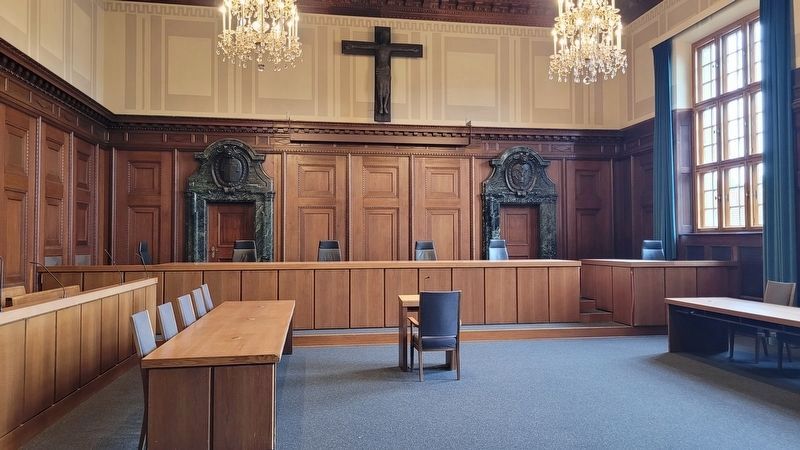
Courtroom 600 became world-famous because of the importance of the trials for the development of modern international criminal law. The "Nuremberg Principles", which were a result of the International Military Tribunal, now form the basis for the International Criminal Court in The Hague.
Erected by Museen der Stadt Nürnberg and Memorium Nürnberger Prozesse.
Topics.
Photographed by James Hulse, September 30, 2024
2. Memorium Nürnberger Prozesse / Memorium Nuremberg Trials Marker - Right Panel
Location. 49° 27.251′ N, 11° 2.865′ E. Marker is in Nürnberg, Bayern (Bavaria). It is in Weststadt. It is at the intersection of Bärenschanzstraße and Benjamin-Ferencz-Platz, on the left when traveling north on Bärenschanzstraße. The marker is located outside the gate to the courthouse. Touch for map. Marker is at or near this postal address: Bärenschanzstraße 72, Nürnberg BY 90429, Germany. Touch for directions.

Regionally, this marker is in German Franconia. Globally, it is in Europe, the European Union, Atlantic Europe, Central Europe, the Schengen Area, Western Europe, and the Western World. Historically, it finds itself in what was once the Holy Roman Empire and also the former West Germany.
Other nearby markers. At least 8 other markers are within 3 kilometers of this marker, measured as the crow flies: St. Elisabeth kath. Pfarrkirche / St. Elisabeth Catholic Parish Church (approx. 1.6 kilometers away); Evang.-Luth. Kirche St. Jakob / Evangelical Lutheran Church of St. James (approx.

Photographed by James Hulse, September 30, 2024
3. Memorium Nürnberger Prozesse / Memorium Nuremberg Trials Marker - Middle Panel
Also see . . . Nuremberg trials. Wikipedia
The Nuremberg trials were held by the Allies against representatives of the defeated Nazi Germany for plotting and carrying out invasions of other countries across Europe and atrocities against their citizens in World War II.(Submitted on November 9, 2024, by James Hulse of Medina, Texas.)
Between 1939 and 1945, Nazi Germany invaded many countries across Europe, inflicting 27 million deaths in the Soviet Union alone. Proposals for how to punish the defeated Nazi leaders ranged from a show trial (the Soviet Union) to summary executions (the United Kingdom). In mid-1945, France, the Soviet Union, the United Kingdom, and the United States agreed toconvene a joint tribunal in Nuremberg, occupied Germany, with the Nuremberg Charter as its legal instrument. Between 20 November 1945 and 1 October 1946, the International Military Tribunal (IMT) tried 22 of the most important surviving leaders of Nazi Germany in the political, military, and economic spheres, as well as six German organizations. The purpose of the trial was not just to convict the defendants but also to assemble irrefutable evidence of Nazi crimes, offer a history lesson to the defeated Germans, and delegitimize the traditional German elite.Photographed by James Hulse, September 30, 20244. The view of the markers in front of the courthouse

Photographed by James Hulse, September 30, 2024
5. The Nuremberg Trials Courthouse
Photographed by James Hulse, September 30, 2024
6. The inside view of the Nuremberg Trials “Courtroom 600”
Credits. This page was last revised on November 9, 2024. It was originally submitted on November 9, 2024, by James Hulse of Medina, Texas. This page has been viewed 202 times since then and 29 times this year. Photos: 1, 2, 3, 4, 5, 6. submitted on November 9, 2024, by James Hulse of Medina, Texas.
