Penn's Landing in Philadelphia in Philadelphia County, Pennsylvania — The American Northeast (Mid-Atlantic)
The Pennsylvania Slave Trade
Photographed by Cosmos Mariner, June 27, 2019
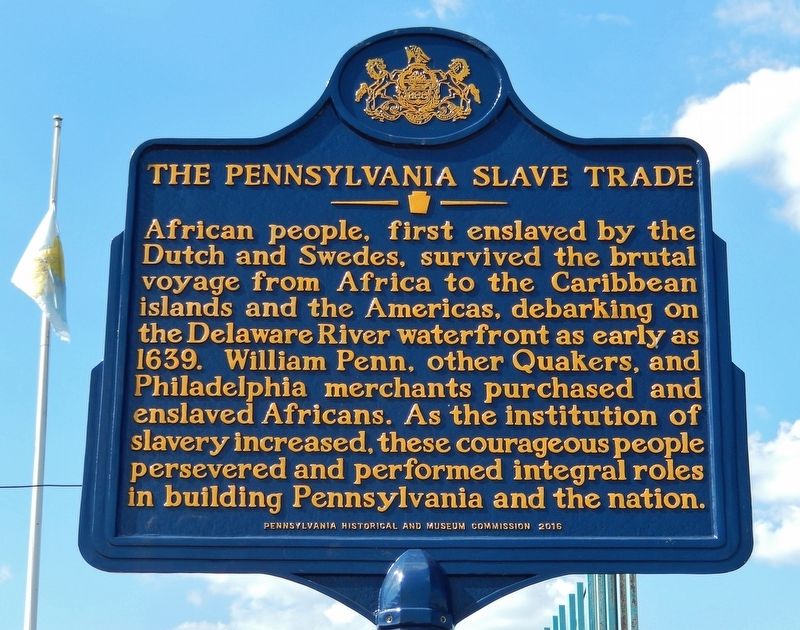
1. The Pennsylvania Slave Trade Marker
African people, first enslaved by the Dutch and Swedes, survived the brutal voyage from Africa to the Caribbean islands and the Americas, debarking on the Delaware River waterfront as early as 1639. William Penn, other Quakers, and Philadelphia merchants purchased and enslaved Africans. As the institution of slavery increased, these courageous people persevered and performed integral roles in building Pennsylvania and the nation.
Erected 2016 by Pennsylvania Historical and Museum Commission.
Topics and series. This historical marker is listed in these topic lists: African Americans • Colonial Era • Industry & Commerce. In addition, it is included in the Pennsylvania Historical and Museum Commission (PHMC), and the Quakerism series lists. A significant historical year for this entry is 1639.
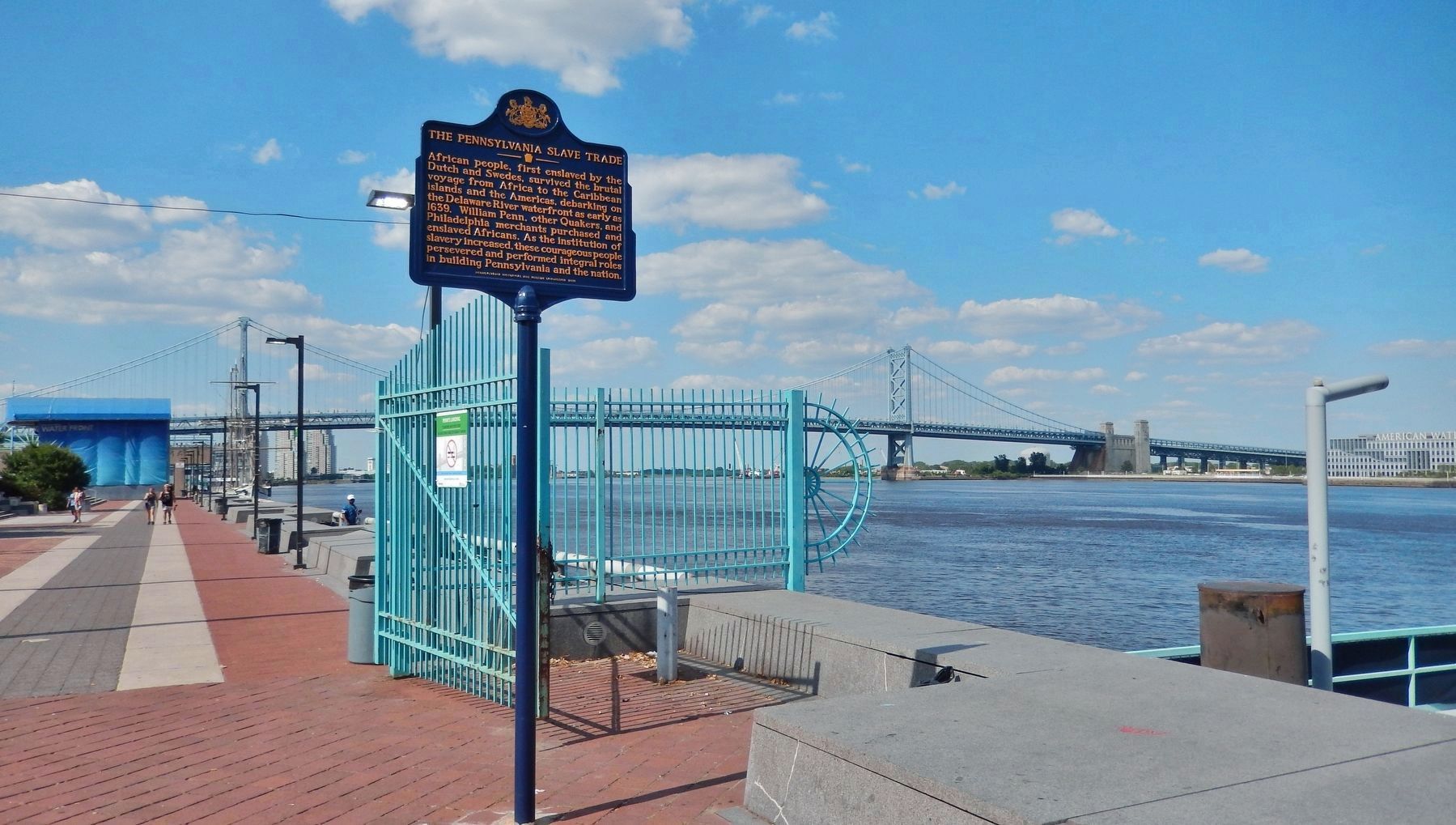
Location. 39° 56.779′ N, 75° 8.388′ W. Marker is in Philadelphia, Pennsylvania, in Philadelphia County. It is in Penn's Landing. It can be reached from South Christopher Columbus Boulevard near Chestnut Street, on the right when traveling north. The marker stands along the Penn's Landing Historic walk on the waterfront
this page online

Regionally, this marker is in Southeast Pennsylvania. It is also in the American Northeast and in the Mid-Atlantic. Globally, it is in North America, the Western Hemisphere, the Western World, and the Anglosphere. Historically, it finds itself in what was once the Haudenosaunee (Iroquois) Confederacy, New Netherland, and one of the original Thirteen Colonies.
Other nearby markers. At least 8 other markers are within walking distance of this marker: Glomar Explorer (within shouting distance of this marker); Pennsylvania Nautical School & Pennsylvania Maritime Academy, 1889 - 1947 (within shouting distance of this marker); William Penn's Philadelphia (within shouting distance of this marker); The Liberation of Jane Johnson (within shouting distance of this marker); Philadelphia Firsts (within shouting distance of this marker); 1702 (within shouting distance of this marker); The Growth of the City / The Trees of the City
Photographed by Cosmos Mariner, June 27, 2019
2. Pennsylvania Slave Trade Marker (Delaware River & Ben Franklin Bridge in background to north)
Also see . . .
1. Slavery in Pennsylvania. William Penn was granted his colony in Pennsylvania in 1681. Though he flooded the "Holy Experiment" with Quakers whose descendants would later find their faith incompatible with slaveholding, the original Quakers had no qualms about it. Penn himself owned slaves, and used them to work his estate, Pennsbury. In Penn's new city of Philadelphia, African slaves were at work by 1684, and in rural Chester County by 1687. Between 1729 and 1758, Chester County had 104 slaves on 58 farms, with 70 percent of the slaveowners likely Quakers. (Submitted on June 28, 2019, by Cosmos Mariner of Cape Canaveral, Florida.)
2. How and where human beings were bought, sold and owned in Center City Philadelphia. (Submitted on June 28, 2019, by Cosmos Mariner of Cape Canaveral, Florida.)
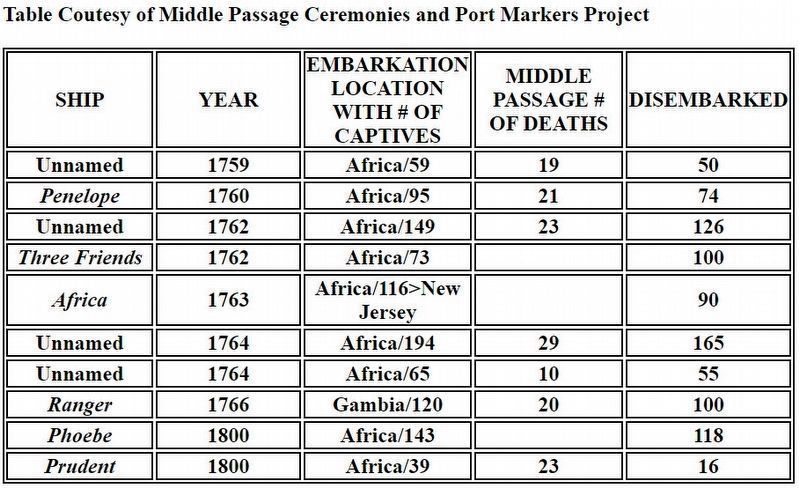
3. Middle Passage Ceremonies and Port Markers Project. (Submitted on March 30, 2020, by John Bloomfield of Palm Coast, Florida.)
Additional commentary.
1. Middle
Photographed by John Bloomfield
3. Table - Courtesy of Middle Passage Ceremonies Port Markers Project
Serving as a major mid-Atlantic commercial and shipping center, the city of “Brotherly Love” supplied enslaved Africans locally and to neighboring states – Delaware and New Jersey. Philadelphia has the distinguished status of being the first of the former U.S. state capitals to publicly acknowledge its role in Middle Passage history with a marker. Because of its Quaker population, the gradual abolition of slavery in Pennsylvania was enacted in 1780.
There are several places of note related to people of African descent:
• Mother Bethel African Methodist Episcopal (A.M.E) Church founded by Richard Allen (1794)
erected on the oldest parcel of land continuously owned by African Americans in the U.S.;
• The nation’s first major museum of African American history – The African American Museum (1976);
• The Philadelphia Tribune - oldest daily newspaper serving the African American community;
• First statue representing an African American on public property;
• African Episcopal Church of St. Thomas, the nation’s first Black Episcopal church, founded in 1792 by Bishop Absolom Jones.
The transatlantic human trade marker was installed in 2015 at historic Penn’s Landing (near Independence Seaport Museum) where the exhibit Tides of Freedom: African Presence on the Delaware River illustrates the 300-year story of the Middle Passage, enslavement, emancipation, Jim Crow, and civil rights with artifacts, documents, and first-person accounts.
— Submitted March 30, 2020, by John Bloomfield of Palm Coast, Florida.
Additional keywords. Middle Passage; Middle Passage Ceremonies and Port Markers Project; human trafficking; Trans-Atlantic Trade; UNESCO Routes of Enslaved Peoples (Slave Route Project); UNESCO Site of Memory; International Coalition Site of Conscience
Credits. This page was last revised on April 27, 2026. It was originally submitted on June 28, 2019, by Cosmos Mariner of Cape Canaveral, Florida. This page has been viewed 1,639 times since then and 185 times this year. Last updated on April 27, 2026, by Kaycee Hailey of Charlotte, North Carolina. Photos: 1, 2. submitted on June 28, 2019, by Cosmos Mariner of Cape Canaveral, Florida. 3. submitted on March 30, 2020, by John Bloomfield of Palm Coast, Florida. • Devry Becker Jones was the editor who published this page.
