Tuscumbia in Colbert County, Alabama — The American South (East South Central)
Engagement at Little Bear Creek
October 26-27, 1863
Photographed by Billy Clemmons, November 9, 2024
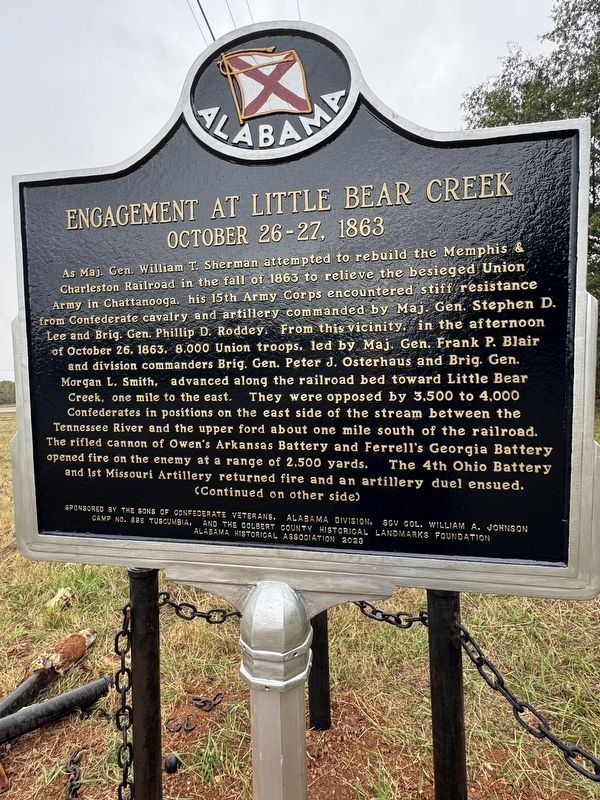
1. Engagement at Bear Creek marker (side 1)
As Maj. Gen. William T. Sherman attempted to rebuild the Memphis & Charleston Railroad in the fall of 1863 to relieve the besieged Union Army in Chattanooga, his 15th Army Corps encountered stiff resistance from Confederate cavalry and artillery commanded by Maj. Gen. Stephen D. Lee and Brig. Gen. Phillip D. Roddey. From this vicinity, in the afternoon of October 26, 1863, 8,000 Union troops, led by Maj. Gen. Frank P. Blair and division commanders Brig. Gen. Peter J. Osterhaus and Brig. Gen. Morgan L. Smith, advanced along the railroad bed toward Little Bear Creek, one mile to the east. They were opposed by 3,500 to 4,000 Confederates in positions on the east side of the stream between the Tennessee River and the upper ford about one mile south of the railroad. The rifled cannon of Owen's Arkansas Battery and Ferrell's Georgia Battery opened fire on the enemy at a range of 2,500 yards. The 4th Ohio Battery and 1st Missouri Artillery returned fire and an artillery duel ensued.
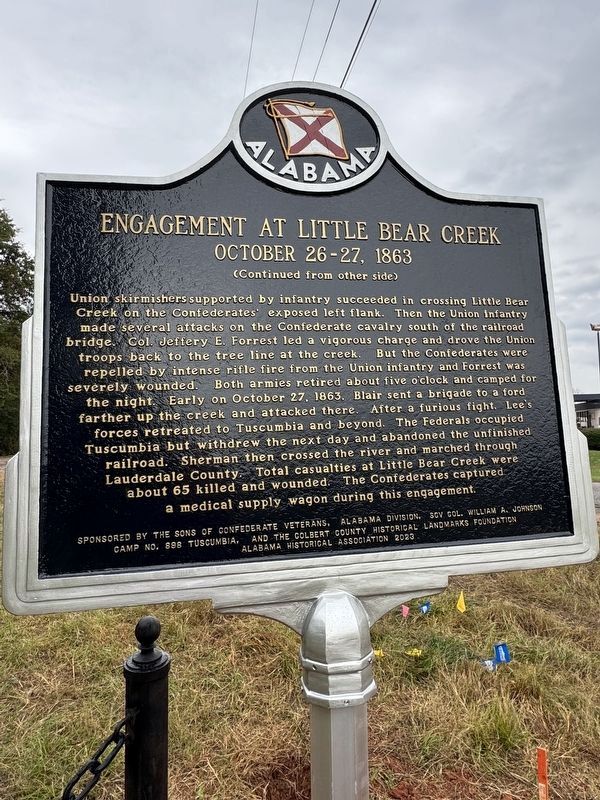
Union skirmishers supported by infantry succeeded in crossing Little Bear Creek on the Confederates' exposed left flank. Then the Union infantry
this page online
Erected 2023 by Sponsored by the Sons of Confederate Veterans, Alabama Division, Camp NO. 898 Tuscumbia, and the Colbert County Historical Landmarks Foundation, Alabama Historical Association.
Topics. This historical marker is listed in this topic list: War, US Civil. A significant historical date for this entry is October 26, 1863.
Location. Marker
Photographed by Billy Clemmons, November 9, 2024
2. Engagement at Little Bear Creek marker (side 2)

Regionally, this marker was in North Alabama and in the Shoals. It was also in the American South, specifically in the Deep South, in Appalachia, and specifically in Southern Appalachia. Globally, it was in North America, a Gulf of Mexico state, the Western Hemisphere, the Western World, and the Anglosphere. Historically, it found itself in what was once the territory of the Mississippian Culture, one of the Confederate States of America, and the Antebellum South.
Other nearby markers. At least 8 other markers are within 3 miles of this location, measured as the crow flies: The Blues Trail: Mississippi to Alabama (approx. 2.2 miles away); U. S. Army M60A3 Main Battle Tank (approx.
Photographed by David Curott, July 23, 2026
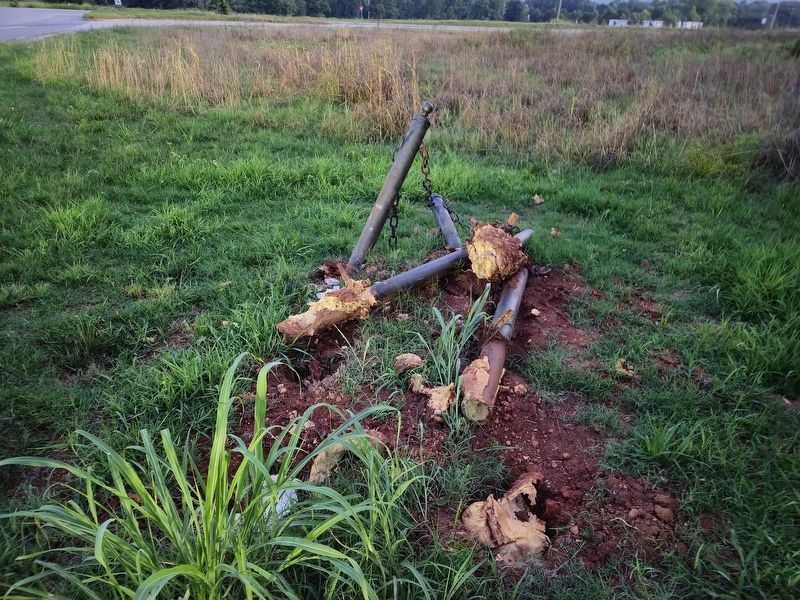
3. Engagement at Little Bear Creek Marker
Missing Marker

Photographed by David Curott, July 23, 2026
4. Area of missing marker
Credits. This page was last revised on August 4, 2026. It was originally submitted on November 9, 2024, by Billy Clemmons of Florence, Alabama. This page has been viewed 1,296 times since then and 165 times this year. Photos: 1, 2. submitted on November 9, 2024, by Billy Clemmons of Florence, Alabama. 3. submitted on July 24, 2026, by David Curott of Florence, Alabama. 4. submitted on July 28, 2026, by David Curott of Florence, Alabama. • Bernard Fisher was the editor who published this page.
