Inwang-dong in Gyeongju, Gyeongsangbuk-do, South Korea — 대한민국 (East Asia, Korean Peninsula)
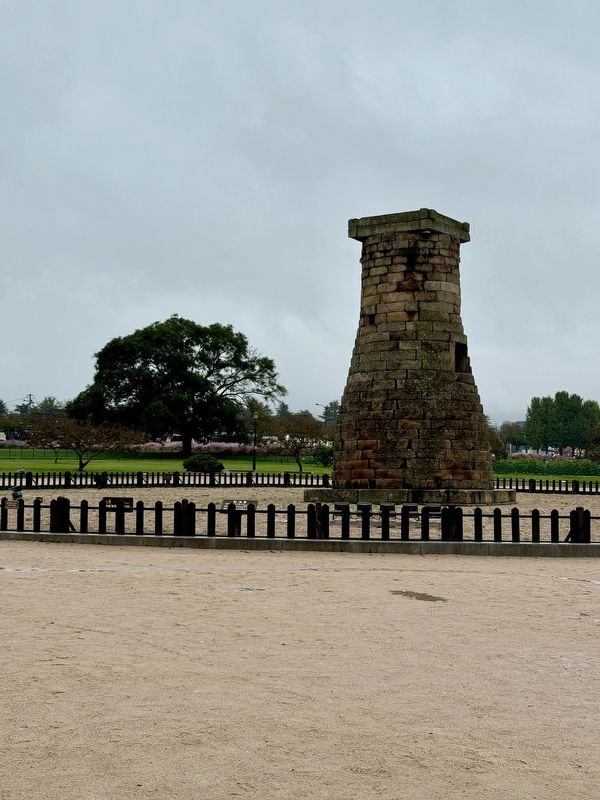
Cheomseongdae Observatory, Gyeongju
경주 첨성대
| — | National Treasure No. 31 | — |

Photographed by Shaw Zavoshy, October 22, 2024
1. Cheomseongdae Observatory, Gyeongju Marker
(Korean text not transcribed)
This stone structure is presumed to have been built during the reign of Queen Seondeok (r. 632-647), the 27th ruler of the Silla kingdom (57 BCE-935 CE). Its name Cheomseongdae means "Platform of Gazing at the Stars,” and it is widely acknowledged to be the oldest surviving astronomical observatory in Asia. In ancient societies, tracking the movement of celestial bodies was of great political importance because astronomical observations served as a guideline for farming as well as a means to foresee the country's fortune.
The structure consists of a square base, a main section, and a top. The main section is made of square-cut stones stacked in 27 tiers which form a curved cylindrical column. On top of this, eight long rectangular stones are stacked in two tiers to create a square frame that resembles the top of a well. Inside, the column is filled with gravel and soil up until the 12th tier of stones, above which it is hollow. There is a square hole on the south side between the 13th and 15th tiers. It is presumed that this hole served as an entrance and was accessed with a ladder,
this page online
Other theories suggest that this structure might have been used as an altar, a religious symbol, or a commemorative monument.
Topics and series. This historical marker is listed in this topic list: Science & Medicine. In addition, it is included in the Astronomical Observatories series list.
Location. 35° 50.074′ N, 129° 13.14′ E. Marker is in Gyeongju, Gyeongsangbuk-do. It is in Inwang-dong. It can be reached from no nearby street. Touch for map. Marker is in this post office area: Gyeongju, Gyeongsangbuk-do 38170, South Korea. Touch for directions.

Regionally, it is in Asia, specifically in East Asia, on the Pacific Rim, and in the Western World.
Also see . . . Cheomseongdae (Wikipedia). Overview:
Cheomseongdae (Korean: 첨성대; Hanja: 瞻星臺; lit. star-gazing tower) is an astronomical observatory in Gyeongju, South Korea. Cheomseongdae is the oldest surviving astronomical observatory in Asia, and possibly even the world. It was(Submitted on November 9, 2024.)constructed in the 7th century in the kingdom of Silla, whose capital was Seorabeol, or present-day Gyeongju (경주). Cheomseongdae was designated as the country's 31st national treasure on December 20, 1962. It forms a UNESCO World Heritage Site along with other Gyeongju Historic Areas.Photographed by Shaw Zavoshy, October 22, 20242. Cheomseongdae Observatory
Modeled on Baekje's Jeomseongdae, which now exists only in historical records, the Cheomseongdae influenced the construction of the Japanese Senseidai (占星台) observatory in 675, and Duke Zhou's observatory in China in 723.
Additional keywords. astronomy
Credits. This page was last revised on June 18, 2026. It was originally submitted on November 9, 2024, by Andrew Ruppenstein of Lamorinda, California. This page has been viewed 286 times since then and 67 times this year. Photos: 1, 2. submitted on November 9, 2024, by Andrew Ruppenstein of Lamorinda, California.
