
Flossenbürg in Neustadt an der Waldnaab, Bavaria, Germany — Central Europe
Konzentrationslager Flossenbürg
⎯⎯⎯
Flossenbürg Concentration Camp
Photographed by James Hulse, September 27, 2024
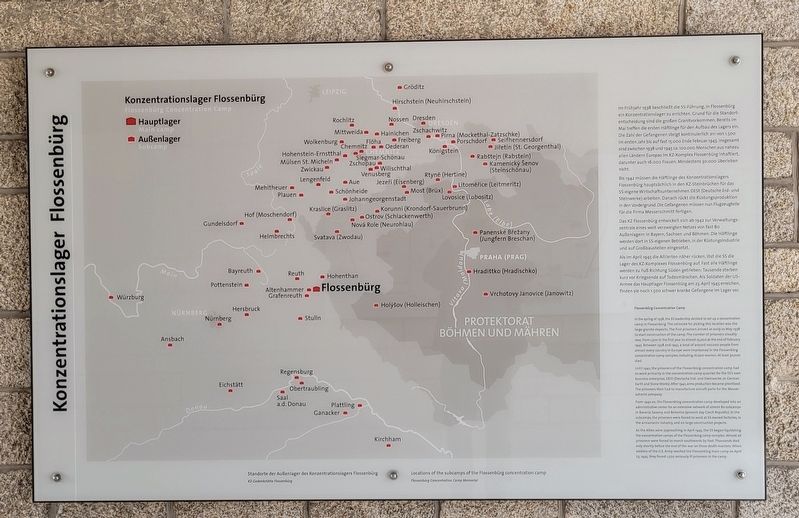
1. Konzentrationslager Flossenbürg / Flossenbürg Concentration Camp Marker

Im Frühjahr 1938 beschließt die SS-Führung, in Flossenbürg ein Konzentrationslager zu errichten. Grund für die Standortentscheidung sind die großen Granitvorkommen. Bereits im Mai treffen die ersten Häftlinge für den Aufbau des Lagers ein. Die Zahl der Gefangenen steigt kontinuierlich an: von 1.500 Im ersten Jahr bis auf fast 15.000 Ende Februar 1945. Insgesamt sind zwischen 1938 und 1945 ca. 100.000 Menschen aus nahezu allen Ländern Europas im KZ-Komplex Flossenbürg inhaftiert, darunter auch 16.000 Frauen. Mindestens 30.000 überleben nicht.
Bis 1942 müssen die Häftlinge des Konzentrationslagers Flossenbürg hauptsächlich in den KZ-Steinbrüchen für das SS-eigene Wirtschaftsunternehmen DESt (Deutsche Erd- und Steinwerke) arbeiten. Danach rückt die Rüstungsproduktion in den Vordergrund. Die Gefangenen müssen nun Flugzeugteile für die Firma Messerschmitt fertigen.
Das KZ Flossenbürg entwickelt sich ab 1942 zur Verwaltungszentrale eines weit verzweigten Netzes von fast 80 Außenlagern in Bayern, Sachsen und Böhmen. Die Häftlinge werden dort in SS-eigenen Betrieben, in der Rüstungsindustrie und auf
this page online
Als im April 1945 die Alliierten näher rücken, löst die SS die Lager des KZ-Komplexes Flossenbürg auf. Fast alle Häftlinge werden zu Fuß Richtung Süden getrieben. Tausende sterben kurz vor Kriegsende auf Todesmärschen. Als Soldaten der US-Armee das Hauptlager Flossenbürg am 23. April 1945 erreichen, finden sie noch 1.500 schwer kranke Gefangene im Lager vor.
Flossenbürg Concentration Camp
In the spring of 1938, the SS leadership decided to set up a concentration camp in Flossenbürg. The rationale for picking this location was the large granite deposits. The first prisoners arrived as early as May 1938 to start construction of the camp. The number of prisoners steadily rose, from 1,500 in the first year to almost 15,000 at the end of February 1945. Between 1938 and 1945, a total of around 100,000 people from almost every country in Europe were imprisoned in the Flossenbürg concentration camp complex, including 16,000 women. At least 30,000 died.
Until 1942, the prisoners of the Flossenbürg concentration camp had to work primarily in the concentration camp quarries for the SS’s own business
Photographed by James Hulse, September 27, 2024
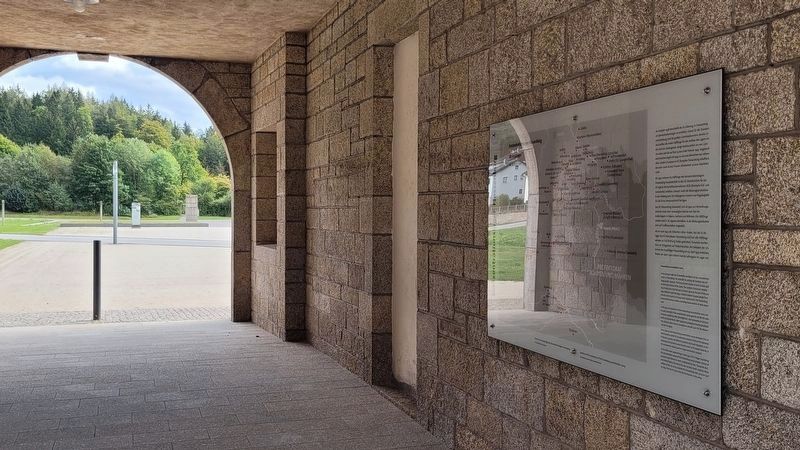
2. The view of the marker in the open tunnel through the building
From 1942 on, the Flossenbürg concentration camp developed into an administrative center for an extensive network of almost 80 subcamps in Bavaria, Saxony, and Bohemia (present-day Czech Republic). In the subcamps, the prisoners were forced to work at SS-owned factories, in the armaments industry, and on large construction projects.
As the Allies were approaching in April 1945, the SS began liquidating the concentration camps of the Flossenbürg camp complex Almost all prisoners were forced to march southwards by foot. Thousands died only shortly before the end of the war on these death marches. When soldiers of the U.S. Army reached the Flossenbürg main camp on April 23, 1945, they found 1,500 seriously ill prisoners in the camp.
Topics and series. This historical marker is listed in these topic lists: Cemeteries & Burial Sites • War, World II. In addition, it is included in the The Holocaust series list. A significant historical month for this entry is February 1945.
Location. 49° 44.178′ N,
Photographed by James Hulse, September 27, 2024
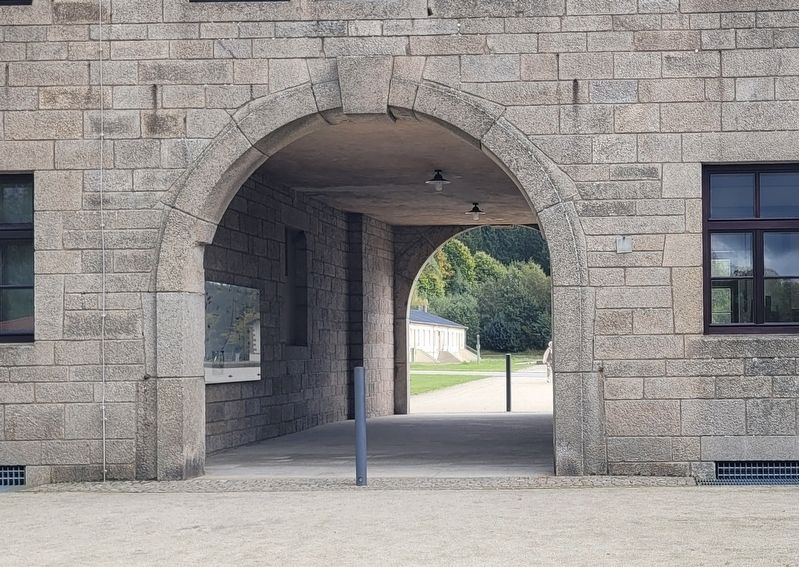
3. Another view of the marker through the building

Regionally, it is in Europe, the European Union, Atlantic Europe, Central Europe, the Schengen Area, Western Europe, and the Western World. Historically, it finds itself in what was once the Holy Roman Empire and also the former West Germany.
Other nearby markers. At least 8 other markers are within walking distance of this marker: Kommandantur / Commandant's Headquarters (within shouting distance of this marker); Lagertor / Camp Gate (within shouting distance of this marker); SS-Wirtschaftsgebäude / SS Utility Building (about 90 meters away, measured in a direct line); Gemeinde Kz-Gedenkstätte / Concentration Camp Memorial Community (about 90 meters away); Burg / Castle (about 90 meters away); Geschichte / Story (about 90 meters away); Appellplatz / Roll Call Square
Photographed by James Hulse, September 27, 2024
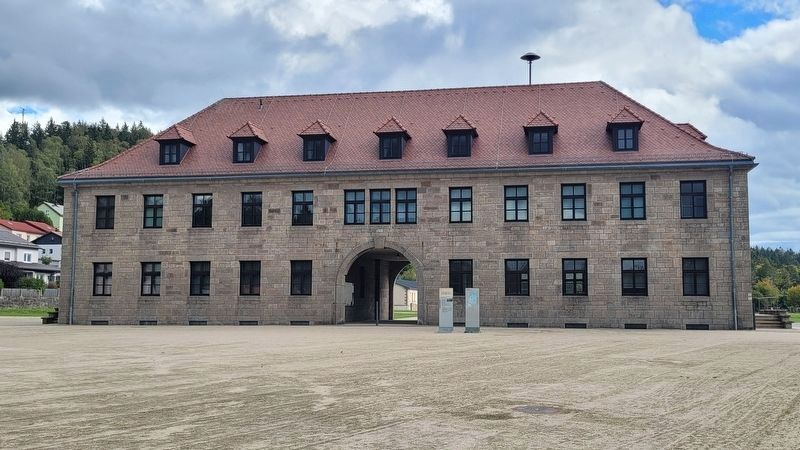
4. The wide view of the marker (in the tunnel) at the Commandant's Headquarters building
More about this marker. The marker is located on the grounds of the Flossenbürg Concentration Camp Memorial.
Also see . . . Flossenbürg Concentration Camp Memorial. KZ-Gedenkstätte Flossenbürg
Before the establishment of the concentration camp, Flossenbürg was merely a small village in the Upper Palatinate forest. Beginning in the late 19th century, a number of quarries were opened in the area in order to exploit local granite deposits, and Flossenbürg developed into a workers’ village.(Submitted on November 11, 2024, by James Hulse of Medina, Texas.)
Credits. This page was last revised on September 30, 2026. It was originally submitted on November 9, 2024, by James Hulse of Medina, Texas. This page has been viewed 139 times since then and 17 times this year. Photos: 1, 2, 3, 4. submitted on November 11, 2024, by James Hulse of Medina, Texas.
