
Flossenbürg in Neustadt an der Waldnaab, Bavaria, Germany — Central Europe
Lagertor
⎯⎯⎯
Camp Gate
Photographed by James Hulse, September 27, 2024
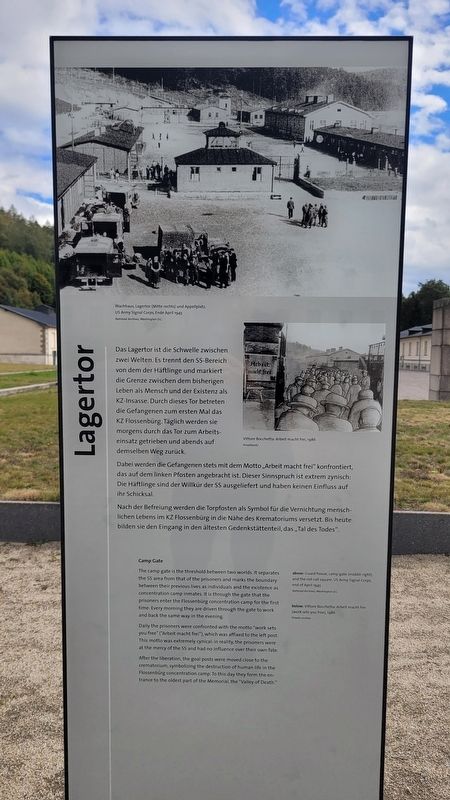
1. Lagertor / Camp Gate Marker

Das Lagertor ist die Schwelle zwischen zwei Welten. Es trennt den SS-Bereich von dem der Häftlinge und markiert die Grenze zwischen dem bisherigen Leben als Mensch und der Existenz als KZ-Insasse. Durch dieses Tor betreten die Gefangenen zum ersten Mal das KZ Flossenbürg. Täglich werden sie morgens durch das Tor zum Arbeitseinsatz getrieben und abends auf demselben Weg zurück.
Dabei werden die Gefangenen stets mit dem Motto „Arbeit macht frei" konfrontiert, das auf dem linken Pfosten angebracht ist. Dieser Sinnspruch ist extrem zynisch: Die Häftlinge sind der Willkür der SS ausgeliefert und haben keinen Einfluss auf ihr Schicksal.
Nach der Befreiung werden die Torpfosten als Symbol für die Vernichtung menschlichen Lebens im KZ Flossenbürg in die Nähe des Krematoriums versetzt. Bis heute bilden sie den Eingang in den ältesten Gedenkstättenteil, das „Tal des Todes".
Bildunterschriften
(Foto Nr. 1) Wachhaus, Lagertor (Mitte rechts) und Appellplatz, US Army Signal Corps, Ende April 1945, National Archives, Washington D.C.
(Foto Nr. 2) Vittore Bocchetta: Arbeit macht frei, 1986, Privatbesitz
Camp Gate
The camp gate is the threshold between two worlds. It separates the SS area from that of the prisoners and marks the boundary between their previous lives as individuals and the existence as concentration camp inmates. It is through the gate that the prisoners enter the Flossenbürg concentration camp for the first time. Every morning they are driven through the gate to work and back the same way in the evening.
Daily the prisoners were confronted with the motto "work sets you free" ("Arbeit macht frei"), which was affixed to the left post. This motto was extremely cynical: in reality, the prisoners were at the mercy of the SS and had no influence over their own fate.
After
this page online
Captions
above: Guard house, camp gate (middle right), and the roll call square, US Army Signal Corps, end of April 1945, National Archives Washington D.C.
below: Vittore Bocchetta: Arbeit macht frei (work sets you free), 1986, Private archive
Topics. This historical marker is listed in these topic lists: Cemeteries & Burial Sites • War, World II. A significant historical month for this entry is April 1945.
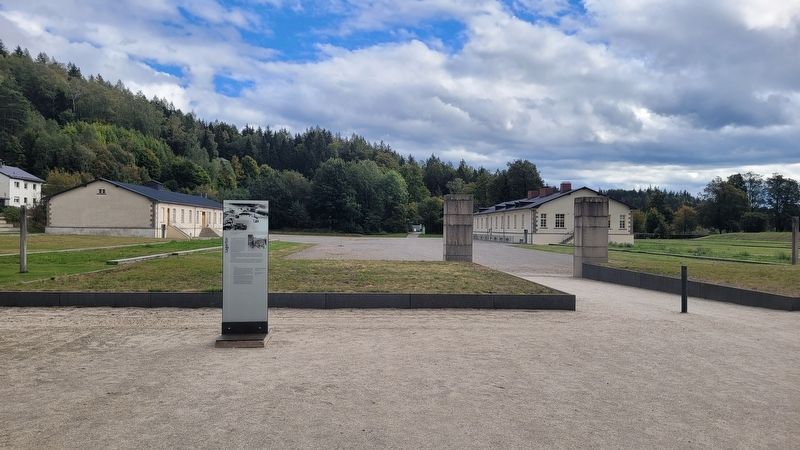
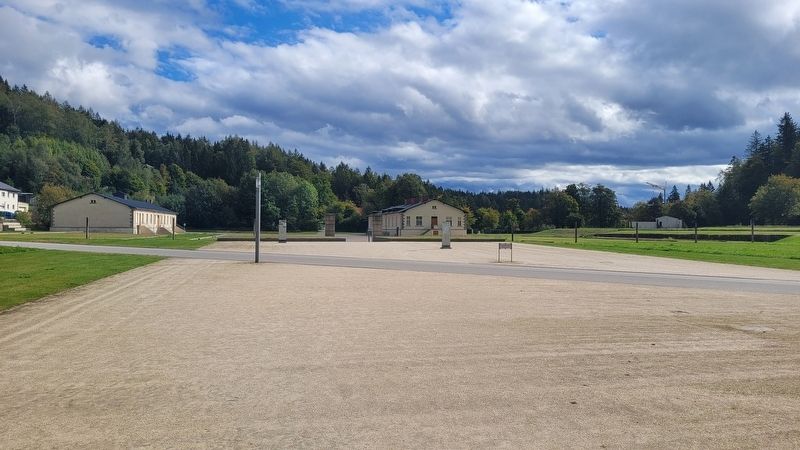
Location. 49° 44.164′ N, 12° 21.36′ E. Marker is in Flossenbürg, Bayern (Bavaria), in Neustadt an der Waldnaab. It is on Gedächtnisallee just east of Silberhüttenstraße. The marker is located at the original gate to the Flossenbürg Concentration Camp. Touch for map. Marker is at or near this postal address: Gedächtnisallee 5-7, Flossenbürg BY 92696, Germany. Touch for directions.

Regionally, it is in Europe, the European Union, Atlantic Europe, Central Europe, the Schengen Area, Western
Photographed by James Hulse, September 27, 2024
2. The Camp Gate and Marker
Other nearby markers. At least 8 other markers are within walking distance of this marker: Konzentrationslager Flossenbürg / Flossenbürg Concentration Camp (within shouting distance of this marker); Appellplatz / Roll Call Square (within shouting distance of this marker); Wäscherei / Laundry Building (about 90 meters away, measured in a direct line); Häftlingsküche / Prisoner Kitchen (about 90 meters away); Kommandantur / Commandant's Headquarters (about 90 meters away); Häftlingsbaracken / Prisoner Barracks (about 120 meters away); To the Memory Of (about 120 meters away); Trois jeunes femmes françaises ont été exécutées / Three young French women were executed (about 120 meters away). Touch for a list and map of all markers in Flossenbürg.
More about this marker. The marker is located on the grounds of the Flossenbürg Concentration Camp Memorial.
Also see . . . Flossenbürg Concentration Camp Memorial. KZ-Gedenkstätte Flossenbürg
Before the establishment of the concentration camp,(Submitted on November 11, 2024, by James Hulse of Medina, Texas.)Flossenbürg was merely a small village in the Upper Palatinate forest. Beginning in the late 19th century, a number of quarries were opened in the area in order to exploit local granite deposits, and Flossenbürg developed into a workers’ village.Photographed by James Hulse, September 27, 20243. The wide view of the Camp Gate and Marker
Credits. This page was last revised on September 30, 2026. It was originally submitted on November 9, 2024, by James Hulse of Medina, Texas. This page has been viewed 130 times since then and 35 times this year. Photos: 1, 2, 3. submitted on November 11, 2024, by James Hulse of Medina, Texas.
