
Flossenbürg in Neustadt an der Waldnaab, Bavaria, Germany — Central Europe
Häftlingsküche
⎯⎯⎯
Prisoner Kitchen
Photographed by James Hulse, September 27, 2024
1. Häftlingsküche / Prisoner Kitchen Marker

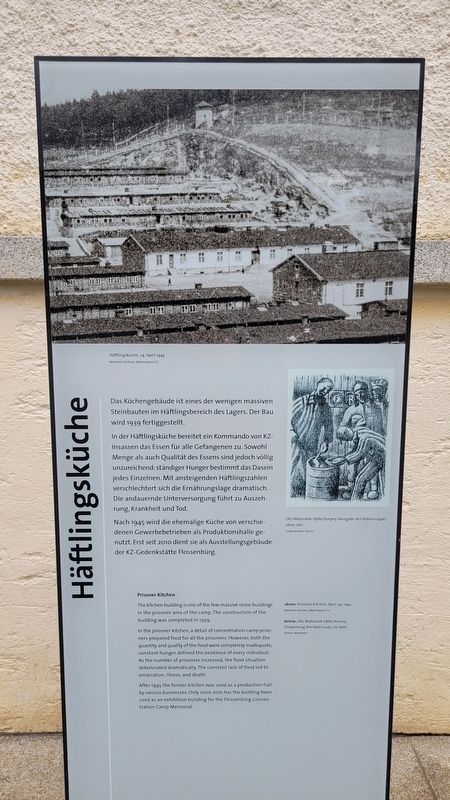
Das Küchengebäude ist eines der wenigen massiven Steinbauten im Häftlingsbereich des Lagers. Der Bau wird 1939 fertiggestellt.
In der Häftlingsküche bereitet ein Kommando von KZ-Insassen das Essen für alle Gefangenen zu. Sowohl Menge als auch Qualität des Essens sind jedoch völlig unzureichend: ständiger Hunger bestimmt das Dasein jedes Einzelnen. Mit ansteigenden Häftlingszahlen verschlechtert sich die Ernährungslage dramatisch. Die andauernde Unterversorgung führt zu Auszehrung, Krankheit und Tod.
Nach 1945 wird die ehemalige Küche von verschiedenen Gewerbebetrieben als Produktionshalle genutzt. Erst seit 2010 dient sie als Ausstellungsgebäude der KZ-Gedenkstätte Flossenbürg.
Bildunterschriften
(Foto Nr. 1) Häftlingsküche, 24. April 1945, National Archives, Washington D.C.
(Foto Nr. 2) Ota Matoušek: Výdej buryny (Ausgabe der Rübensuppe), ohne Jahr, Gedenkstätte Terezin
Prisoner Kitchen
The kitchen building is one of the few massive stone buildings in the prisoner area of the camp. The construction of the building was completed in 1939.
In the prisoner kitchen, a detail of concentration camp prisoners prepared food for all the prisoners. However, both the quantity and quality of the food were completely inadequate; constant hunger defined the existence of every individual. As the number of prisoners increased, the food situation deteriorated dramatically. The constant lack of food led to emaciation, illness, and death.
After 1945 the former kitchen was used as a production hall by various businesses. Only since 2010 has the building been used as an exhibition building for the Flossenbürg Concentration Camp Memorial.
Captions
above: Prisoner Kitchen, April 24, 1945, National Archives, Washington D.C.
below: Ota Matoušek Výdej buryny (Dispensing the beet soup), no date, Temezin Memonial
Topics.
this page online
Location. 49° 44.162′ N, 12° 21.433′ E. Marker is in Flossenbürg, Bayern (Bavaria), in Neustadt an der Waldnaab. It is on Gedächtnisallee just east of Silberhüttenstraße. The marker is located at the east section of the Flossenbürg Concentration Camp. Touch for map. Marker is at or near this postal address: Gedächtnisallee 5-7, Flossenbürg BY 92696, Germany. Touch for directions.

Regionally, it is in Europe, the European Union, Atlantic Europe, Central Europe, the Schengen Area, Western Europe, and the Western World. Historically, it finds itself in what was once the Holy Roman Empire and also the former West Germany.
Other nearby markers. At least 8 other markers are within walking distance of this marker: Appellplatz / Roll Call Square (within shouting distance of this marker); Wäscherei / Laundry Building (within shouting distance of this marker); Häftlingsbad / Prisoner Bathroom (within shouting distance of this marker); Lagertor / Camp Gate (about 90 meters away, measured
Photographed by James Hulse, September 27, 2024
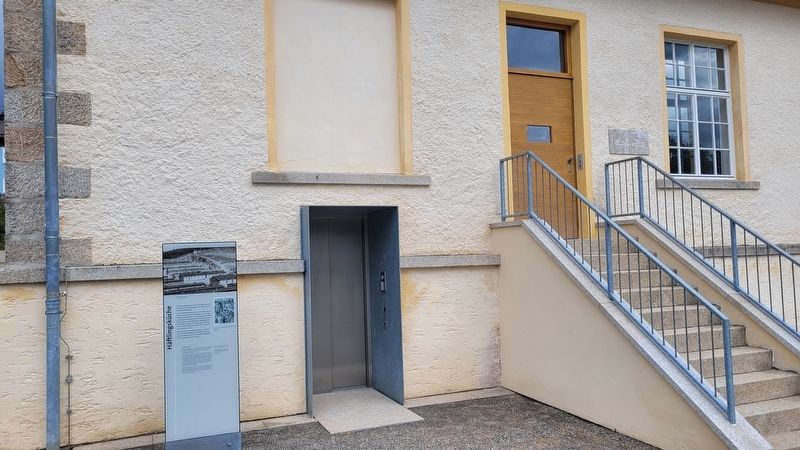
2. The Prisoner Kitchen building and Marker
More about this marker. The marker is located on the grounds of the Flossenbürg Concentration Camp Memorial.
Also see . . . Flossenbürg Concentration Camp Memorial. KZ-Gedenkstätte Flossenbürg
Before the establishment of the concentration camp, Flossenbürg was merely a small village in the Upper Palatinate forest. Beginning in the late 19th century, a number of quarries were opened in the area in order to exploit local granite deposits, and Flossenbürg developed into a workers’ village.(Submitted on November 11, 2024, by James Hulse of Medina, Texas.)
Photographed by James Hulse, September 27, 2024
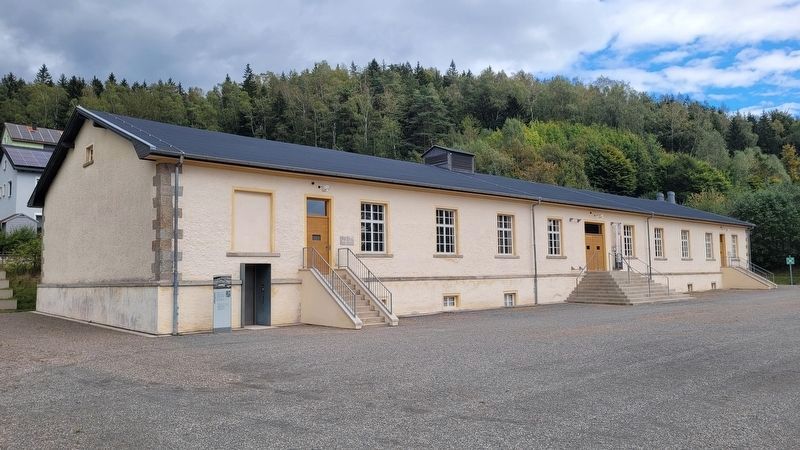
3. The view of the Prisoner Kitchen from the Roll Call Square
Credits. This page was last revised on September 30, 2026. It was originally submitted on November 9, 2024, by James Hulse of Medina, Texas. This page has been viewed 109 times since then and 19 times this year. Photos: 1, 2, 3. submitted on November 11, 2024, by James Hulse of Medina, Texas.
