Monroe in Ouachita Parish, Louisiana — The American South (West South Central)
Mt. Nebo Elementary School
Photographed by Brian Davis, August 3, 2024
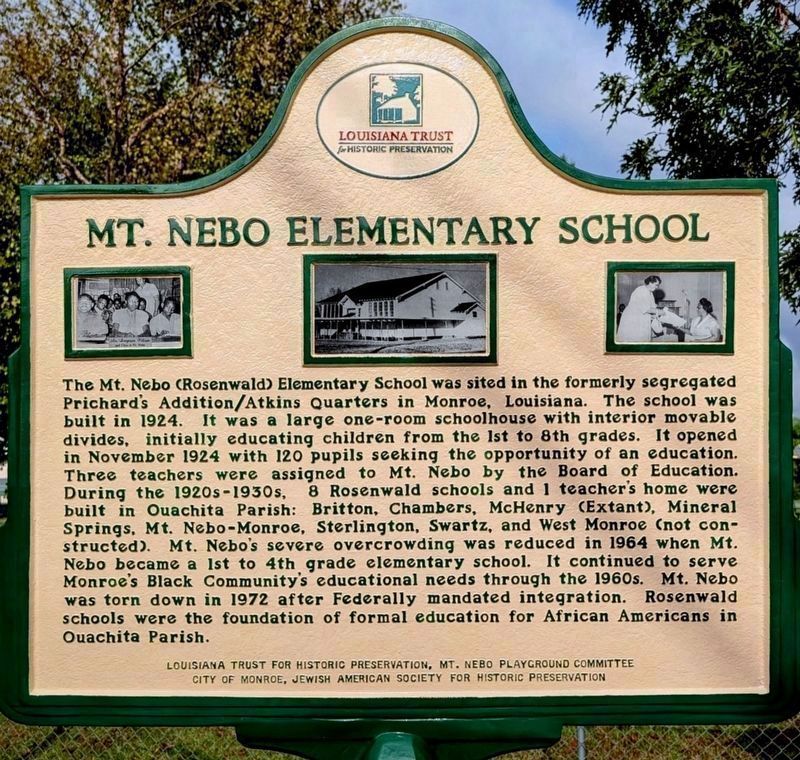
1. Mt. Nebo Elementary School Marker - obverse
Mt. Nebo Elementary School
The Mt. Nebo (Rosenwald) Elementary School was sited in the formerly segregated Prichard's Addition/Atkins Quarters in Monroe, Louisiana. The school was built in 1924. It was a large one room schoolhouse with interior movable divides initially educating children from the 1st to 8th grades. It opened in November, 1924 with 120 pupils seeking the opportunity of an education. Three teachers were assigned to Mt. Nebo by the Board of Education. The severe overcrowding was reduced a few years later when Mt. Nebo became a 1st to 4th grade elementary school. It continued to serve Monroe’s Black Community’s educational needs until it was closed in the 1960s when Federal law mandated integration. During the 1920s-1930s, 8 Rosenwald schools and 1 teacher’s home were built in Ouachita Parish, among which were Britton-Chambers, McHenry-Mineral Springs (Extant), Mt Nebo-Monroe, Sterlington-Swartz, and West Monroe. Rosenwald schools were the foundation of formal education for African Americans in Ouachita Parish.
Rosenwald Schools
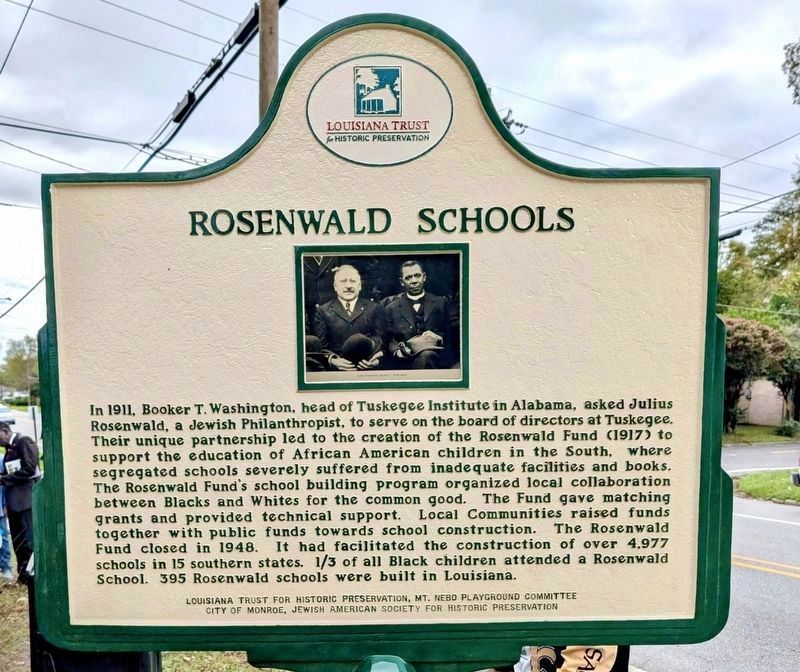
In 1911, Booker T. Washington, head of Tuskegee Institute in Alabama,
this page online
Erected 2024 by Jewish American Society for Historic Preservation, Louisiana Trust for Historic Preservation, Mt. Nebo Playground Committee City of Monroe.
Topics and series. This historical marker is listed in these topic lists: African Americans • Civil Rights • Education. In addition, it is included in the Jewish American Society for Historic Preservation.,
Photographed by Brian Davis, August 3, 2024
2. Mt. Nebo Elementary School Marker - reverse
Location. 32° 28.246′ N, 92° 6.481′ W. Marker is in Monroe, Louisiana, in Ouachita Parish. It is at the intersection of Jackson Street and Thomas Avenue, on the right when traveling north on Jackson Street. Touch for map. Marker is at or near this postal address: 3013 Jackson Street, Monroe LA 71202, United States of America. Touch for directions.

Regionally, this marker is in North Louisiana. It is also in the American South and specifically in the Deep South. Globally, it is in North America, a Gulf of Mexico state, the Western Hemisphere, the Western World, and the Anglosphere. Historically, it finds itself in what was once the territory of the Mississippian Culture, the Louisiana Purchase, one of the Confederate States of America, and the Antebellum South.
Other nearby markers. At least 8 other markers are within 3 miles of this marker, measured as the crow flies: Fort Miro (approx. 1.9 miles away); Mr. Jack Hayes / Mrs. Ann Stapp Hayes (approx. 1.9 miles away); Ouachita Parish High School (approx. 1.9 miles away); Operation Iraqi Freedom Memorial
Photographed by Brian Davis, August 3, 2024
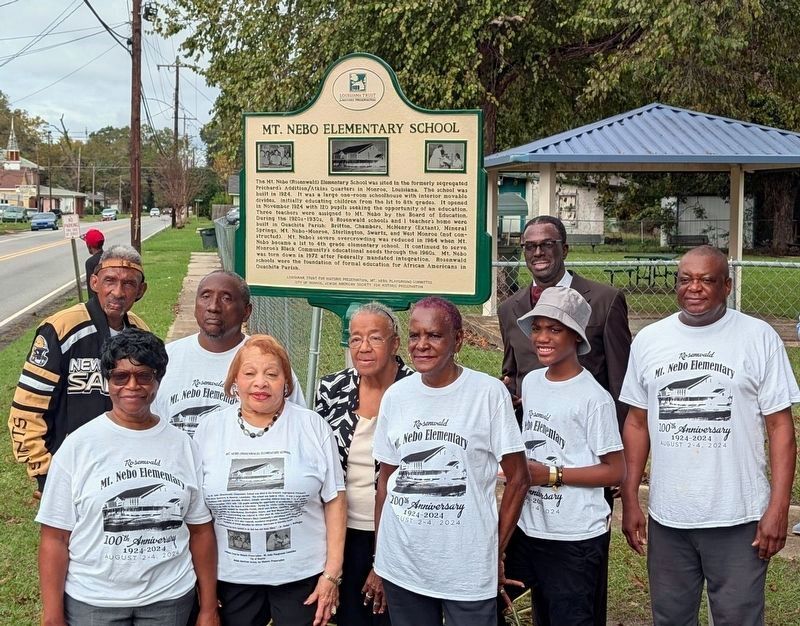
3. Mt Nebo (Rosenwald) Elementary School Marker
Regarding Mt. Nebo Elementary School. National Park Service:
A school day in a Rosenwald School in the early 20th century was in many ways similar to school days today. But before they could start their day, this class of African American students in the segregated south walked to school. When they arrived, they had to sweep out the classroom, collect wood for the stove, and draw water from a well. The students were proud of their schoolhouse. Before it was built, some had attended classes in living rooms or front yards. Some had learned to read while sitting in a field or in church pews. But that was before their community built them a real school by donating labor, materials, and money to match a grant from the Rosenwald school building program.
The Rosenwald school building program was a Progressive Era program funded by Jewish philanthropist Julius Rosenwald. He partnered with African American educator and activist Booker T. Washington, first working with Washington's Tuskegee Institute and then forming an independent foundation to manage the school program. After meeting in 1912, the two men built thousands of schools for black students in 15 states. The Rosenwald Schools, as they are known, were often the first schools in a black community and helped improve education across the South.
Also see . . .
1. Rosenwald Schools helped educate Black students in segregated South. Could a national park follow?.
It was in schools like this one, and nearly 5,000 others built in the American South a century ago, that Black students largely ignored by whites in power gained an educational foundation through the generosity of a Jewish businessman who could soon be memorialized with a national park.(Submitted on November 11, 2024, by Jerry Klinger of Boynton Beach, Florida.)
2. How-rosenwald-schools-shaped-legacy-generation-black-leaders.
Little more than a century ago, deep in America’s rural South, a community-based movement ignited by two unexpected collaborators quietly grew to become so transformative, its influence shaped the educational and economic future of an entire generation of African American families.(Submitted on November 11, 2024, by Jerry Klinger of Boynton Beach, Florida.)
Between 1917 and 1932, nearly 5,000 rural schoolhouses, modest one-, two-, and three-teacher buildings known as Rosenwald Schools, came to exclusively serve more than 700,000 black children over four decades. It was through the shared ideals and a partnership between Booker T. Washington, an educator, intellectual and prominent African American thought leader, and Julius Rosenwald, a German-Jewish immigrant who accumulated his wealth as head of the behemoth retailer, Sears, Roebuck & Company, that Rosenwald Schools would come to comprise more than one in five Black schools operating throughout the South by 1928.
3. Photo History: The Incredible True Story of How Booker T. Washington & the President of Sears Built.
The unlikely partners — a former slave and a first-generation Jewish American from Chicago, a Northerner whose company was known for shipping home-building kits through the mail — provided funding, blueprints and guidance that enabled black communities in 15 states to build inviting, permanent places for their children to learn.(Submitted on November 11, 2024, by Jerry Klinger of Boynton Beach, Florida.)
4. Mt. Nebo/Rosenwald Elementary School, Racism – and Louis Farrakhan.
Many people, even today, mistakenly believe freedom is owning land. Many people mistakenly believe freedom is making money. A different reality, a very Jewish one, is understood about freedom. Freedom is education.(Submitted on November 19, 2024, by Jerry Klinger of Boynton Beach, Florida.)
Land can be taken away. Money can be taken away. A person’s physical freedom can be taken away. What can never be taken away is an educated mind. Education is portable wealth. Jewish history, the universal Jewish experience, has long memories of sudden banishment and degradation when war and political changes occur.
Credits. This page was last revised on March 29, 2025. It was originally submitted on November 11, 2024, by Jerry Klinger of Boynton Beach, Florida. This page has been viewed 1,207 times since then and 106 times this year. Photos: 1, 2, 3. submitted on November 11, 2024, by Jerry Klinger of Boynton Beach, Florida. • Andrew Ruppenstein was the editor who published this page.
