
Flossenbürg in Neustadt an der Waldnaab, Bavaria, Germany — Central Europe
Arrestbau
⎯⎯⎯
Detention Building
Photographed by James Hulse, September 27, 2024
1. Arrestbau / Detention Building Marker

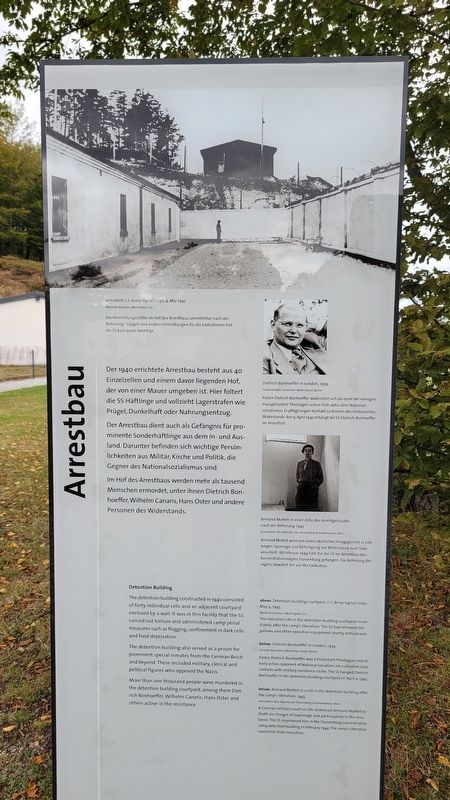
Der 1940 errichtete Arrestbau besteht aus 40 Einzelzellen und einem davor liegenden Hof, der von einer Mauer umgeben ist. Hier foltert die SS Häftlinge und vollzieht Lagerstrafen wie Prügel, Dunkelhaft oder Nahrungsentzug.
Der Arrestbau dient auch als Gefängnis für prominente Sonderhäftlinge aus dem In- und Ausland. Darunter befinden sich wichtige Persönlichkeiten aus Militär, Kirche und Politik, die Gegner des Nationalsozialismus sind.
Im Hof des Arrestbaus werden mehr als tausend Menschen ermordet, unter ihnen Dietrich Bonhoeffer, Wilhelm Canaris, Hans Oster und andere Personen des Widerstands.
Bildunterschriften
(Foto Nr. 1) Arresthof, U.S. Army Signal Corps, 4. Mai 1945, National Archives, Washington D.C., Die Hinrichtungsstätte im Hof des Arrestbaus unmittelbar nach der Befreiung. Galgen und andere Vorrichtungen für die Exekutionen hat die SS kurz zuvor beseitigt.
(Foto Nr. 2) Dietrich Bonhoeffer in London, 1939, Gedenkstätte Deutscher Widerstand, Berlin, Pastor Dietrich Bonhoeffer widersetzt sich als einer der wenigen evangelischen Theologen schon früh aktiv dem Nationalsozialismus. Er pflegt engen Kontakt zu Kreisen des militärischen. Widerstands. Am 9. April 1945 erhängt die SS Dietrich Bonhoeffer im Arresthof.
(Foto Nr. 3) Armand Mottet in einer Zelle des Arrestgebäudes, nach der Befreiung 1945, Association des déportés de Flossenbürg et Kommandos, Paris, Armand Mottet wird von einem deutschen Kriegsgericht in Lille wegen Spionage und Beteiligung am Widerstand zum Tode verurteilt. Ab Februar 1944 hält ihn die SS im Arrestbau des Konzentrationslagers Flossenbürg gefangen. Die Befreiung des Lagers bewahrt ihn vor der Exekution.
Detention Building
The detention building constructed in 1940 consisted of forty individual cells and an adjacent courtyard enclosed
this page online
The detention building also served as a prison for prominent special inmates from the German Reich and beyond. These included military, clerical and political figures who opposed the Nazis.
More than one thousand people were murdered in the detention building courtyard, among them Dietrich Bonhoeffer, Wilhelm Canaris, Hans Oster and others active in the resistance.
Captions
above: Detention building courtyard, U.S. Army Signal Corps. May 4, 1945, National Archives, Washington, D.C., The execution site in the detention building courtyard immediately after the camp's liberation. The SS had removed the gallows and other execution equipment shortly beforehand.
below: Dietrich Bonhoeffer in London, 1939, German Resistance Memorial Center, Berlin, Pastor Dietrich Bonhoeffer was a Protestant theologian and an early active opponent of National Socialism. He cultivated close contacts with military resistance circles. The SS hanged Dietrich Bonhoeffer in the detention building courtyard on April 9, 1945.
below: Armand Mottet in a cell in the detention building after the camp's liberation, 1945, Association des déportés de Flossenbürg et Kommandos, Paris, A German military court in Lille sentenced Armand Mottet to death on charges of espionage and participation in the resistance. The SS imprisoned him in the Flossenbürg concentration camp detention building in February 1944. The camp's liberation saved him from execution.
Topics.
Photographed by James Hulse, September 27, 2024
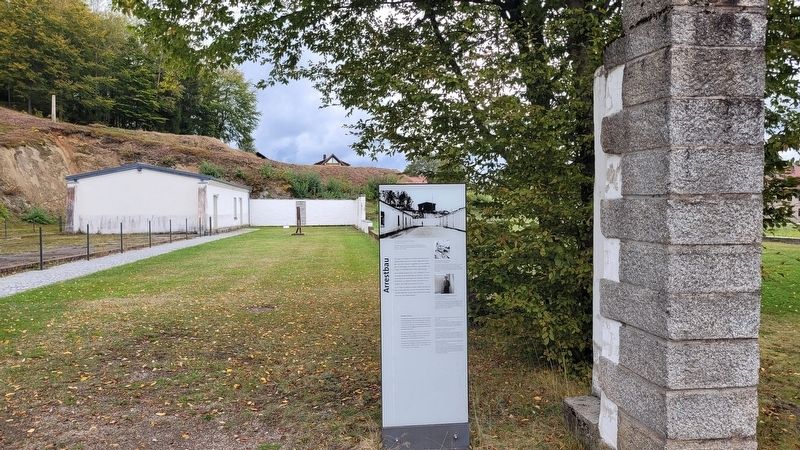
2. The Detention Building and Marker
Location. 49° 44.092′ N, 12° 21.385′ E. Marker is in Flossenbürg, Bayern (Bavaria), in Neustadt an der Waldnaab. It is on Gedächtnisallee just east of Silberhüttenstraße. The marker is located at the east section of the Flossenbürg Concentration Camp. Touch for map. Marker is at or near this postal address: Gedächtnisallee 5-7, Flossenbürg BY 92696, Germany. Touch for directions.

Regionally, it is in Europe, the European Union, Atlantic Europe, Central Europe, the Schengen Area, Western Europe, and the Western World. Historically, it finds itself in what was once the Holy Roman Empire and also the former West Germany.
Other nearby markers. At least 8 other markers are within walking distance of this marker: Krankenrevier / Infirmary (here, next to this marker); Häftlingsbaracken / Prisoner Barracks (within shouting distance of this marker); Lagerbordell / Camp Brothel (within shouting distance of this marker); S úctou spomíname / With respect, we remember them (within shouting
Photographed by James Hulse, September 27, 2024
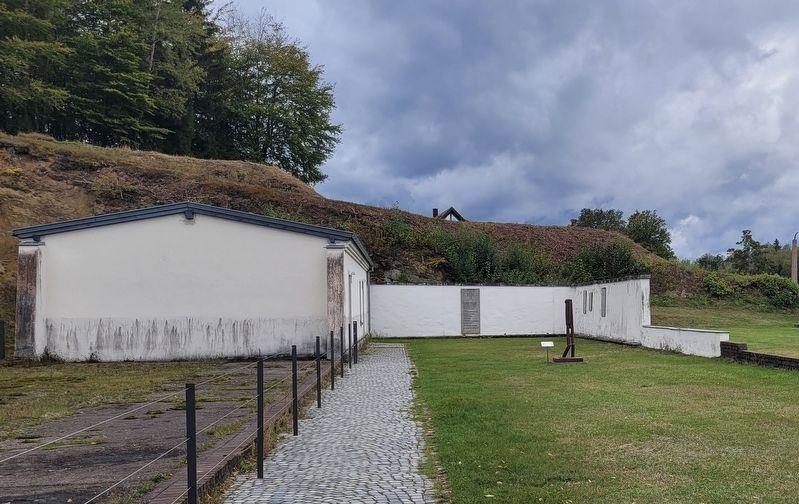
3. The view of the Detention Building
More about this marker. The marker is located on the grounds of the Flossenbürg Concentration Camp Memorial.
Also see . . . Dietrich Bonhoeffer. Wikipedia
Dietrich Bonhoeffer (4 February 1906 – 9 April 1945) was a German Lutheran pastor, neo-orthodox theologian and anti-Nazi dissident who was a key founding member of the Confessing Church. His writings on Christianity's role in the secular world have become widely influential; his 1937 book The Cost of Discipleship is described as a modern classic. Apart from his theological writings, Bonhoeffer was known for his staunch resistance to the Nazi dictatorship, including vocal opposition to Adolf Hitler's euthanasia program and genocidal persecution of the Jews. He was arrested in April 1943 by the Gestapo and imprisoned at Tegel Prison for 1½ years. Later, he was transferred to Flossenbürg concentration camp.(Submitted on November 12, 2024, by James Hulse of Medina, Texas.)
Credits. This page was last revised on September 30, 2026. It was originally submitted on November 11, 2024, by James Hulse of Medina, Texas. This page has been viewed 135 times since then and 22 times this year. Photos: 1, 2, 3. submitted on November 12, 2024, by James Hulse of Medina, Texas.
