Gunnison in Sanpete County, Utah — The American Mountains (Southwest)
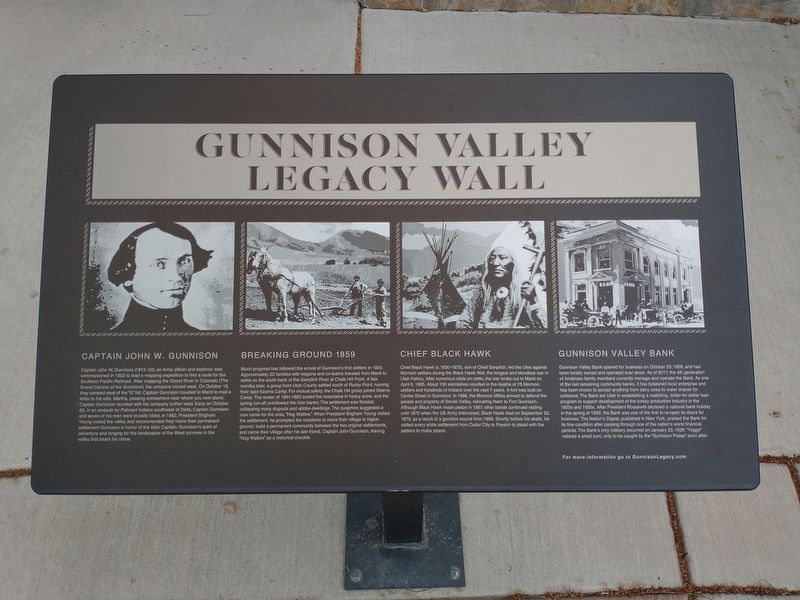
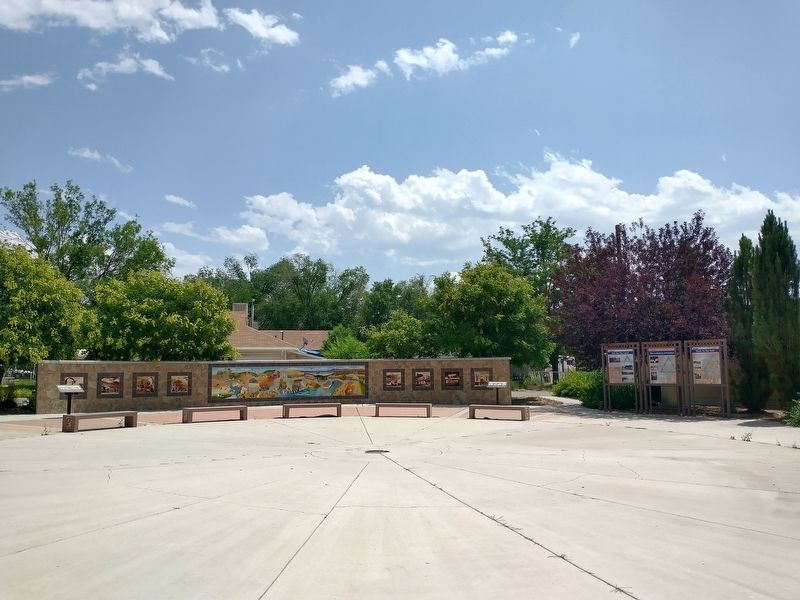
Gunnison Valley Legacy Wall
Photographed by Tom Bosse, July 27, 2024
1. Gunnison Valley Legacy Wall Marker
Captain John. W. Gunnison
Captain John. W. Gunnison (1812-53), an army officer and explorer, was commissioned in 1853 to lead a mapping expedition to find a route for the Southern Pacific Railroad. After mapping the Grand River in Colorado (The Grand Canyon of the Gunnison), the company moved west. On October 19, they camped west of the “G” hill. Captain Gunnison traveled to Manti to mail a letter to his wife, Martha, passing somewhere near where you now stand. Captain Gunnison reunited with his company further west. Early on October 26, in an ambush by Pahvant Indians southwest of Delta, Captain Gunnison and seven of his men were brutally killed. In 1862, President Brigham Young visited the valley and recommended they name their permanent settlement Gunnison in honor of the slain Captain. Gunnison’s spirit of adventure and longing for the landscapes of the West survives in the valley that bears his name.
Breaking Ground 1859
Much progress has followed the arrival of Gunnison’s first settlers in 1859. Approximately 22 families with wagons and ox-teams traveled from Manti to settle on the south bank of the Sanpitch
this page online
Chief Black Hawk
Chief Black Hawk (c. 1830-1870), son of Chief Sanpitch, led the Utes against Mormon settlers during the Black Hawk War, the longest and bloodiest war in Utah history. After numerous raids on cattle, the war broke out in Manti on April 9, 1865. About 150 skirmishes resulted in the deaths of 75 Mormon settlers and hundred of Indians over the next 7 years. A fort was built on Center Street
Photographed by Tom Bosse, July 27, 2024
2. Gunnison Valley Legacy Wall Marker
Gunnison Valley Bank
Gunnison Valley Bank opened for business on October 23, 1909, and has been locally owned and operated ever since. As of 2017, the 4th generation of Andersen family members currently manage and operate the Bank. As one of the last remaining community banks, it has bolstered local enterprise and has been known to accept anything from dairy cows to water share for collateral. The Bank led Utah in establishing a matching, dollar-for-dollar loan program to support development of the turkey production industry in the 1920s and 1930s. After President Roosevelt declared a national bank holiday in the spring of 1933, the Bank was one of the first to re-open its doors for

Photographed by Tom Bosse, July 27, 2024
3. Gunnison Valley Bank
For more information go to GunnisonLegacy.com
Topics. This historical marker is listed in these topic lists: Exploration • Indigenous Peoples and Communities • Industry & Commerce • Settlements & Settlers. A significant historical date for this entry is January 23, 1929.
Location. 39° 9.294′ N, 111° 49.074′ W. Marker is in Gunnison, Utah, in Sanpete County. It is at the intersection of South Main Street and East Center Street, on the right when traveling north on South Main Street. Touch for map. Marker is in this post office area: Gunnison UT 84634, United States of America. Touch for directions.

Regionally, this marker is in the Central Utah Valleys. It is also in the American Mountain West and on the Colorado Plateau. Globally, it is in North America, the Western Hemisphere, the Western World, and the Anglosphere. Historically, it finds itself in what was once New Spain and also Mexico’s Alta California.
Other nearby markers. At least 8 other markers are within 3 miles of this marker, measured as the crow flies: A different marker also named Gunnison Valley Legacy Wall (a few steps from this marker); “Back to the Soil” (a few steps from this marker); The Colonists of Clarion (a few steps from this marker); Life on the Land (a few steps from this marker); Casino / Star Theatre (about 400 feet away, measured in a direct line); Gunnison (approx. 0.3 miles away); First Public Buildings (approx. 2.3 miles away); Centerfield (approx. 2.3 miles away). Touch for a list and map of all markers in Gunnison.
Also see . . .
1. John Williams Gunnison. (Submitted on November 12, 2024, by Tom Bosse of Jefferson City, Tennessee.)
2. Black Hawk War (1865–1872). (Submitted on November 12, 2024, by Tom Bosse of Jefferson City, Tennessee.)
Credits. This page was last revised on November 19, 2024. It was originally submitted on November 12, 2024, by Tom Bosse of Jefferson City, Tennessee. This page has been viewed 204 times since then and 39 times this year. Photos: 1, 2, 3. submitted on November 12, 2024, by Tom Bosse of Jefferson City, Tennessee. • Andrew Ruppenstein was the editor who published this page.
