
Flossenbürg in Neustadt an der Waldnaab, Bavaria, Germany — Central Europe
Häftlingsbaracken
⎯⎯⎯
Prisoner Barracks
Photographed by James Hulse, September 27, 2024
1. Häftlingsbaracken / Prisoner Barracks Marker

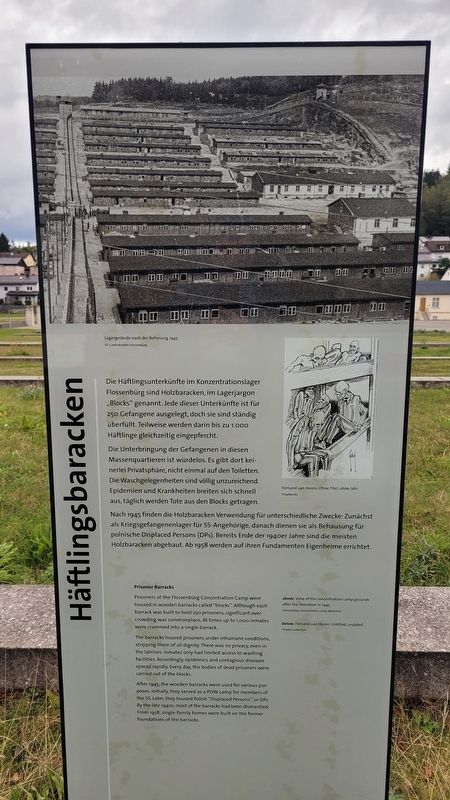
Die Häftlingsunterkünfte im Konzentrationslager Flossenbürg sind Holzbaracken, im Lagerjargon „Blocks" genannt. Jede dieser Unterkünfte ist für 250 Gefangene ausgelegt, doch sie sind ständig überfüllt. Teilweise werden darin bis zu 1.000 Häftlinge gleichzeitig eingepfercht.
Die Unterbringung der Gefangenen in diesen Massenquartieren ist würdelos. Es gibt dort keinerlei Privatsphäre, nicht einmal auf den Toiletten. Die Waschgelegenheiten sind völlig unzureichend. Epidemien und Krankheiten breiten sich schnell aus, täglich werden Tote aus den Blocks getragen.
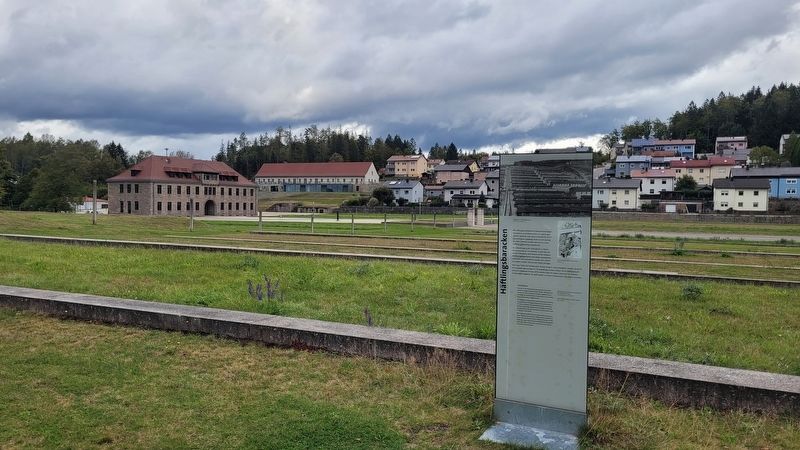
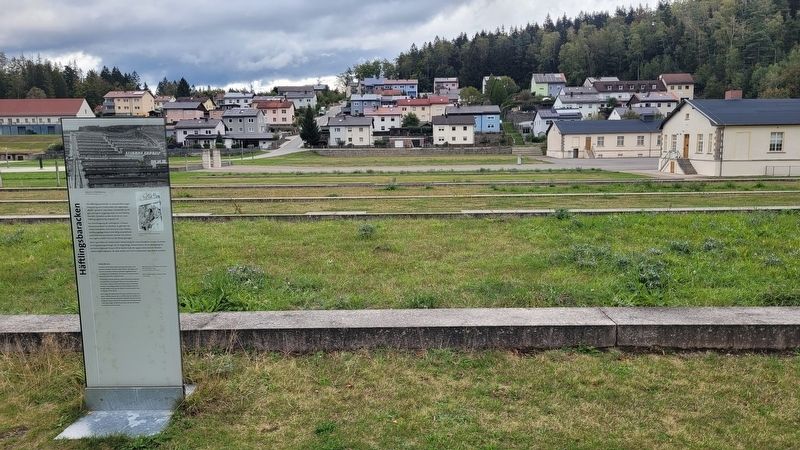
Nach 1945 finden die Holzbaracken Verwendung für unterschiedliche Zwecke: Zunächst als Kriegsgefangenenlager für SS-Angehörige, danach dienen sie als Behausung für polnische Displaced Persons (DPs). Bereits Ende der 1940er Jahre sind die meisten Holzbaracken abgebaut. Ab 1958 werden auf ihren Fundamenten Eigenheime errichtet.
Bildunterschriften
(Foto Nr. 1) Lagergelände nach der Befreiung 1945, KZ-Gedenkstätte Flossenburg
(Foto Nr. 2) Fernand van Horen: Ohne Titel, ohne Jahr, Privatbesitz
Prisoner Barracks
Prisoners at the Flossenbürg Concentration Camp were housed in wooden barracks called "blocks". Although each barrack was built to hold 250 prisoners, significant overcrowding was commonplace. At times up to 1,000 inmates were crammed into a single barrack.
The barracks housed prisoners under inhumane conditions, stripping them of all dignity. There was no privacy, even in the latrines. Inmates only had limited access to washing facilities. Accordingly, epidemics and contagious diseases. spread rapidly. Every day, the bodies of dead prisoners were carried out of the blocks.
After 1945, the wooden barracks were used for various purposes. Initially, they served as a POW camp for members of the SS. Later,
this page online
Captions
above: View of the concentration camp grounds after the liberation in 1945, Flossenbürg Concentration Camp Memorial
below: Fernand van Horen: Untitled, undated, Private Collection
Topics. This historical marker is listed in these topic lists: Cemeteries & Burial Sites • War, World II. A significant historical year for this entry is 1945.
Location. 49° 44.102′ N, 12° 21.366′ E. Marker is in Flossenbürg, Bayern (Bavaria), in Neustadt an der Waldnaab. It is on Gedächtnisallee just east of Silberhüttenstraße. The marker is located at the east section of the Flossenbürg Concentration Camp. Touch for map. Marker is at or near this postal address: Gedächtnisallee 5-7, Flossenbürg BY 92696, Germany. Touch for directions.

Regionally, it is in Europe, the European Union, Atlantic Europe, Central Europe, the Schengen Area, Western Europe, and the Western World. Historically, it finds itself in what was once the Holy Roman
Photographed by James Hulse, September 27, 2024
2. Prisoner Barracks and Marker
Other nearby markers. At least 8 other markers are within walking distance of this marker: S úctou spomíname / With respect, we remember them (a few steps from this marker); Trois jeunes femmes françaises ont été exécutées / Three young French women were executed (a few steps from this marker); To the Memory Of (within shouting distance of this marker); Arrestbau / Detention Building (within shouting distance of this marker); Im Widerstand Gegen Diktatur und Terror / In Resistance Against Dictatorship and Terror (within shouting distance of this marker); Krankenrevier / Infirmary (within shouting distance of this marker); Lagerbordell / Camp Brothel (within shouting distance of this marker); Wäscherei / Laundry Building (about 90 meters away, measured in a direct line). Touch for a list and map of all markers in Flossenbürg.
More about this marker. The marker is located on the grounds of the Flossenbürg Concentration Camp Memorial.
Also see . . . Flossenbürg Concentration Camp. KZ-Gedenkstätte Flossenbürg
Before the establishment of the concentration camp, Flossenbürg was(Submitted on November 12, 2024, by James Hulse of Medina, Texas.)merely a small village in the Upper Palatinate forest. Beginning in the late 19th century, a number of quarries were opened in the area in order to exploit local granite deposits, and Flossenbürg developed into a workers’ village.Photographed by James Hulse, September 27, 20243. The concrete lines show the former site of the Prisoner Barracks
Credits. This page was last revised on September 30, 2026. It was originally submitted on November 12, 2024, by James Hulse of Medina, Texas. This page has been viewed 111 times since then and 25 times this year. Photos: 1, 2, 3. submitted on November 13, 2024, by James Hulse of Medina, Texas.
