
Flossenbürg in Neustadt an der Waldnaab, Bavaria, Germany — Central Europe
»Tal des Todes«
⎯⎯⎯
The "Valley of Death"
Photographed by James Hulse, September 27, 2024
1. »Tal des Todes« / The "Valley of Death" Marker

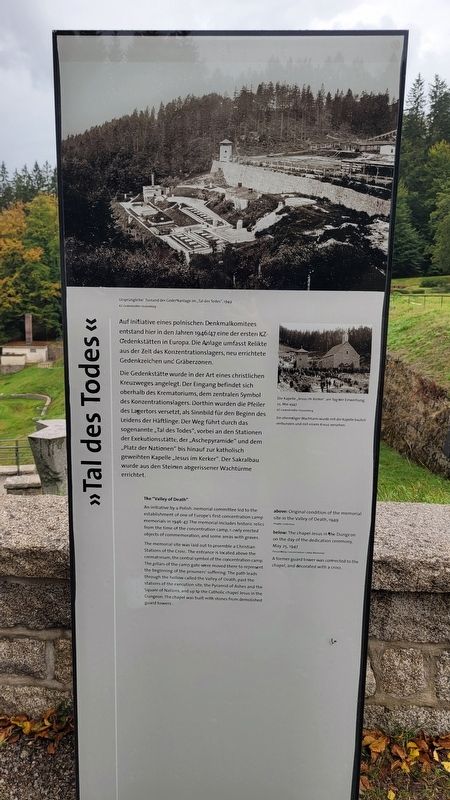
Auf Initiative eines polnischen Denkmalkomitees entstand hier in den Jahren 1946/47 eine der ersten KZ-Gedenkstätten in Europa. Die Anlage umfasst Relikte aus der Zeit des Konzentrationslagers, neu errichtete Gedenkzeichen und Gräberzonen.
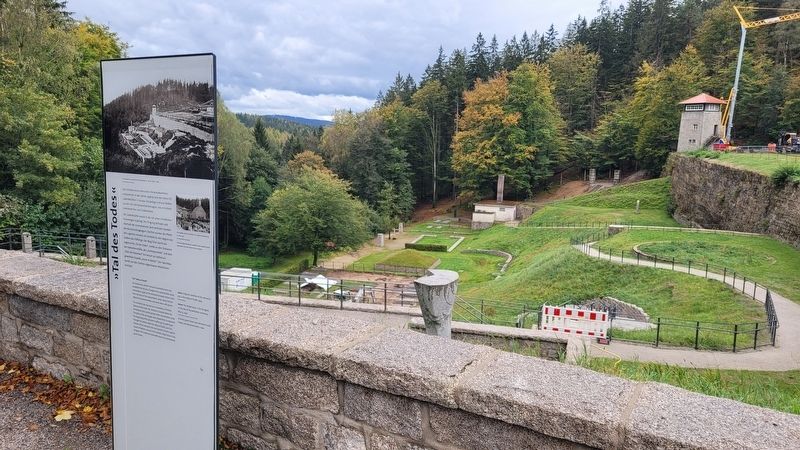
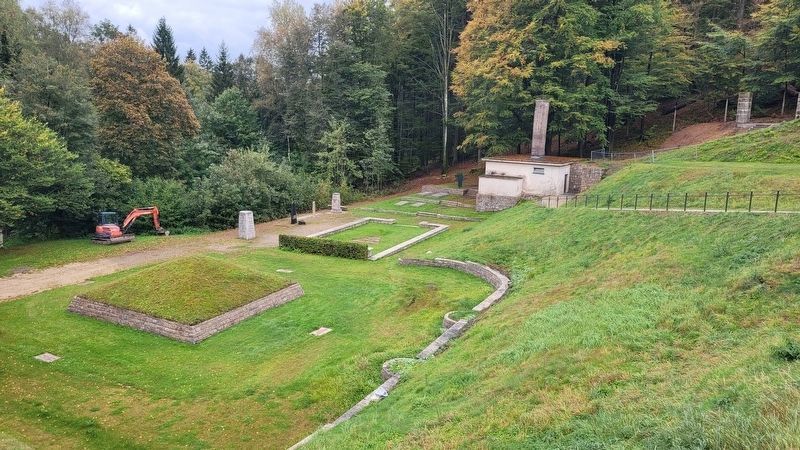
Die Gedenkstätte wurde in der Art eines christlichen Kreuzweges angelegt. Der Eingang befindet sich oberhalb des Krematoriums, dem zentralen Symbol des Konzentrationslagers. Dorthin wurden die Pfeiler des Lagertors versetzt, als Sinnbild für den Beginn des Leidens der Häftlinge. Der Weg führt durch das sogenannte „Tal des Todes", vorbei an den Stationen der Exekutionsstätte, der „Aschepyramide" und dem „Platz der Nationen" bis hinauf zur katholisch geweihten Kapelle „Jesus im Kerker". Der Sakralbau wurde aus den Steinen abgerissener Wachtürme errichtet.
Bildunterschriften
(Foto Nr. 1) Ursprüngliche Zustand der Gederkanlage im „Tal des Todes", 1949, KZ-Gedenkstätte Flossenbürg
(Foto Nr. 2) Die Kapelle „Jesus im Kerker" Tag der Einweihung, 25. Mai 1947, KZ-Gedenkstätte Flossenbürg, Ein ehemaliger Wachturm wurde mit der Kapelle baulich verbunden und mit einem Kreuz versehen.
The "Valley of Death"
An initiative by a Polish memorial committee led to the establishment of one of Europe's first concentration camp memorials in 1946-47. The memorial includes historic relics from the time of the concentration camp, newly erected objects of commemoration, and some areas with graves.
The memorial site was laid out to resemble a Christian Stations of the Cross. The entrance is located above the crematorium, the central symbol of the concentration camp. The pillars of the camp gate were moved there to represent the beginning of the prisoners' suffering. The path leads through the hollow called the Valley of Death, past the stations of the execution
this page online
Captions
above: Original condition of the memorial site in the Valley of Death, 1949, Private Collection
below: The chapel Jesus in the Dungeon on the day of the dedication ceremony, May 25, 1947, Flossenbürg Concentration Camp Memorial, A former guard tower was connected to the chapel, and decorated with a cross.
Topics. This historical marker is listed in these topic lists: Cemeteries & Burial Sites • War, World II. A significant historical date for this entry is May 25, 1947.
Location. 49° 44.093′ N, 12° 21.529′ E. Marker is in Flossenbürg, Bayern (Bavaria), in Neustadt an der Waldnaab. It is on Gedächtnisallee just east of Silberhüttenstraße. The marker is located at the east section of the Flossenbürg Concentration Camp. Touch for map. Marker is at or near this postal address: Gedächtnisallee 5-7, Flossenbürg BY 92696, Germany. Touch for directions.

Regionally, it is in Europe, the European Union, Atlantic Europe, Central Europe, the Schengen Area, Western
Photographed by James Hulse, September 27, 2024
2. The "Valley of Death" and Marker
Other nearby markers. At least 8 other markers are within walking distance of this marker: Quarantänebaracken / Quarantine Barracks (about 90 meters away, measured in a direct line); Ehrenfriedhof / Cemetery of Honour (about 90 meters away); Häftlingsbad / Prisoner Bathroom (about 120 meters away); Wäscherei / Laundry Building (about 150 meters away); Krankenrevier / Infirmary (about 150 meters away); Lagerbordell / Camp Brothel (about 150 meters away); Arrestbau / Detention Building (about 180 meters away); Häftlingsküche / Prisoner Kitchen (about 180 meters away). Touch for a list and map of all markers in Flossenbürg.
More about this marker. The marker is located on the grounds of the Flossenbürg Concentration Camp Memorial.
Also see . . . Flossenbürg Concentration Camp. KZ-Gedenkstätte Flossenbürg
Before the establishment of the concentration camp, Flossenbürg was merely a small village in the Upper Palatinate forest. Beginning in the late 19th century, a number of quarries(Submitted on November 13, 2024, by James Hulse of Medina, Texas.)were opened in the area in order to exploit local granite deposits, and Flossenbürg developed into a workers’ village.Photographed by James Hulse, September 27, 20243. The Pyramid of AshesThe crematorium is located behind the Pyramid of Ashes.
Credits. This page was last revised on September 30, 2026. It was originally submitted on November 13, 2024, by James Hulse of Medina, Texas. This page has been viewed 121 times since then and 23 times this year. Photos: 1, 2, 3. submitted on November 13, 2024, by James Hulse of Medina, Texas.
