
Flossenbürg in Neustadt an der Waldnaab, Bavaria, Germany — Central Europe
Quarantänebaracken
⎯⎯⎯
Quarantine Barracks
Photographed by James Hulse, September 27, 2024
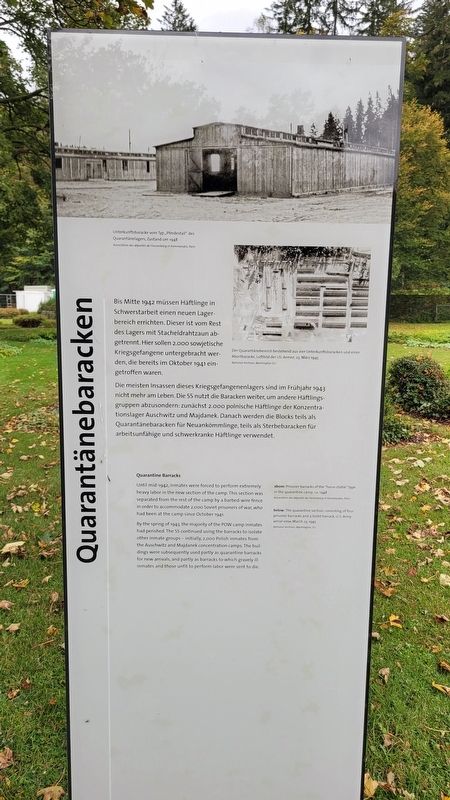
1. Quarantänebaracken / Quarantine Barracks Marker

Bis Mitte 1942 müssen Häftlinge in Schwerstarbeit einen neuen Lagerbereich errichten. Dieser ist vom Rest des Lagers mit Stacheldrahtzaun abgetrennt. Hier sollen 2.000 sowjetische Kriegsgefangene untergebracht werden, die bereits im Oktober 1941 eingetroffen waren.
Die meisten Insassen dieses Kriegsgefangenenlagers sind im Frühjahr 1943 nicht mehr am Leben. Die SS nutzt die Baracken weiter, um andere Häftlingsgruppen abzusondern: zunächst 2.000 polnische Häftlinge der Konzentrationslager Auschwitz und Majdanek. Danach werden die Blocks teils als Quarantänebaracken für Neuankömmlinge, teils als Sterbebaracken für arbeitsunfähige und schwerkranke Häftlinge verwendet.
Bildunterschriften
(Foto Nr. 1) Unterkunftsbaracke vom Typ „Pferdestall" des Quarantänelagers, Zustand um 1948, Association des déportés de Flossenhing et Kommandos, Paris
(Foto Nr. 2) Der Quarantänebereich bestehend aus vier Unterkunftsbaracken und einer Abortbaracke, Luftbild der US-Armee, 23. März 1945, National Archives, Washington D.C.
Quarantine Barracks
Until mid-1942, inmates were forced to perform extremely heavy labor in the new section of the camp. This section was separated from the rest of the camp by a barbed-wire fence in order to accommodate 2,000 Soviet prisoners of war, who had been at the camp since October 1941.
By the spring of 1943, the majority of the POW camp inmates had perished. The SS continued using the barracks to isolate other inmate groups - initially, 2,000 Polish inmates from the Auschwitz and Majdanek concentration camps. The buildings were subsequently used partly as quarantine barracks for new arrivals, and partly as barracks to which gravely ill inmates and those unfit to perform labor were sent to die.
Captions
above: Prisoner barracks of the "horse stable" type in the quarantine camp, ca. 1948, Association des déportés de Flossenbürg et Kommandos, Paris
below: The quarantine section, consisting of four prisoner barracks and a toilet barrack, US Army aerial view, March 23, 1945, National Archives, Washington D.C.
Topics.
this page online
Location. 49° 44.078′ N, 12° 21.458′ E. Marker is in Flossenbürg, Bayern (Bavaria), in Neustadt an der Waldnaab. It is on Gedächtnisallee east of Silberhüttenstraße. The marker is located at the east section of the Flossenbürg Concentration Camp in the cemetery. Touch for map. Marker is at or near this postal address: Gedächtnisallee 5-7, Flossenbürg BY 92696, Germany. Touch for directions.

Regionally, it is in Europe, the European Union, Atlantic Europe, Central Europe, the Schengen Area, Western Europe, and the Western World. Historically, it finds itself in what was once the Holy Roman Empire and also the former West Germany.
Other nearby markers. At least 8 other markers are within walking distance of this marker: Ehrenfriedhof / Cemetery of Honour (within shouting distance of this marker); Lagerbordell / Camp Brothel (within shouting distance of this marker); Krankenrevier / Infirmary (about 90 meters away, measured in a direct line); Häftlingsbad / Prisoner Bathroom (about
Photographed by James Hulse, September 27, 2024
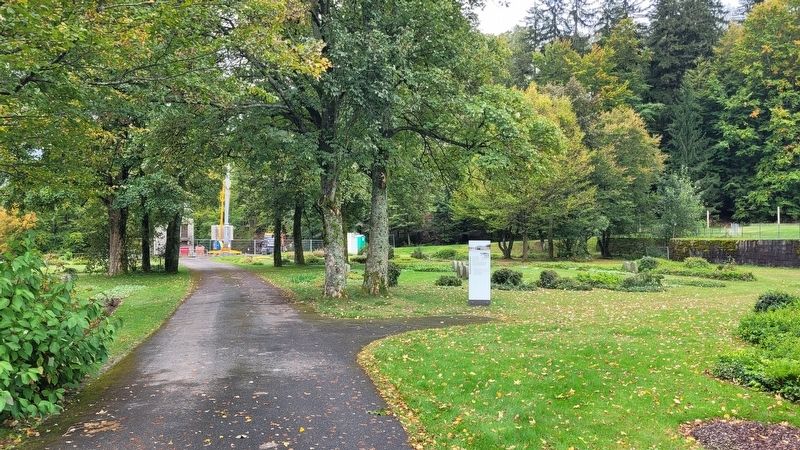
2. The view of the Quarantine Barracks Marker in the cemetery
More about this marker. The marker is located on the grounds of the Flossenbürg Concentration Camp Memorial.
Also see . . . Flossenbürg Concentration Camp. KZ-Gedenkstätte Flossenbürg
Before the establishment of the concentration camp, Flossenbürg was merely a small village in the Upper Palatinate forest. Beginning in the late 19th century, a number of quarries were opened in the area in order to exploit local granite deposits, and Flossenbürg developed into a workers’ village.(Submitted on November 13, 2024, by James Hulse of Medina, Texas.)
Credits. This page was last revised on September 30, 2026. It was originally submitted on November 13, 2024, by James Hulse of Medina, Texas. This page has been viewed 102 times since then and 13 times this year. Photos: 1, 2. submitted on November 15, 2024, by James Hulse of Medina, Texas.
