
Flossenbürg in Neustadt an der Waldnaab, Bavaria, Germany — Central Europe
Lagerbordell
⎯⎯⎯
Camp Brothel
Photographed by James Hulse, September 27, 2024
1. Lagerbordell / Camp Brothel Marker

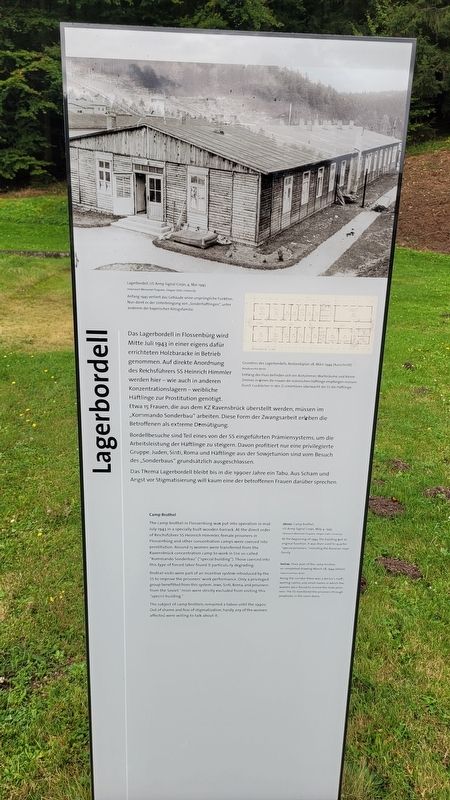
Das Lagerbordell in Flossenbürg wird Mitte Juli 1943 in einer eigens dafür errichteten Holzbaracke in Betrieb genommen. Auf direkte Anordnung des Reichsführers SS Heinrich Himmler werden hier - wie auch in anderen Konzentrationslagern - weibliche Häftlinge zur Prostitution genötigt. Etwa 15 Frauen, die aus dem KZ Ravensbrück überstellt werden, müssen im „Kommando Sonderbau" arbeiten. Diese Form der Zwangsarbeit erleben die Betroffenen als extreme Demütigung.
Bordellbesuche sind Teil eines von der SS eingeführten Prämiensystems, um die Arbeitsleistung der Häftlinge zu steigern. Davon profitiert nur eine privilegierte Gruppe. Juden, Sinti, Roma und Häftlinge aus der Sowjetunion sind vom Besuch des „Sonderbaus" grundsätzlich ausgeschlossen.
Das Thema Lagerbordell bleibt bis in die 1990er Jahre ein Tabu. Aus Scham und Angst vor Stigmatisierung will kaum eine der betroffenen Frauen darüber sprechen.
Bildunterschriften
(Foto Nr. 1) Lagerbordell, US Army Signal Corps, 4. Mai 1945, Holocaust Memorial Program, Oregon State University, Anfang 1945 verliert das Gebäude seine ursprüngliche Funktion. Nun dient es der Unterbringung von „Sonderhäftlingen", unter anderem der bayerischen Königsfamilie.
(Foto Nr. 2) Grundriss des Lagerbordells, Bestandsplan 28. März 1944 (Ausschnitt), Bundesarchiv Berlin, Entlang des flurs befinden sich ein Arztzimmer, Warteräume und kleine Zimmer, in denen die Frauen die männlichen Häftlinge empfangen müssen. Durch Gucklöcher in den Zimmertüren überwacht die SS die Häftlinge
Camp Brothel
The camp brothel in Flossenbürg was put into operation in mid-July 1943 in a specially built wooden barrack. At the direct order of Reichsführer SS Heinrich Himmler, female prisoners in Flossenbürg and other concentration camps were coerced into prostitution. Around
this page online
Brothel visits were part of an incentive system introduced by the SS to improve the prisoners work performance. Only a privileged group benefitted from this system. Jews, Sinti, Roma, and prisoners from the Soviet Union were strictly excluded from visiting this "special building".
The subject of camp brothels remained a taboo until the 1990s. Out of shame and fear of stigmatization, hardly any of the women affected were willing to talk about it.
Captions
above: Camp brothel, US Army Signal Corps, May 4, 1945, At the beginning of 1945, the building lost its original function. It was then used to quarter "spectal prisoners", including the Bavarian royal family.
below: Floor plan of the camp brothel, as-completed drawing, March 28, 1944 (detail), Along the corridor there a doctor's room, waiting rooms, and small rooms in which the women were forced to receive the male prisoners. The SS monitored the prisoners through peepholes in the room doors.
Topics.
Photographed by James Hulse, September 27, 2024
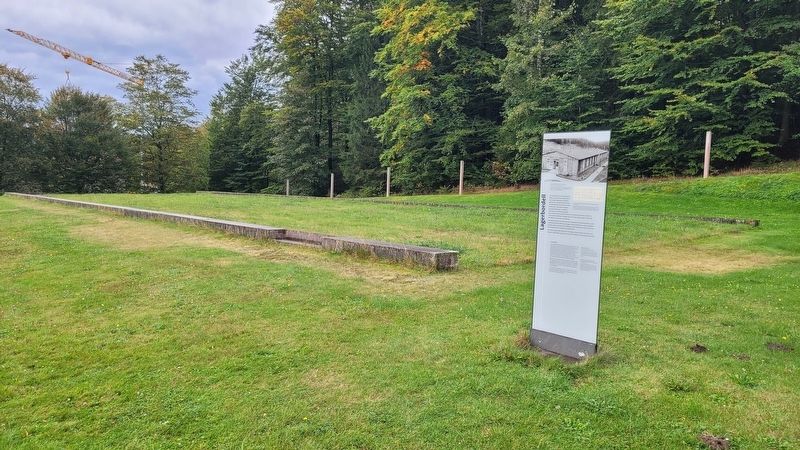
2. The former location of the Camp Brothel and Marker
Location. 49° 44.073′ N, 12° 21.393′ E. Marker is in Flossenbürg, Bayern (Bavaria), in Neustadt an der Waldnaab. It is on Gedächtnisallee just east of Silberhüttenstraße. The marker is located at the east section of the Flossenbürg Concentration Camp. Touch for map. Marker is at or near this postal address: Gedächtnisallee 5-7, Flossenbürg BY 92696, Germany. Touch for directions.

Regionally, it is in Europe, the European Union, Atlantic Europe, Central Europe, the Schengen Area, Western Europe, and the Western World. Historically, it finds itself in what was once the Holy Roman Empire and also the former West Germany.
Other nearby markers. At least 8 other markers are within walking distance of this marker: Krankenrevier / Infirmary (within shouting distance of this marker); Arrestbau / Detention Building (within shouting distance of this marker); Häftlingsbaracken / Prisoner Barracks (within shouting distance of this marker); S úctou spomíname / With respect, we remember them
Photographed by James Hulse, September 27, 2024
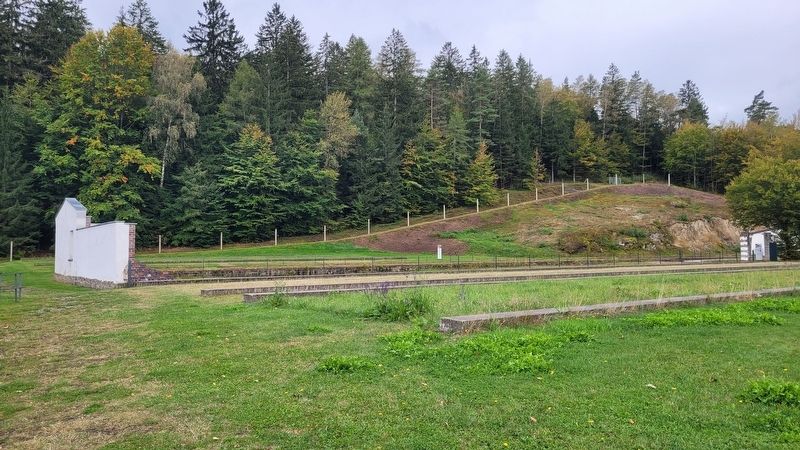
3. The wide view of the Camp Brothel Marker (center) from the cemetery
More about this marker. The marker is located on the grounds of the Flossenbürg Concentration Camp Memorial.
Also see . . . Flossenbürg Concentration Camp. KZ-Gedenkstätte Flossenbürg (Submitted on November 13, 2024, by James Hulse of Medina, Texas.)
Credits. This page was last revised on September 30, 2026. It was originally submitted on November 13, 2024, by James Hulse of Medina, Texas. This page has been viewed 241 times since then and 87 times this year. Photos: 1, 2, 3. submitted on November 15, 2024, by James Hulse of Medina, Texas.
