Trent-Severn Waterway National Historic Site
Lieu historique national de la Voie-Navigable-Trent-Severn


• The Peterborough Lift Lock was inaugurated on July 9, 1904. It took eight years to build.
• With a height of 19.8 metres, it is the highest hydraulic lift lock in the world.
• Only eight lift locks of this type have been built in the world. There are two in Canada; the others are in Belgium, Great Britain and France.
• At the time of its construction, it was one of the largest non-reinforced concrete structures in the world. It contains 20,000 cubic metres of concrete.
• Regardless of the number of boats in the chamber, the weight in the chamber will not change. According to the Archimede's principle of physics, a boat will displace a quantity of water equivalent to the weight of the boat.
More questions about the lift lock?
Don't hesitate to ask Parks Canada staff.
Here’s how it works
1. The two chambers are mounted on rams, each of which plunges into a water-filled cylinder. The cylinders are connected by a pipe. The connection between the cylinders is controlled by a valve (V), a kind of tap in the middle of this pipe.
2. The boats enter the chambers. During this operation, the valveV is closed. In the diagram, the boats going downriver enter chamber A and the boats going upriver enter chamber B.
Click or scan to see
this page online
3. Chamber A is heavier than chamber B since extra water was added to it earlier. Without this, the two chambers would balance out in mid-stroke. Chamber and ram A go down and push the water in cylinder A into cylinder B. Chamber and ram B rise.
4. When chamber A is down and chamber B is up, the valve is closed and the gates are opened.
• L’ascenseur à bateaux dé Peterborough a été inauguré le 9 juillet 1904. Sà construction a pris huit ans.Vous avez d'autres questions sur l’ascenseur hydraulique?
• Avec une chute de 19.8 métres, c'est le plus grand ascenseur hydraulique au monde.
• Seulement huit ascenseurs de ce type ont été construits dans le monde. Il y a en a deux au Canada, et tes autres sont en Belgique, en Grande-Bretagne et en France.
• Au moment de sa construction, c'était une des structures en béton non renforcé les plus massives au monde. Il comprend plus de 20 000 mètres cubes de béton.
• Quel que soit le nombre de bateaux dans un bac rempli d'eau, le poids du bac ne changera pas. Selon le principe d'Archimède, un principe de physique,un bateau déplacera hors du bac la quantité d'eau équivalente à son propre poids. 2. Marker detail: Lift Lock Diagram
N'hésitez pas à vous adresser au personnel de Parcs Canada.
Comment ça marche?
1. Les deux bacs sont montés sur des pistons qui plongent chacun dans un cylindré rempli d'eau. Les cylindres communiquent par un tuyau. Au milieu, la vanne (V), une sorte de robinet, permet d'ouvrir ou de fermer la communication entre les cylindres.
2. Les bateaux entrent dans les bacs. Pendant cette manœuvre, la Vanne V est fermée. Sur le diagramme, les bateaux qui descendent la rivière vont dans le bac A et ceux qui remontent dans le bac B.
3. Le bac A est plus lourd que le bac B, car on y a admis au préalable une surcharge d'eau. Sans cela, les deux bacs s'équilibreraient au milieu de leur course. On ouvre la vanne. Le bac et le piston A s'enfoncent et chassent l'eau du cylindre A dans le cylindre B. Le piston et le bac B montent.
4. Lorsque le bac A est en bas, et le bac B en haut, on ferme la vanne et on ouvre les portes.
Erected by Parks Canada / Parcs Canada.
Topics. This historical marker is listed

Location. 44° 18.477′ N, 78° 18.045′ W. Marker is in Peterborough, Ontario, in Peterborough County. It can be reached from Hunter Street East 0.1 kilometers west of Ashburnham Drive, on the right when traveling west. The marker is located on the upper-level observation deck of the Peterborough Lift Lock structure, overlooking the lift lock chambers from the north side of Hunter Street East. Touch for map. Marker is at or near this postal address: 353 Hunter Street East, Peterborough ON K9H 7B5, Canada. Touch for directions.

Regionally, this marker is in the Kawarthas Northumberland Area and in Eastern Ontario. It is also in Central Canada. Globally, it is in North America, the Western Hemisphere, the Western World, and the Anglosphere. Historically, it finds itself in what was once a British colony, the Viceroyalty of New France, the Haudenosaunee (Iroquois) Confederacy, and Rupert’s Land.
Other nearby markers. At least 8 other markers are within walking distance of this marker: Richard Birdsall Rogers (here,

Related markers. Click here for a list of markers that are related to this marker. Peterborough Lift Lock National Historic Site
Also see . . . Peterborough Lift Lock (Wikipedia).
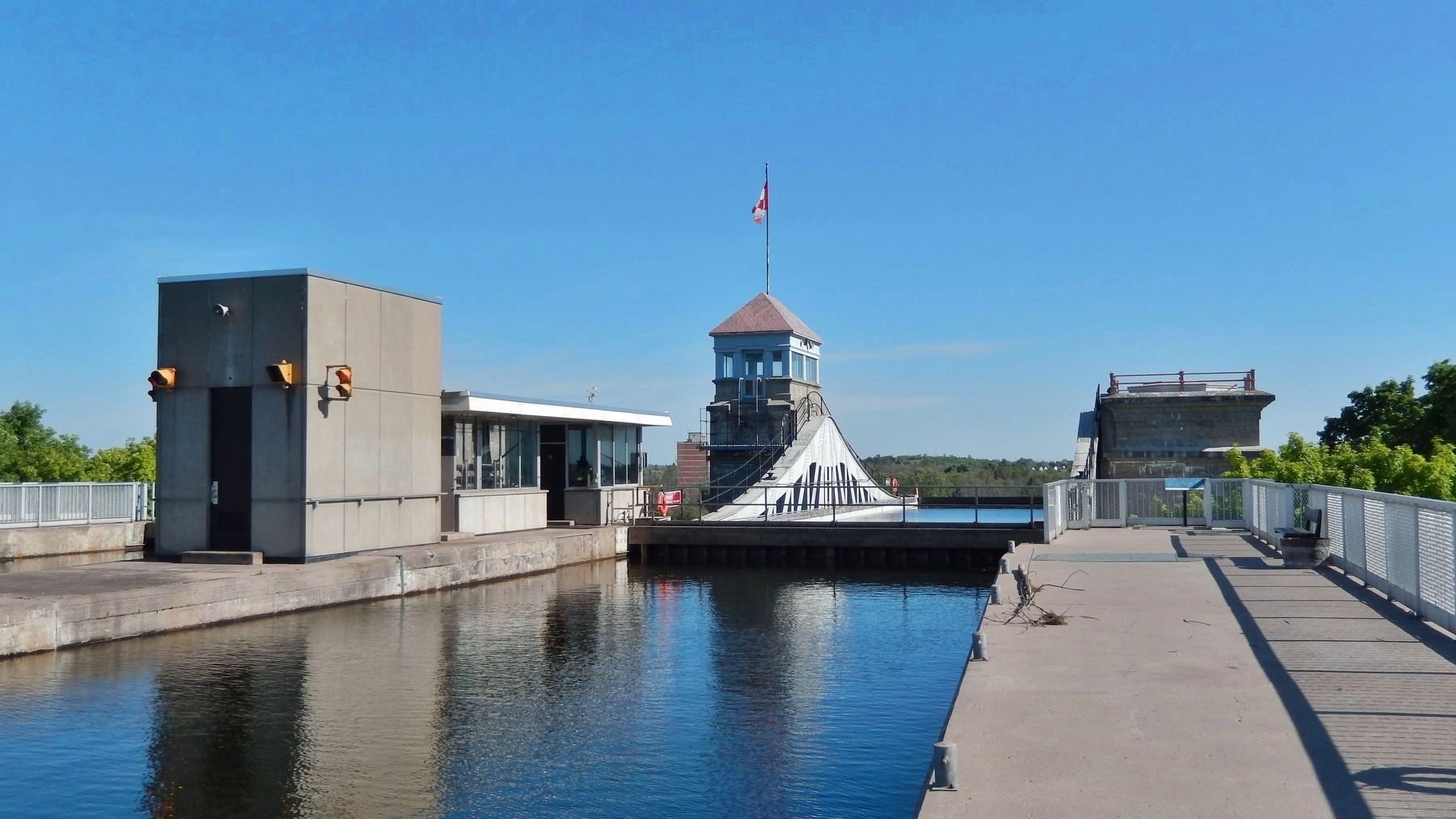
Excerpt: The Peterborough Lift Lock is a boat lift located on the Trent Canal and is Lock 21 on the Trent-Severn Waterway. For many years, the lock's dual lifts were the highest hydraulic boat lifts in the world, raising boats 65 ft. This was a considerable accomplishment in the first years of the 20th century, when conventional locks usually only had a 7 ft rise. The Peterborough(Submitted on November 17, 2024, by Cosmos Mariner of Cape Canaveral, Florida.)Lift Lock was designated a National Historic Site in 1979 and was named an Historic Mechanical Engineering Landmark by the American Society of Mechanical Engineers in 1987.Photographed by Cosmos Mariner, May 31, 20245. Peterborough Lift LockLooking south along the canal toward the lift lock. There are no vessels in the canal or chamber waiting to go downstream at this time. The marker is against the pedestrian railing on the right side of the observation deck.The lock has two identical bathtub-like ship caissons in which vessels ascend and descend. Both caissons are enclosed at each end by pivoting gates, and there are pivoting gates at the upper and lower reaches of the canal at the junctions with the caissons. Each caisson sits on a 7.5 ft diameter ram, the shafts for which are sunk into the ground, are filled with water, and are connected with a pipe that has a crossover control valve. The caissons are guided up and down on either side by rails affixed to concrete towers. The caissons are 140 ft long, 33 ft wide, and 7 ft deep and when filled with 228,093 gallons of water weigh 1,500 tons. No external power is needed: the lift lock functions by gravity alone using the counterweight principle. One caisson always ascends and the other always descends during each locking cycle.

Credits. This page was last revised on November 17, 2024. It was originally submitted on November 13, 2024, by Cosmos Mariner of Cape Canaveral, Florida. This page has been viewed 197 times since then and 31 times this year. Photos: 1, 2, 3, 4, 5, 6. submitted on November 17, 2024, by Cosmos Mariner of Cape Canaveral, Florida.
