Thurmont in Frederick County, Maryland — The American Northeast (Mid-Atlantic)
The Ingredients For Iron
Catoctin Furnace Iron Trail
Photographed by Allen C. Browne, October 30, 2024
1. The Ingredients For Iron Marker
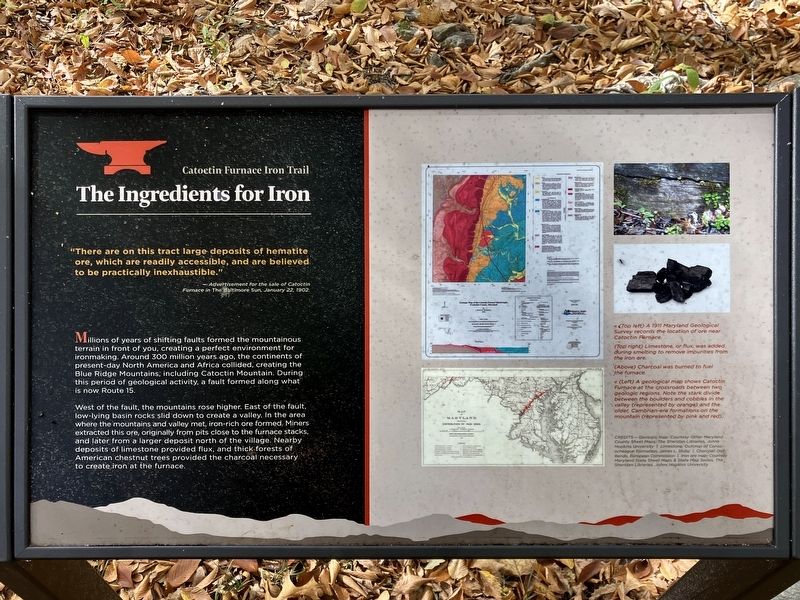
“There are on this tract large deposits of hematite ore, which are readily accessible, and are believed to be practically inexhaustible."
- Advertisement for the sale of Catoctin Furnace in The Baltimore Sun, January 22, 1902.
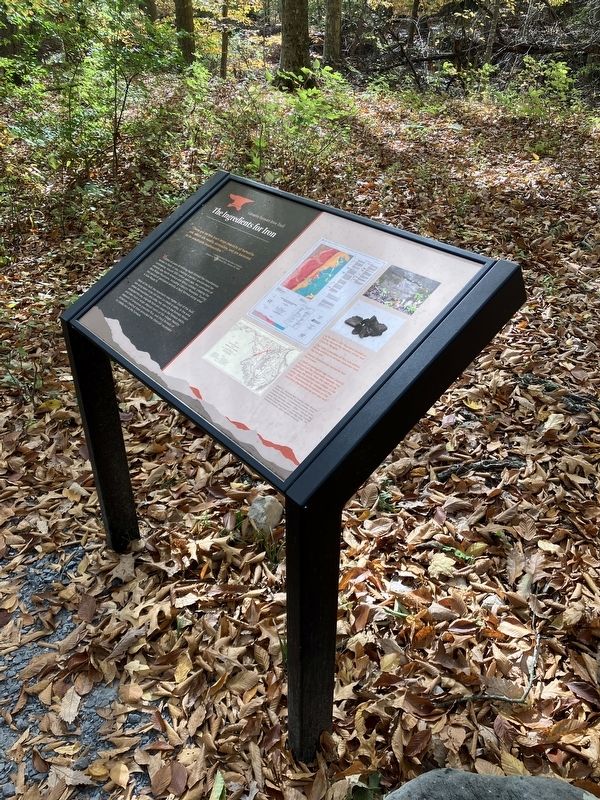
Millions of years of shifting faults formed the mountainous terrain in front of you, creating a perfect environment for ironmaking. Around 300 million years-ago, the continents of present-day North America and Africa collided, creating the Blue Ridge Mountains, including Catoctin Mountain. During this period of geological activity, a fault formed along what is now Route 15.
West of the fault, the mountains rose higher East of the fault, Iow-lying basin rocks slid down to create a valley. In the area where the mountains and valley met, iron-rich ore formed. Miners extracted this ore, originally from pits close to the furnace stacks, and later from a larger deposit north of the village. Nearby deposits of limestone provided flux, and thick forests of American Chestnut trees provided the charcoal, necessary to create iron at the furnace.
[Captions:]
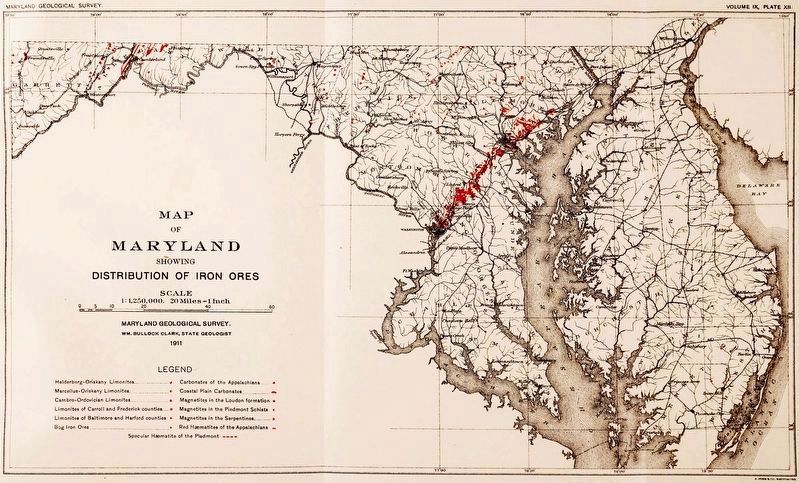
« (Top left) A 1911 Maryland Geographical Survey records the location of ore near Catoctin Furnace.
(Top right) Limestone, or flux, was added during smelting to remove impurities from the iron ore.
(Above) Charcoal was burned to fuel the furnaces.
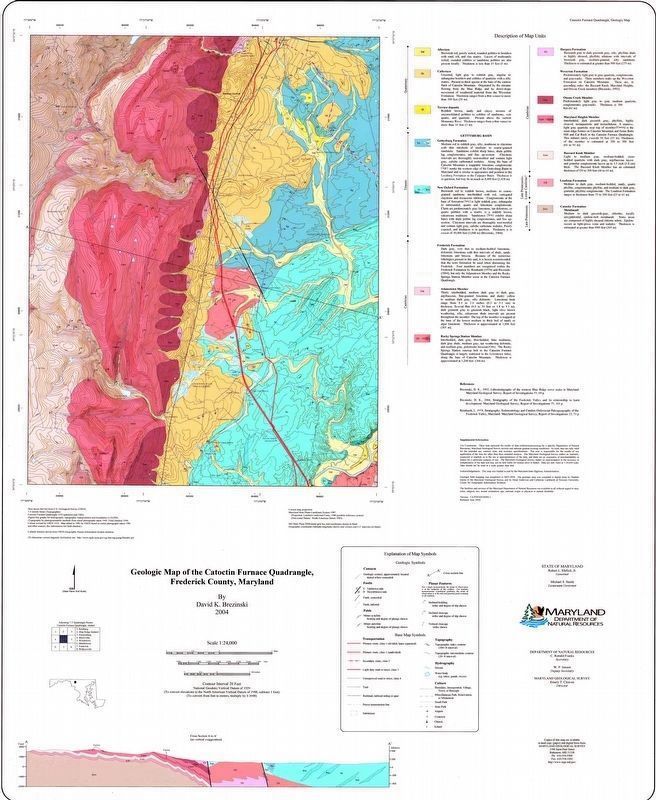
« (Left) A geological map shows Catoctin Furnace at the crossroads between two geologic regions. Note the stark divide between the boulders and cobbles in the valley (represented by orange) and the older, Cambrian-era formations on the mountain (represented by pink and red).
Erected by Catoctin
this page online
Topics. This historical marker is listed in these topic lists: Industry & Commerce • Natural Features • Natural Resources. A significant historical date for this entry is January 22, 1902.
Location. 39° 35.112′ N, 77° 26.173′ W. Marker is in Thurmont, Maryland, in Frederick County. It can be reached from Cunningham Falls Park Road west of U.S. 15, on the right when traveling west. Touch for map. Marker is at or near this postal address: 6701 Cunningham Falls Park Rd, Thurmont MD 21788, United States of America. Touch for directions.

Regionally, this marker is in the Washington Metropolitan Area and in Central Maryland. It is also in the American Mid-Atlantic. Globally, it is in North America, the Western Hemisphere, the Western World, and the Anglosphere. Historically, it finds itself in what was once one of the original Thirteen Colonies and also the Antebellum South.
Other nearby markers. At least 8 other markers are within walking distance of this marker: A Creek Rediscovered (within shouting distance
Photographed by Allen C. Browne, October 30, 2024
2. The Ingredients For Iron Marker
Other markers no longer nearby. Little Hunting Creek (was within shouting distance of this marker but has been replaced with another marker now near it); Second Growth Forest (was within shouting distance of this marker but has been replaced with another marker now near it); Slag Heaps (was about 700 feet away but has been replaced with another marker now near it).
Maryland State Archives
3. Geologic Map of the Catoctin Furnace Quadrangle
by David K. Brezinki
2004
by David K. Brezinki
2004
Library of Congress
4. Map of Maryland showing Distribution of Iron Ores
by Wm. Bullock Clark, State Geologist
by Wm. Bullock Clark, State Geologist
A 1911 Maryland Geological Survey records the location of ore near Catoctin Furnace.
Page 83 of The Iron Ores of Maryland, with an account of the iron industry by Joseph T. Singewald, 1911.
Page 83 of The Iron Ores of Maryland, with an account of the iron industry by Joseph T. Singewald, 1911.
Credits. This page was last revised on May 18, 2026. It was originally submitted on November 14, 2024, by Allen C. Browne of Silver Spring, Maryland. This page has been viewed 174 times since then and 32 times this year. Photos: 1. submitted on November 14, 2024, by Allen C. Browne of Silver Spring, Maryland. 2, 3, 4. submitted on November 15, 2024, by Allen C. Browne of Silver Spring, Maryland.
Editor’s want-list for this marker. Transcription of the captions • Can you help?
