Captiva in Lee County, Florida — The American South (South Atlantic)
Historic Captiva Cemetery
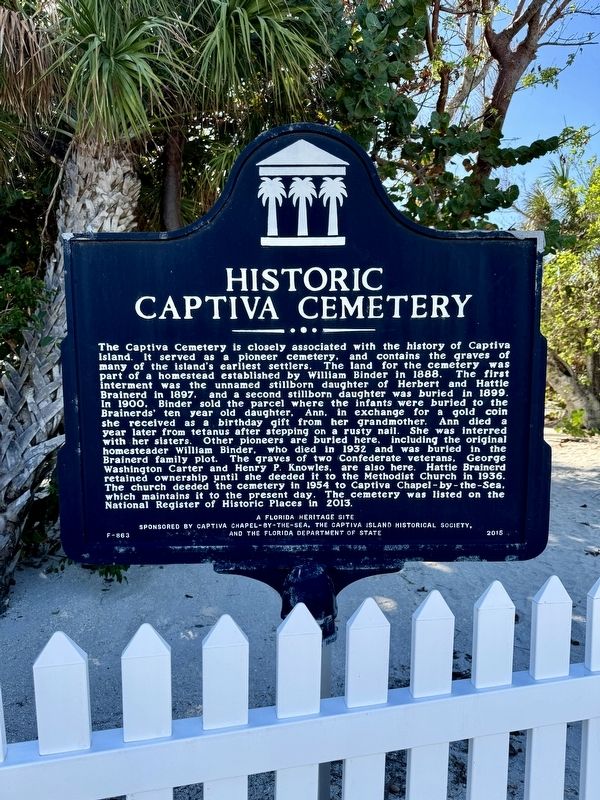
Photographed by Brandon D Cross
1. Historic Captiva Cemetery Marker
this page online
Erected 2015 by Captiva Chapel-By-The-Sea, The Captiva Island Historical Society and The Florida Department of State. (Marker Number F-863.)
Topics. This historical marker is listed in these topic lists: Cemeteries & Burial Sites • Settlements & Settlers. A significant historical year for this entry is 1888.
Location. 26° 31.204′ N, 82° 11.539′ W. Marker is in Captiva, Florida, in Lee County. It can be reached from the intersection of Chapin Lane and Wiles Drive, on the right when traveling west. The marker is located at the entrance to the cemetery. Touch for map. Marker is at or near this postal address: 11580 Chapin Lane, Captiva FL 33924, United States of America. Touch for directions.

Regionally, this marker is on Florida’s Gulf Coast. It is also in the American South and on the Gulf Coast. Globally, it is in the North Atlantic Region, North America, a Gulf of Mexico state, the Western Hemisphere, the Western World, and the Anglosphere. Historically, it finds itself in what was once New Spain, the territory of the Mississippian
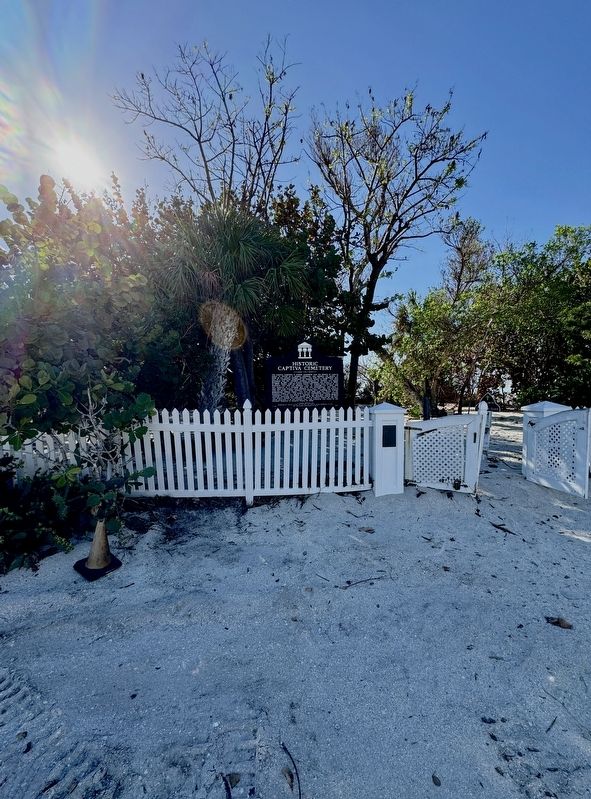
Photographed by Brandon D Cross
2. Historic Captiva Cemetery Marker
Other nearby markers. At least 8 other markers are within 9 miles of this marker, measured as the crow flies: Captiva School & Captiva Chapel~By~The~Sea (within shouting distance of this marker); 'Tween Waters Inn (approx. 0.7 miles away); Wildlife (approx. 7 miles away); Education (approx. 7 miles away); Conservation (approx. 7.1 miles away); Environment (approx. 8.3 miles away); Sanibel Pioneers (approx. 8.7 miles away); The Packing House (approx. 9.1 miles away). Touch for a list and map of all markers in Captiva.
Also see . . . Captiva’s Historic Cemetery. (Submitted on November 15, 2024, by Brandon D Cross of Flagler Beach, Florida.)
Credits. This page was last revised on February 18, 2026. It was originally submitted on November 15, 2024, by Brandon D Cross of Flagler Beach, Florida. This page has been viewed 217 times since then and 75 times this year. Photos: 1, 2. submitted on November 15, 2024, by Brandon D Cross of Flagler Beach, Florida. • Bernard Fisher was the editor who published this page.
