Peterborough in Peterborough County, Ontario — Central Canada (North America)
Women and the Second World War
⎯⎯⎯
Les femmes et la Seconde Guerre mondiale
1939-1945

Photographed by Cosmos Mariner, May 31, 2024
1. Women and the Second World War / Les femmes et la Seconde Guerre mondiale Marker

this page online
Erected by Parks Canada / Parcs Canada.
Topics. This historical marker is listed in these topic lists: War, World II • Women. A significant historical year for this entry is 1939.
Location. 44° 18.416′ N, 78° 18.101′ W. Marker is in Peterborough, Ontario, in Peterborough County. It can be reached from Hunter Street East 0.1 kilometers west of Ashburnham Drive, on the left when traveling south. The marker is located near the Trent-Severn Waterway Peterborough Lift Lock Visitor Centre entrance. Touch for map. Marker is at or near this postal address: 353 Hunter Street East, Peterborough ON K9H 7B5, Canada. Touch for directions.

Regionally, this marker is in the Kawarthas Northumberland Area and in Eastern Ontario. It is also in Central Canada. Globally, it is in North America, the Western Hemisphere, the Western World, and the Anglosphere. Historically, it finds itself in what was once a British colony, the Viceroyalty of New France, the Haudenosaunee (Iroquois) Confederacy, and Rupert’s Land.
Other nearby markers. At least 8 other markers are within walking distance of this marker: D-Day/Jour J
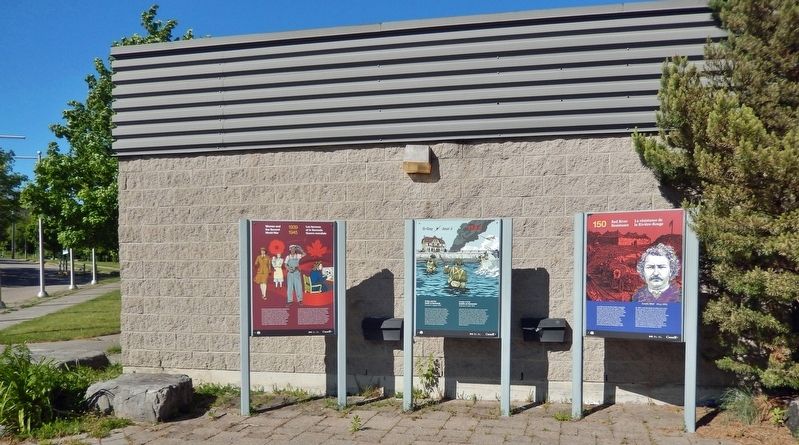
Photographed by Cosmos Mariner, May 31, 2024
2. Women and the Second World War / Les femmes et la Seconde Guerre mondiale Marker
This is the leftmost of three markers near the Trent-Severn Waterway Peterborough Lift Lock Visitor Centre entrance.
Also see . . . Canadian Women and War (Canadian Encyclopedia).
Excerpt: The first two women’s services were created as auxiliaries to the air force and the army in 1941. Some 50,000 Canadian women eventually enlisted in the air force, army and navy. While the Royal Canadian Air Force Women’s Division members were initially trained for clerical, administrative and support roles, they eventually came to work as parachute riggers, laboratory assistants, and within the electrical and mechanical trades. The Canadian Women’s Army Corps followed(Submitted on November 16, 2024, by Cosmos Mariner of Cape Canaveral, Florida.)the same path, with its members starting out as cooks, nurses and seamstresses, but later becoming drivers and mechanics. The third women’s military corps, the Women’s Royal Canadian Naval Service (WRCNS, or “Wrens” informally), was established in 1942.Photographed by Cosmos Mariner, May 31, 20243. Trent-Severn Waterway Peterborough Lift Lock Visitor CentreThere is another copy of this marker visible in the background — on the far-right side of the entrance.

Credits. This page was last revised on November 16, 2024. It was originally submitted on November 16, 2024, by Cosmos Mariner of Cape Canaveral, Florida. This page has been viewed 112 times since then and 15 times this year. Photos: 1, 2, 3. submitted on November 16, 2024, by Cosmos Mariner of Cape Canaveral, Florida.
