Goose Island in Chicago in Cook County, Illinois — The American Midwest (Great Lakes)
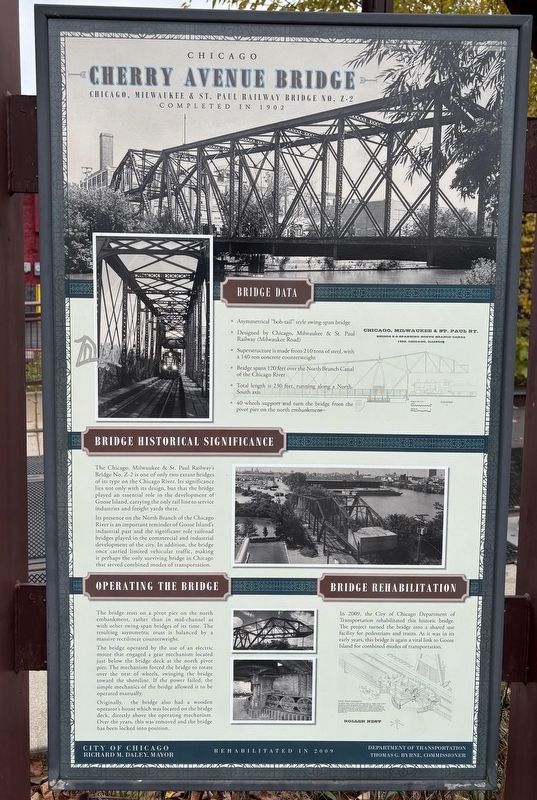
Cherry Avenue Bridge
Chicago, Milwaukee & St. Paul Railway Bridge No. Z-2
| — | Completed in 1902; Rehabilitated in 2009 | — |
Photographed by Sean P. Flynn, November 18, 2024
1. Cherry Avenue Bridge Marker
• Designed by Chicago, Milwaukee & St. Paul Railway (Milwaukee Road)
• Superstructure is made from 210 tons of steel, with a 140 ton concrete counterweight
• Bridge spans 120 feet over the North Branch Canal of the Chicago River
• Total length is 230 feet, running along a North-South axis
• 40 wheels support and turn the bridge from the pivot pier on the north embankment
Bridge Historical Significance
The Chicago, Milwaukee & St. Paul Railway's Bridge No. Z-2 is one of only two extant bridges of its type on the Chicago River. Its significance lies not only with its design, but that the bridge played an essential role in the development of Goose Island, carrying the only rail line to service industries and freight yards there. Its presence on the North Branch of the Chicago River is an important reminder of Goose Island's industrial past and the significant role railroad bridges played in the commercial and industrial development of the city. In addition, the bridge once carried limited vehicular traffic, making it perhaps the only surviving bridge in Chicago that served combined modes of transportation.
Operating the Bridge
The bridge rests on a pivot pier on the north embankment, rather than in mid-channel as with other swing-span bridges of its time. The resulting asymmetric truss is balanced by a massive rectilinear counterweight. The bridge operated by the use of an electric motor that engaged a gear mechanism located
this page online
Originally, the bridge also had a wooden operator's house which was located on the bridge deck, directly above the operating mechanism. Over the years, this was removed and the bridge has been locked into position.
Bridge Rehabilitation
In 2009, the City of Chicago Department of Transportation rehabilitated this historic bridge. The project turned the bridge into a shared use facility for pedestrians and trains. As it was in its early years, this bridge is again a vital link to Goose Island for combined modes of transportation.
Erected 2009 by City
Photographed by Sean P. Flynn, November 18, 2024
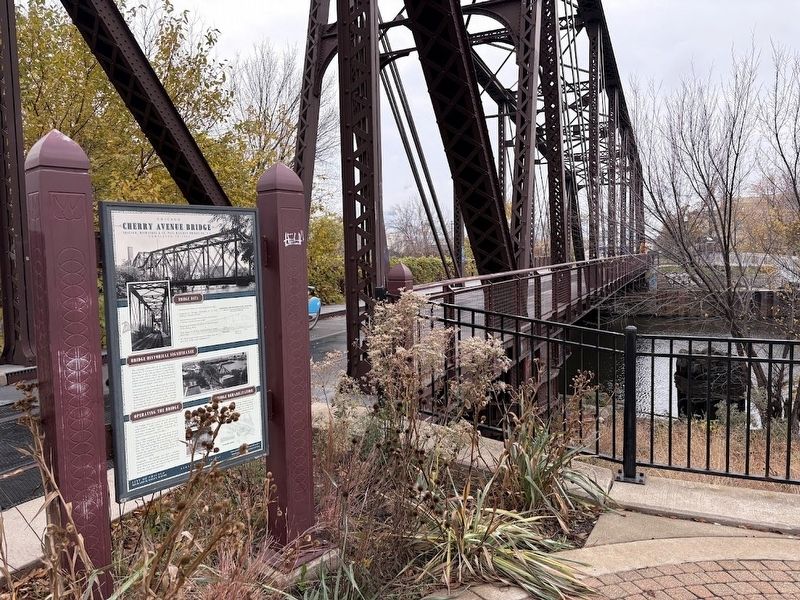
2. Cherry Avenue Bridge Marker
Topics and series. This historical marker is listed in these topic lists: Bridges & Viaducts • Industry & Commerce • Railroads & Streetcars • Waterways & Vessels. In addition, it is included in the Chicago, Milwaukee, St. Paul and Pacific Railroad series list. A significant historical year for this entry is 1902.
Location. 41° 54.634′ N, 87° 39.335′ W. Marker is in Chicago, Illinois, in Cook County. It is on Goose Island. It is on North Avenue (Illinois Route 64) 0.1 miles west of Kingsbury Street, on the right when traveling east. The marker is on the north end of the bridge. Touch for map. Marker is in this post office area: Chicago IL 60642, United States of America. Touch for directions.

Regionally, this marker is on Chicago’s North Side. It is also in the American Midwest.

Photographed by Sean P. Flynn, November 18, 2024
3. View from Cherry Avenue Bridge
The Chicago skyline is obscured by trees and fog.
Other nearby markers. At least 8 other markers are within walking distance of this marker: Pulaski Park Fieldhouse (approx. half a mile away); Armitage-Halsted (approx. 0.6 miles away); St. James Church Crosses (approx. 0.7 miles away); Fremont Row Houses (approx. 0.7 miles away); Bell from the First Holy Trinity Church (approx. 0.7 miles away); Bissell Street (approx. 0.7 miles away); Polish National Alliance Building (approx. 0.7 miles away); a different marker also named Bissell Street (approx. ¾ mile away). Touch for a list and map

Photographed by Sean P. Flynn, November 18, 2024
4. Cherry Avenue Bridge Marker
This west view of the bridge shows the large concrete counterweight that sits overhead on the north end near North Avenue.
More about this marker. Goose Island is a manmade island created on Chicago's north side when the North Branch Canal was constructed from the North Branch of the Chicago River. The island is best known today for its namesake brewery, which was founded in Chicago in 1988 and is today owned by Anheuser-Busch InBev.
Also see . . .
1. Historic Bridges: Cherry Avenue Bridge.
Excerpt: "The bridge is a rare asymmetrical "bobtail" type of swing bridge. The pier is on the north side, and a concrete counterweight overhead at that end balances the structure out. This bridge was one of the first movable bridges to use concrete as a counterweight. The bridge was important to the development of Goose Island, since it was the only railroad connection to the island. The bridge was(Submitted on November 18, 2024, by Sean P. Flynn of Oak Park, Illinois.)designed and operated by the Chicago, Milwaukee, and St. Paul Railroad. In its later years, the bridge would become the property of Canadian Pacific Railroad. The bridge was then bought by the Chicago Terminal Railroad, who continued to run a train across the bridge on Tuesdays and Thursdays and other days as needed. The bridge is pin connected and carries a single set of tracks. Given its rare design, it is among the most significant of Chicago's vast collection of historic bridges."Photographed by Sean P. Flynn, November 18, 20245. Cherry Avenue Bridge (inset photo)This historic photo shows a train crossing the bridge.

2. Chicago, Milwaukee and St. Paul Railway history. The Encyclopedia of Milwaukee looks at this historic rail line, which was popularly known as the Milwaukee Road line. The line closed permanently in 1986. (Submitted on November 18, 2024, by Sean P. Flynn of Oak Park, Illinois.)
Credits. This page was last revised on February 21, 2025. It was originally submitted on November 18, 2024, by Sean P. Flynn of Oak Park, Illinois. This page has been viewed 441 times since then and 92 times this year. Photos: 1, 2, 3, 4, 5. submitted on November 18, 2024, by Sean P. Flynn of Oak Park, Illinois.
