Stowe in Lamoille County, Vermont — The American Northeast (New England)
Gold Brook Covered Bridge
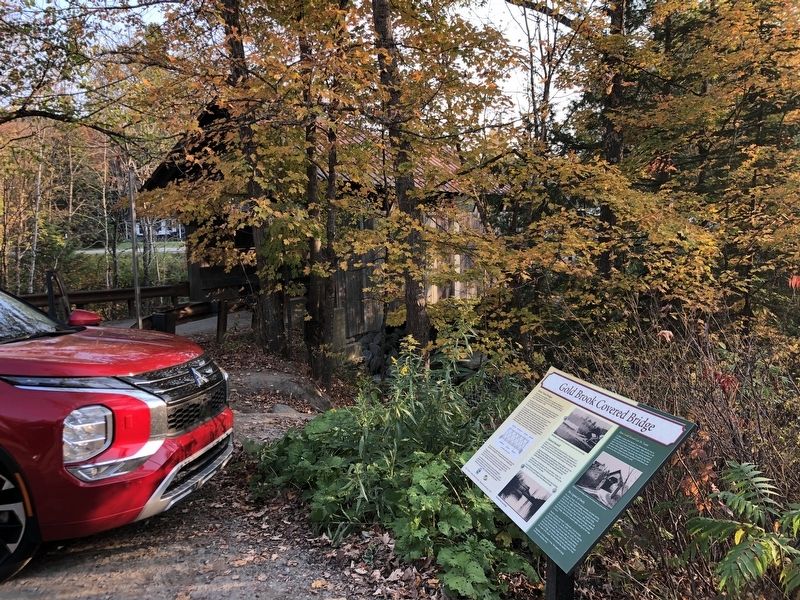
Photographed by Duane and Tracy Marsteller, October 3, 2024
1. Gold Brook Covered Bridge Marker
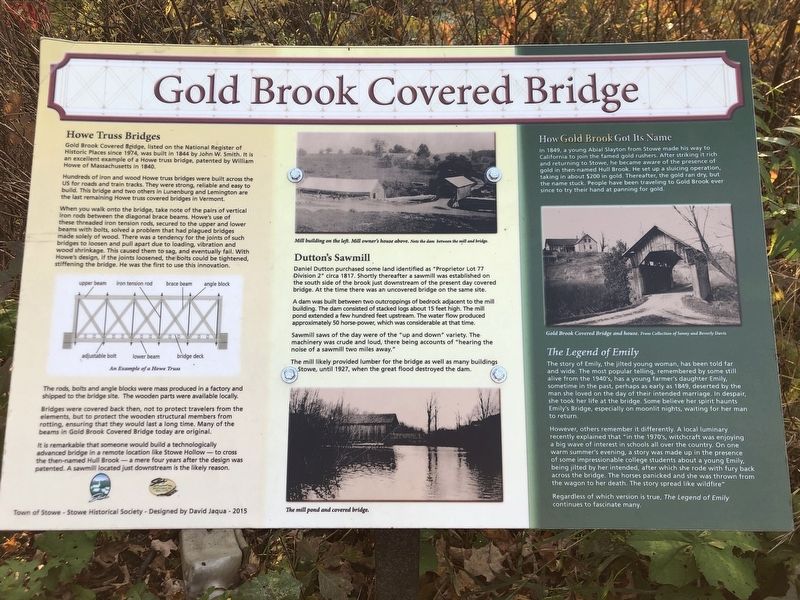
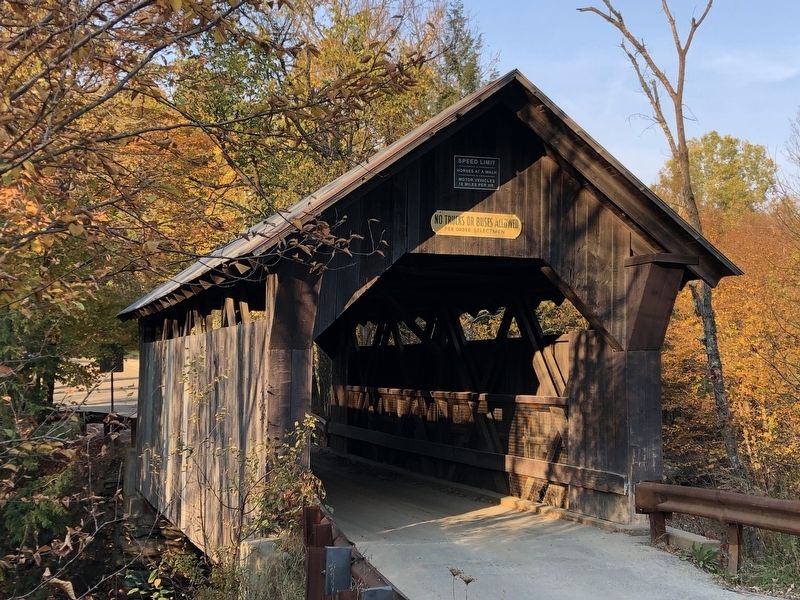
Gold Brook Covered Bridge, listed on the National Register of Historic Places since 1974, was built in 1844 by John W. Smith. It is an excellent example of a Howe truss bridge, patented by William Howe of Massachusetts in 1840.
Hundreds of iron and wood Howe truss bridges were built across the US for roads and train tracks. They were strong, reliable and easy to build. This bridge and two others in Lunenburg and Lemington are the last remaining Howe truss covered bridges in Vermont.
When you walk onto the bridge, take note of the pairs of vertical iron rods between the diagonal brace beams. Howe's use of these threaded iron tension rods, secured to the upper and lower beams with bolts, solved a problem that had plagued bridges made solely of wood. There was a tendency for the joints of such bridges to loosen and pull apart due to loading, vibration and wood shrinkage. This caused them to sag, and eventually fail. With Howe's design, if the joints loosened, the bolts could be tightened, stiffening the bridge. He was the first to use this innovation.
The rods, bolts and angle blocks were mass
this page online
Bridges were covered back then, not to protect travelers from the elements, but to protect the wooden structural members from rotting, ensuring that they would last a long time. Many of the beams in Gold Brook Covered Bridge today are original.
It is remarkable that someone would build a technologically advanced bridge in a remote location like Stowe Hollow – to cross the then-named Hull Brook – a mere four years after the design was patented. A sawmill located just downstream is the likely reason.
Dutton's Sawmill
Daniel Dutton purchased some land identified as “Proprietor Lot 77 Division 2” circa 1817. Shortly thereafter a sawmill was established on the south side of the brook just downstream of the present day covered bridge. At the time there was an uncovered bridge on the same site.
A dam was built between two outcroppings of bedrock adjacent to the mill building. The dam consisted of stacked logs about 15 feet high. The mill pond extended a few hundred feet upstream. The water flow produced approximately 50 horse-power,
Photographed by Duane and Tracy Marsteller, October 3, 2024
2. Gold Brook Covered Bridge Marker
Sawmill saws of the day were of the “up and down” variety. The machinery was crude and loud, there being accounts of “hearing the noise of a sawmill two miles away.”
The mill likely provided lumber for the bridge as well as many buildings in Stowe, until 1927, when the great flood destroyed the dam.
How Gold Brook Got Its Name
In 1849, a young Abial Slayton from Stowe made his way to California to join the famed gold rushers. After striking it rich and returning to Stowe, he became aware of the presence of gold in then-named Hull Brook. He set up a sluicing operation, taking in about $200 in gold. Thereafter, the gold ran dry, but the name stuck. People have been traveling to Gold Brook ever since to try their hand at panning for gold.
The Legend of Emily
The story of Emily, the jilted young woman, has been told far and wide. The most popular telling, remembered by some still alive from the 1940's, has a young farmer's daughter Emily, sometime in the past, perhaps as early as 1849, deserted by the man she loved on the day of their intended marriage. In despair, she took her life at
Photographed by Duane and Tracy Marsteller, October 3, 2024
3. Gold Brook Covered Bridge
However, others remember it differently. A local luminary recently explained that “in the 1970's, witchcraft was enjoying a big wave of interest in schools all over the country. On one warm summer's evening, a story was made up in the presence of some impressionable college students about a young Emily, being jilted by her intended, after which she rode with fury back across the bridge. The horses panicked and she was thrown from the wagon to her death. The story spread like wildfire.”
Regardless of which version is true, The Legend of Emily continues to fascinate many.
[Captions]
• Left: An example of a Howe Truss.
• Center, top: Mill building on the left. Mill owner's house above. Note the dam between the mill and bridge.
• Center, bottom: The mill pond and covered bridge.
• Right: Gold Brook Covered Bridge and house. Collection of Sony and Beverly Davis
Erected 2015 by Town of Stowe, VT • Stowe Historical Society.
Topics and series. This historical marker is listed in these topic lists: Bridges & Viaducts • Industry & Commerce • Waterways & Vessels. In addition, it is included in the Covered Bridges, and the National Register of Historic Places (NRHP) series lists. A significant historical year for this entry is 1849.
Location. 44° 26.436′ N, 72° 40.792′ W. Marker is in Stowe, Vermont, in Lamoille County. It is on Covered Bridge Road north of Stowe Hollow Road, on the left when traveling north. Touch for map. Marker is at or near this postal address: 2115 Covered Bridge Rd, Stowe VT 05672, United States of America. Touch for directions.

Regionally, this marker is in the Green Mountains. It is also in the American Northeast and in New England. Globally, it is in North America, the Great North Woods, the Western Hemisphere, the Western World, and the Anglosphere. Historically, it finds itself in what was once the Vermont Republic.
Other nearby markers. At least 8 other markers are within 10 miles of this marker, measured as the crow flies: Smugglers Notch (approx. 1.6 miles away); Waterbury Center Methodist Church (approx. 4.6 miles away); Dr. Henry Janes (approx. 8 miles away); Vermont State Hospital (approx. 8.2 miles away); 10th Mountain Division World War II Memorial Highway (approx. 8.3 miles away); Mount Mansfield Natural Area (approx. 9.2 miles away); Noyes House Museum (approx. 9.2 miles away); Second Noyes House (approx. 9.2 miles away). Touch for a list and map of all markers in Stowe.
Also see . . .
1. Gold Brook Covered Bridge (PDF). National Register nomination for the bridge, which was listed in 1974. (Prepared by Hugh H. Henry, Vermont Division of Historic Sites; via National Park Service) (Submitted on November 21, 2024, by Duane and Tracy Marsteller of Murfreesboro, Tennessee.)
2. This Place in History: Emily's Bridge. The Gold Brook Bridge in Stowe is popularly known as Emily’s Bridge and people come from all over because of supernatural activity that supposedly takes place there. (Vermont Historical Society, uploaded Nov. 2, 2020) (Submitted on November 21, 2024, by Duane and Tracy Marsteller of Murfreesboro, Tennessee.)
Credits. This page was last revised on November 21, 2024. It was originally submitted on November 21, 2024, by Duane and Tracy Marsteller of Murfreesboro, Tennessee. This page has been viewed 262 times since then and 67 times this year. Photos: 1, 2, 3. submitted on November 21, 2024, by Duane and Tracy Marsteller of Murfreesboro, Tennessee.
