
Cape Girardeau in Cape Girardeau County, Missouri — The American Midwest (Upper Plains)
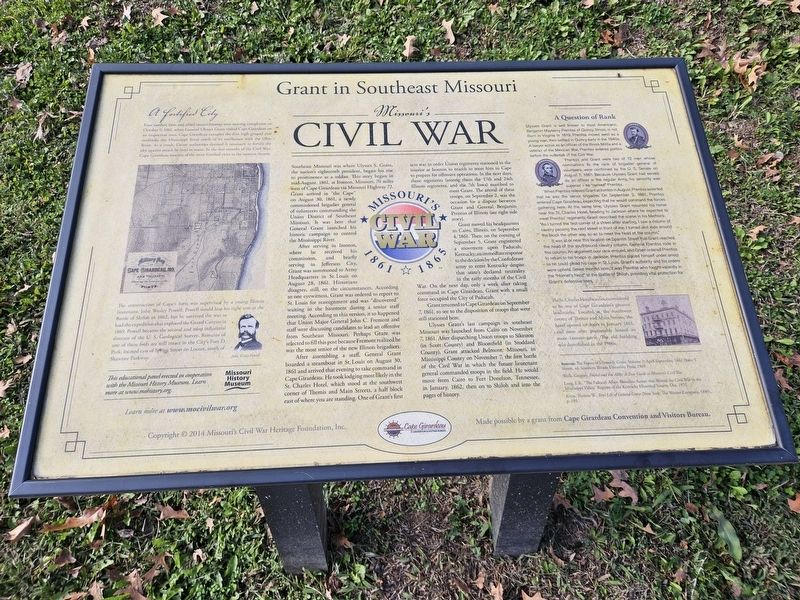
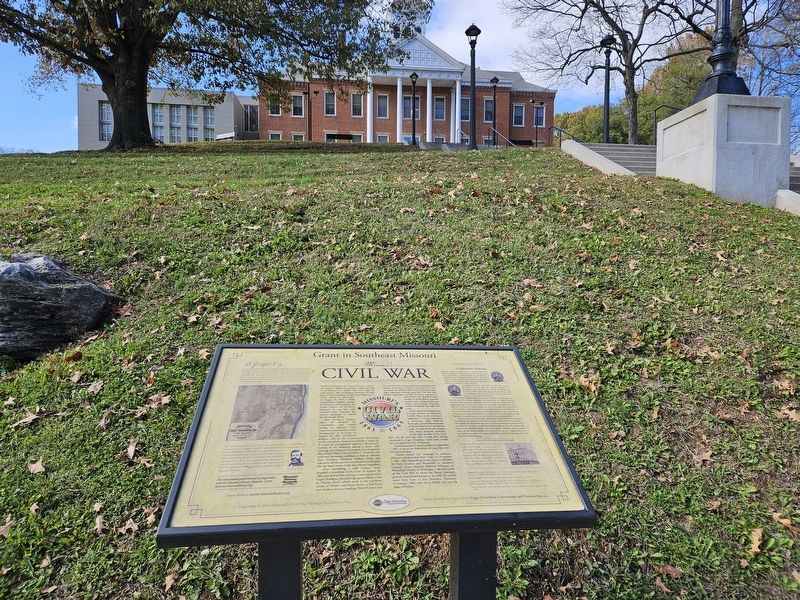
Grant in Southeast Missouri
Missouri's Civil War
Photographed by Edward Troxel, November 16, 2024
1. Grant in Southeast Missouri Marker
After serving in Ironton, where he received his commission, and briefly serving in Jefferson City, Grant was summoned to Army Headquarters in St. Louis on August 28, 1861. Historians disagree, still, on the circumstances. According to one eyewitness, Grant was ordered to report to St. Louis for reassignment and was "discovered" waiting in the basement during a senior staff meeting. According to this version, it so happened that Union Major General John C. Fremont and staff were discussing candidates to lead an offensive from Southeast Missouri. Perhaps Grant was selected to fill this post because Fremont realized he was the most senior
this page online
After assembling a staff, General Grant boarded a steamboat in St. Louis on August 30, 1861 and arrived that evening to take command in Cape Girardeau. He took lodging most likely in the St. Charles Hotel, which stood at the southwest corner of Themis and Main Streets, a half block east of where you are standing. One of Grant's first acts was to order Union regiments stationed in the interior at Ironton to march to meet him in Cape to prepare for offensive operations. In the next days, those regiments (among them the 17th and 24th Illinois regiments, and the 7th Iowa) marched to meet Grant. The arrival of these troops, on September 2, was the occasion for a dispute between Grant and General Benjamin Prentiss of Illinois (see right side story).
Grant moved his headquarters to Cairo, Illinois, on September 4, 1861. Then, on the evening of September 5, Grant engineered a movement upon Paducah, Kentucky, and immediate response to the decision by the Confederate army to enter Kentucky despite that state's declared neutrality in the early months of the Civil War. On the next day, only a week after taking
Photographed by Edward Troxel, November 16, 2024
2. Grant in Southeast Missouri Marker
Grant returned to Cape Girardeau on September 7, 1861, to see to the disposition of troops that were still stationed here.
Ulysses Grant's last campaign in southeast Missouri was launched from Cairo on November 7, 1861. After dispatching Union troops to Sikeston (in Scott County) and Bloomfield (in Stoddard County), Grant attacked Belmont, Missouri, in Mississippi County on November 7, the first battle of the Civil War in which the future lieutenant general command troops in the field. He would move from Cairo to Fort Donelson, Tennessee in January, 1862, then on to Shiloh and into the pages of history.
A Fortified City
Four earthen forts and allied entrenchments were nearing completion on October 9, 1861, when General Ulysses Grant visited Cape Girardeau on an inspection tour. Cape Girardeau occupies the first high ground that overlooks the Mississippi River north of its confluence with the Ohio River. As a result, Union authorities deemed it necessary to fortify the city against attack by land or water. In the first months of the Civil War, Cape Girardeau was one of the most fortified cities in the western theatre.
The construction of Cape's forts was supervised by a young Illinois lieutenant, John Wesley Powell. Powell would lose his right arm at the Battle of Shiloh in 1862, but he survived the war to lead the expedition that explored the Grand Canyon in 1869. Powell became the second and most influential director of the U. S. Geological Survey. Remains of one of these forts are still intact in the City's Fort D Park, located east of Sprigg Street on Locust, south of Shawnee Parkway.
(caption) John Wesley Powell
A Question of Rank
Ulysses Grant is well known to most Americans; Benjamin Mayberry Prentiss of Quincy, Illinois, is not. Born in Virginia in 1819, Prentiss moved west as a young man, then settled in Quincy early in the 1840s. A lawyer active as an officer of the Illinois Militia and a veteran of the Mexican War, Prentiss entered politics before the outbreak of the Civil War.
Prentiss and Grant were two of 12 men whose nominations to the rank of brigadier general of volunteers were confirmed by the U.S. Senate on August 7, 1861. Because Ulysses Grant had served as an officer in the regular Army, his seniority was superior - he "ranked" Prentiss.
When Prentiss relieved Grant at Ironton in August, Prentiss asserted that he was the senior brigadier. On September 2, 1861, Prentiss entered Cape Girardeau, expecting that he would command the forces gathering here. At the same time, Ulysses Grant mounted his horse near the St. Charles Hotel, heading to Jackson where he expected to meet Prentiss' regiments. Grant described the scene in his Memoirs: "As I turned the first corner of a street after starting, I saw a column of cavalry passing the next street in front of me. I turned and rode around the block the other way, so as to meet the head of the column."
It was at or near this location on Spanish Street that Grant reached the head of the southbound cavalry column. General Prentiss rode in this column. An argument over rank ensued, and Grant ordered Prentiss to return to his troops in Jackson. Prentiss placed himself under arrest so he could plead his case in St. Louis. Grant's authority and his orders were upheld. Seven months later, it was Prentiss who fought valiantly in the "Hornet's Nest" at the Battle of Shiloh, providing vital protection for Grant's defensive lines.
(caption) The St. Charles Hotel was once considered to be one of Cape Girardeau's greatest landmarks. Located, at the southwest corner of Themis and Main Streets, the hotel opened its doors in January 1861, and soon after presumably hosted its most famous guest. The old building was demolished in the 1960s.
Sources: The Papers of Ulysses S. Grant, Volume.2: April-September, 1861 (John Y. Simon, ed. Southern Ilinois University Press, 1969)
Wolk, Gregory, Friend and Foe Alike: A Tour Guide to Missouri's Civil War.
Long, E.B., "The Paducah Affair: Bloodless Action that Altered the Civil War in the Mississippi Valley," Register of the Kentucky Historical Society, Oct. 1972.
Knox, Thomas W., Boy's Life of General Grant (New York: The Werner Company,1899), p. 185.
Erected 2014 by Cape Girardeau Convention and Visitors Bureau.
Topics. This historical marker is listed in this topic list: War, US Civil. A significant historical month for this entry is August 1861.
Location. 37° 18.291′ N, 89° 31.168′ W. Marker is in Cape Girardeau, Missouri, in Cape Girardeau County. It is at the intersection of North Spanish Street and Themis Street, on the left when traveling north on North Spanish Street. Touch for map. Marker is in this post office area: Cape Girardeau MO 63701, United States of America. Touch for directions.

Regionally, this marker is in Southeast Missouri. It is also in the American Ozarks, in the Lewis & Clark Corridor, in the Corn Belt, and in the Great River Road Region. Globally, it is in North America, the Western Hemisphere, the Western World, and the Anglosphere. Historically, it finds itself in what was once the territory of the Mississippian Culture, the Louisiana Purchase, and the Antebellum South.
Other nearby markers. At least 8 other markers are within walking distance of this marker: Telephone Service (within shouting distance of this marker); Ivers Square Civil War Monuments (about 400 feet away, measured in a direct line); Filburn & Sloan Commission House (about 500 feet away); a different marker also named 1909 (about 500 feet away); a different marker also named 1916 (about 500 feet away); The Art of Printing / Gathering & Disseminating News (about 500 feet away); a different marker also named 1880 (about 500 feet away); a different marker also named 1875 (about 500 feet away). Touch for a list and map of all markers in Cape Girardeau.
Other markers no longer nearby. 1909 (was about 500 feet away but has been replaced with another marker now near it); 1916 (was about 500 feet away but has been replaced with another marker now near it); 1880 (was about 500 feet away but has been replaced with another marker now near it); 1875 (was about 500 feet away but has been replaced with another marker now near it).
Also see . . . Missouri Historical Society. Missouri History Museum; History Library & Research Center; Soldiers Memorial (Submitted on November 26, 2024.)
Credits. This page was last revised on November 26, 2024. It was originally submitted on November 22, 2024, by Edward Troxel of Creal Springs, Illinois. This page has been viewed 843 times since then and 82 times this year. Photos: 1, 2. submitted on November 22, 2024, by Edward Troxel of Creal Springs, Illinois. • Bernard Fisher was the editor who published this page.
