Canehill in Washington County, Arkansas — The American South (West South Central)
The Troops Who Fought at Cane Hill
Troops Clash in the Boston Mountains
Photographed by Duane and Tracy Marsteller, May 21, 2023
1. The Troops Who Fought at Cane Hill Marker
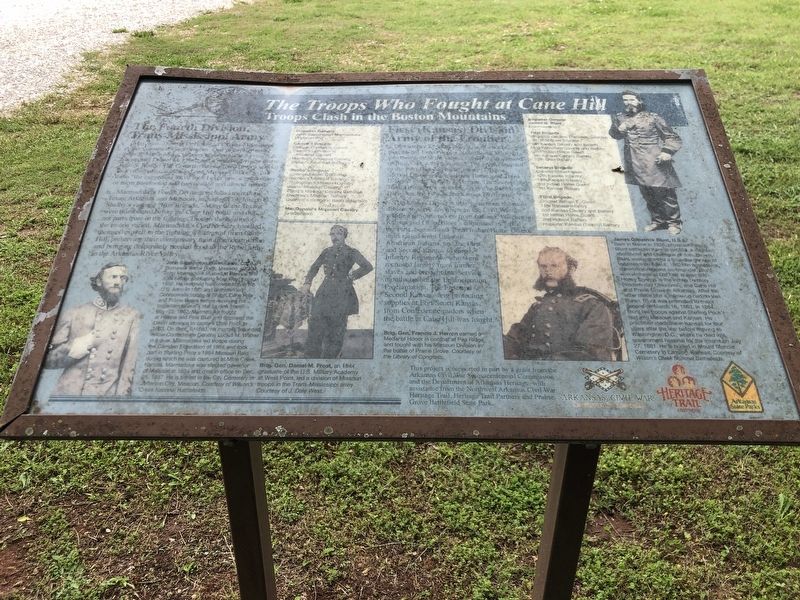
The Fourth Division, Trans-Mississippi Army Maj. Gen. Thomas C. Hindman's Trans-Mississippi Army contained four divisions: One of cavalry under John S. Marmaduke, infantry divisions under Francis A. Shoup and Daniel M. Frost, and a reserve division under John S. Roane. The Confederates suffered from a serious lack of supplies, which led one Missouri official to call them “the raggediest lot of men I ever saw, a great many of them barefooted and bareheaded and almost naked.”
Marmaduke's Fourth Division included men from Texas, Arkansas and Missouri, including Col. Joseph O. Shelby's vaunted “Iron Brigade.” Many of the Texans were dismounted before the Cane Hill battle and did not participate in the fighting. Though the quality of the troops varied, Marmaduke's Confederates handled themselves well in the fighting withdrawal from Cane Hill, preserving their commissary train from destruction and bringing desperately needed food to the Rebel army in the Arkansas River Valley.
[Sidebar]
Brigadier General John Sappington Marmaduke, commanding
Carroll's Brigade Colonel Charles A. Carroll • Carroll's (Johnson's) Arkansas
this page online
Shelby's Brigade Colonel Joseph O. Shelby • Gordon's Missouri Cavalry • Thompson's Missouri Cavalry • Jeans' Missouri Cavalry • Elliott's Missouri Cavalry Battalion • Bledsoe's Missouri Battery • Quantrill's (Greeg's) Band (attached)
MacDonald's Missouri Cavalry (unattached)
First (Kansas) Division, Army of the Frontier On October 12, 1861, Maj. Gen. Samuel Curtis reorganized Union troops in southwest Missouri into the Army of the Frontier under the command of Brig. Gen. John Schofield. The army consisted of the First Division under James G. Blunt, Second Division under James Totten, and Third Division under Francis J. Herron. The Second and Third Divisions were better known as the Missouri Divisions, the First as the Kansas Division.
The Kansas Division may have been the most diverse to serve anywhere in the Civil War. In addition to white troops from Indiana, Wisconsin, Kansas and Ohio, Blunt's command included the First, Second and Third Indian Home Guard units raised from Unionist American Indians, and the First and Second Kansas Colored Infantry Regiments, who
Photographed by Duane and Tracy Marsteller, May 21, 2023
2. The Troops Who Fought at Cane Hill Marker
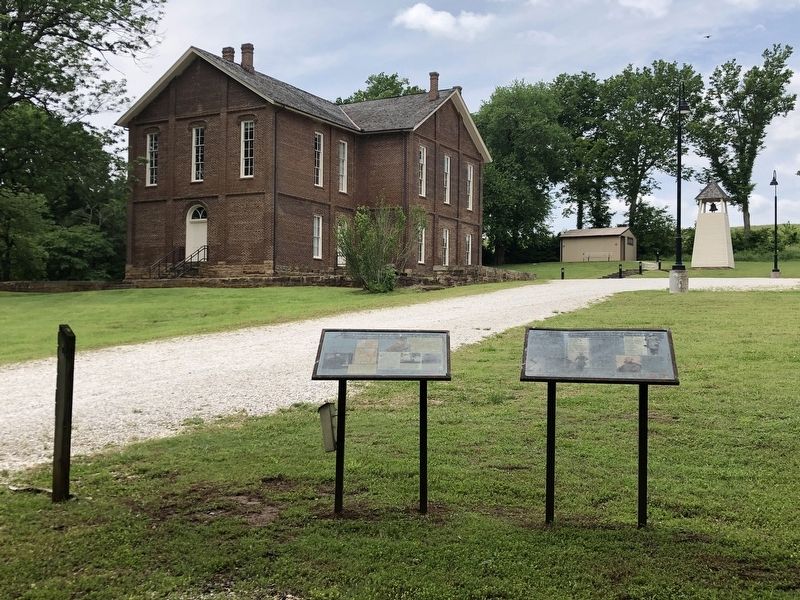
Featured marker is on the right.
[Sidebar]
Brigadier General James G. Blunt commanding
First Brigade Brigadier General Frederick Salomon • 9th Wisconsin Infantry • 6th Kansas Cavalry and Battery • 3rd Wisconsin Cavalry and Battery • 2nd Indian Home Guard • 9th Kansas Cavalry Battery • 25th Ohio Battery
Second Brigade Colonel William Weer • 10th Kansas Infantry • 13th Kansas Infantry • 3rd Indian Home Guard • 1st Kansas Battery
Third Brigade Colonel William F. Cloud • 11th Kansas Infantry • 2nd Kansas Cavalry and Battery • 1st Indian Home Guard • 2nd Indiana Battery • Hopkins' Kansas (Trophy) Battery
[Captions (left to right)]
• John Sappington Marmaduke, C.S.A. Born near Arrow Rock, Missouri, in 1833, John Marmaduke studied at Harvard and Yale before graduating from West Point in 1857. He resigned his commission in the U.S. Army in 1861 and commanded Confederate troops at Shiloh, Cane Hill and Prairie Grove before receiving his brigadier general's star to rank from Nov. 15, 1862. Marmaduke fought at Helena and Pine Bluff and opposed the Union advance to capture Little Rock in 1863. On Sept. 6, 1863, he mortally wounded fellow Confederate General Lucius M. Walker in a duel. Marmaduke led troops during the Camden Expedition of 1864 and took part in Sterling Price's 1864 Missouri Raid, during which he was captured at Mine Creek, Kansas. Marmaduke was elected governor of Missouri in 1884 and died in office on Dec. 28, 1887. He is buried in the City Cemetery in Jefferson City, Missouri. Courtesy of Wilson's Creek National Battlefields
• Brig. Gen. Daniel M. Frost, an 1844 graduate of the U.S. Military Academy at West Point, led a division of Missouri troops in the Trans-Mississippi Army. Courtesy of J. Dale West
• Brig. Gen. Francis J. Herron earned a Medal of Honor in combat at Pea Ridge and fought with his Missouri Division in the battle of Prairie Grove. Courtesy of the Library of Congress
• James Gilpatrick Blunt, U.S.A. Born in Maine in 1826, physician James Blunt settled in Kansas in 1856. A devoted abolitionist and colleague of John Brown, Blunt was appointed a brigadier general of volunteers on April 8, 1862. An aggressive, sometimes reckless, commander, Blunt won victories at Old Fort Wayne and Honey Springs in the Indian Territory (modern-day Oklahoma), and Cane Hill and Prairie Grove in Arkansas. After the latter battle and a follow-up raid on Van Buren, Blunt was promoted to major general on March 16, 1863. In 1864, Blunt led troops against Sterling Price's raid into Missouri and Kansas.He practiced medicine in Kansas for four years after the war before moving to Washington, D.C., where he died in a government hospital for the insane on July 27, 1881. He is buried in Mount Muncie Cemetery in Lansing, Kansas. Courtesy of Wilson's Creek Battlefields
Erected by Arkansas Civil War Sesquicentennial Commission • Department of Arkansas Heritage • Northwest Arkansas Civil War Heritage Trail • Heritage Trail Partners • Prairie Grove Battlefield State Park.
Topics and series. This historical marker is listed in this topic list: War, US Civil. In addition, it is included in the Arkansas Civil War Sesquicentennial Commission series list. A significant historical date for this entry is October 12, 1861.
Location. Marker has been permanently removed. It was located near 35° 54.67′ N, 94° 23.828′ W. Marker was in Canehill, Arkansas, in Washington County. It was on College Road near McClellan Road, on the left when traveling north. Touch for map. Marker was at or near this postal address: 14219 College Rd, Lincoln AR 72744, United States of America.
We have been informed that this marker is no longer there and will not be replaced. This page is an archival view of what was.
Regionally, this marker was in Northwest Arkansas, on the Ozark Plateau, in the Cherokee Heritage Region, and in Osage Territory. It was also in the American South, specifically in the Upper South, and in the Ozarks. Globally, it was in North America, the Western Hemisphere, the Western World, and the Anglosphere. Historically, it found itself in what was once the territory of the Mississippian Culture, the Louisiana Purchase, one of the Confederate States of America, and the Antebellum South.

Other nearby markers. At least 8 other markers are within 6 miles of this location, measured as the crow flies: Washington County Cane Hill College (within shouting distance of this marker); Archie Leonard Reed Sorghum Shed (about 400 feet away, measured in a direct line); Zebulon and Eunice Edmiston House – 1872 (approx. 0.2 miles away); Dr. William and Laura Welch House - 1855 (approx. ¼ mile away); Fruit Cellar (approx. 0.3 miles away); Bethlehem Cemetery (approx. 4.6 miles away); Bethlehem Methodist-Episcopal Church South (approx. 4.6 miles away); John Tilley House (approx. 5.7 miles away). Touch for a list and map of all markers in Canehill.
Other markers no longer nearby. Confederates Fall Back Before Union Assault (was here, next to this marker but has been permanently removed); The Battle of Cane Hill (was approx. 0.2 miles away but has been confirmed missing).
More about this marker. Marker has been removed due to poor condition. It is unknown if it will be replaced according to the Canehill Historical Museum
Credits. This page was last revised on November 27, 2024. It was originally submitted on June 3, 2023, by Duane and Tracy Marsteller of Murfreesboro, Tennessee. This page has been viewed 814 times since then and 74 times this year. Last updated on November 22, 2024, by Michael Manning of Woodlawn, Tennessee. Photos: 1, 2. submitted on June 3, 2023, by Duane and Tracy Marsteller of Murfreesboro, Tennessee. • Devry Becker Jones was the editor who published this page.
