
Sugar Land in Fort Bend County, Texas — The American South (West South Central)
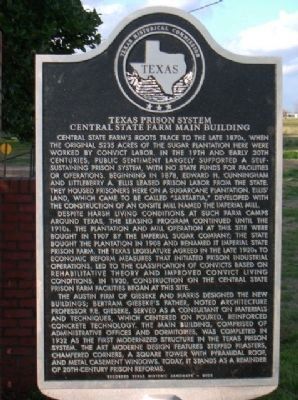
Texas Prison System Central State Farm Main Building
Photographed by Gregory Walker, February 21, 2010
1. Central State Prison Farm Marker
Despite harsh living conditions at such farm camps around Texas, the leasing program continued until the 1910s. The plantation and mill operation at this site were bought in 1907 by the Imperial Sugar Company; the state bought the plantation in 1908 and renamed it Imperial State Prison Farm. The Texas Legislature agreed in the late 1920s to economic reform measures that initiated prison industrial operations, led to the classification of convicts based on rehabilitative theory and improved convict living conditions. In 1930, construction on the Central State
this page online
The Austin firm of Gieseke and Harris designed the new buildings; Bertram Gieseke's father, noted architecture professor F.E. Gieseke, served as a consultant on materials and techniques, which centered on poured, reinforced concrete technology. The main building, comprised of administrative offices and dormitories, was completed in 1932 as the first modernized structure in the Texas prison system. The Art Moderne design features stepped pilasters, chamfered corners, a square tower with pyramidal roof, and metal casement windows. Today, it stands as a reminder of 20th-century prison reforms.
Recorded Texas Historic Landmark - 2003.
Erected 2003 by Texas Historical Commission. (Marker Number 12990.)
Topics. This historical marker is listed in these topic lists: Agriculture • Government & Politics • Notable Buildings.
Location. Marker has been reported missing. It was located near 29° 36.54′ N, 95° 39.625′ W. Marker was in Sugar Land, Texas, in Fort Bend County. It was at the intersection of U.S. 90A and Midway Drive, on the

Photographed by Gregory Walker, February 21, 2010
2. Central State Prison Farm seen across the prison farm fields.

Regionally, this marker was in the Houston Metropolitan Area. It was also on the American Gulf Coast. Globally, it was in North America, a Gulf of Mexico state, the Western Hemisphere, the Western World, and the Anglosphere. Historically, it found itself in what was once New Spain, the Republic of Texas, one of the Confederate States of America, and the Antebellum South.
Other nearby markers. At least 8 other markers are within 2 miles of this location, measured as the crow flies: Imperial Prison Farm Cemetery (approx. 0.3 miles away); Bullhead Camp Cemetery (approx. ¾ mile away); a different marker also named Bullhead Camp Cemetery (approx. ¾ mile away); "Found and Not Forgotten" (approx. ¾ mile away); “Sugar Land 95” State Convict Lease Labor Camp Cemetery (approx. 0.8 miles away); Sugar Land Refinery (approx. 1.7 miles away); Sugar Land High School World War II Memorial (approx. 2 miles away); In Honor of Lonnie Green
Photographed by Gregory Walker, February 21, 2010
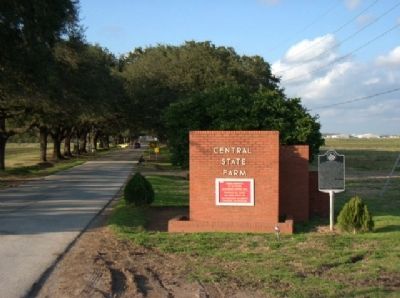
3. Central State Prison Farm entrance with historical marker to the right.
Regarding Texas Prison System Central State Farm Main Building. Sometimes prisoners can still be seen working the fields, supervised by prison guards on horseback.

Photographed by Doug Green, November 22, 2024
4. The historic marker has been gone since at least May 2015.
Credits. This page was last revised on November 24, 2024. It was originally submitted on March 10, 2010, by Gregory Walker of La Grange, Texas. This page has been viewed 4,343 times since then and 248 times this year. Last updated on November 23, 2024, by Doug Green of Sugar Land, Texas. Photos: 1, 2, 3. submitted on March 10, 2010, by Gregory Walker of La Grange, Texas. 4. submitted on November 23, 2024, by Doug Green of Sugar Land, Texas. • James Hulse was the editor who published this page.
