Parowan in Iron County, Utah — The American Mountains (Southwest)
Paiute Indian Tribe of Utah

Photographed by Tom Bosse, July 29, 2024
1. Paiute Indian Tribe of Utah Marker
[Caption]: Utah’s Patchwork Parkway offers travelers a diverse patchwork of colors, cultures, and climates.
[Caption]: Photos above: Southern Paiute Group Near Cedar, UT, 1872 & Basket Maker
A visit to the surrounding Parowan Valley reveals abundant evidence of the ancestors of the Paiute Indian Tribe of Utah’s earlier life through rock writings, archaeological findings, and artifacts.
The Southern Paiutes are a proud and noble people who have survived in this challenging terrain for centuries, defending their land from other tribes and eventually the European-Americans who migrated to their homeland. Southern Paiutes suffered many confrontations with the European-Americans over water and land rights.
Harmony with the Earth
Imagine the active volcanoes that existed in this region long ago. The Southern Paiutes have lived in Southern Utah since the time of the fiery, fuming mountains.
These ancestral people were storytellers who passed their tribal history down orally from generation to generation.
Their history tells of a people who followed the Creator’s guidance of caring for the land and all forms
this page online
The ancestors of the Paiute Indian Tribe of Utah were successful farmers for thousands of years growing crops throughout the region of Utah, Nevada, California, Arizona, and Colorado. They raised corn, squash, melons, gourds, sunflowers, and wheat. They also practiced floodplain gardening, creating reservoirs and irrigation ditches to water their crops.
Ancestral Southern Paiutes were also travelers who moved to various areas to harvest food and natural materials in their appropriate seasons. As they gathered at various sites, the people would celebrate their friendship and hope for a successful harvest through dancing and storytelling around the campfire.
They hunted from the highest mountains to the hot dry deserts for mountain sheep, antelope, woodchucks, rabbits, and deer. Their skill at making their own tools and spear points were traded with many surrounding tribes.
In addition to being accomplished farmers and hunters, Southern Paiutes are skilled basket weavers. They gathered seeds, roots, tubers,

Photographed by Tom Bosse, July 29, 2024
2. Paiute Indian Tribe of Utah Marker
Early explorers estimated 8,000 to 10,000 Southern Paiutes in the Parowan and Cedar Valleys. The loss of valuable farmland and water resources has decimated the area’s Southern Paiutes to a current population of less than 1,000.
[Caption]: Photo Below: Parowan Gap – Native American Petroglyph Site.
Preserving Their Native Language
Each of the Paiute Indian Tribe of Utah’s five bands (Cedar, Indian Peaks, Kanosh, Shivwits, and Koosharem) speaks a different dialect of the Numic branch of the Uto-Aztecan language. By working with tribal elders who still speak the language, the tribe is actively preserving its native language and dialects for future generations.
[Caption]: Photo Above: Vala Parashonts, Jeremy Garcia and Farron Kanosh
Recognizing the Paiute Nation
The five bands of the Paiute Indian Tribe of Utah – Shivwits (A); Indian Peaks (B); Cedar (C); Kanosh (D); and Koosharem (E) (located on the map above) were unfortunate subjects of the United States Government Termination Policy in 1956 and were terminated

Photographed by Tom Bosse, July 29, 2024
3. Paiute Indian Tribe of Utah Marker
The Paiute Indian Tribe of Utah has successfully established the Paiute Nation and has reservation lands in five Southern Utah counties. The Tribe continues to pursue economic development projects t ensure sustainability and cultural preservation for future generations. Their annual Pow Wow held in nearby Cedar City attracts hundreds of visitors each year.
Topics. This historical marker is listed in this topic list: Indigenous Peoples and Communities. A significant historical date for this entry is April 3, 1980.
Location. 37° 50.35′ N, 112° 49.217′ W. Marker is in Parowan, Utah, in Iron County. It is at the intersection of South Cyn Road (U.S. 143) and East 200 South Street, on the right when traveling south on South Cyn Road. Touch for map. Marker is in this post office area: Parowan UT 84761, United States of America. Touch for directions.

Regionally, this marker is in Color Country. It is also in the American Mountain West and on the Colorado Plateau. Globally,
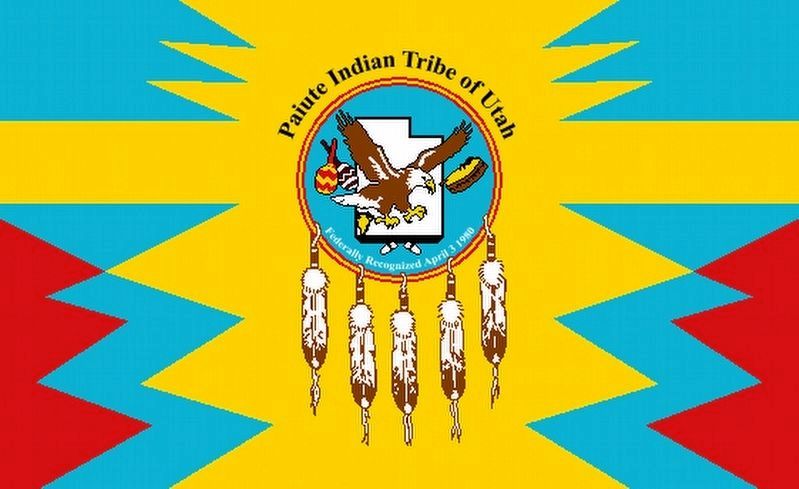
4. Paiute Indian Tribe of Utah Flag
Other nearby markers. At least 8 other markers are within walking distance of this marker: Welcome to Parowan, Utah (here, next to this marker); The “Mother Town” of Southern Utah (here, next to this marker); Explore Southern Utah (here, next to this marker); Life on the High Plateau (here, next to this marker); Following the Water (here, next to this marker); Establishing a Community (here, next to this marker); Public Works (approx. 0.3 miles away); William and Julia Lyman House (approx. 0.4 miles away). Touch for a list and map of all markers in Parowan.
Related markers. Click here for a list of markers that are related to this marker.
Also see . . . Paiute Indian Tribe of Utah. (Submitted on November 23, 2024, by Tom Bosse of Jefferson City, Tennessee.)
Credits. This page was last revised on November 26, 2024. It was originally submitted on November 23, 2024, by Tom Bosse of Jefferson City, Tennessee. This page has been viewed 201 times since then and 29 times this year. Photos: 1, 2, 3, 4. submitted on November 23, 2024, by Tom Bosse of Jefferson City, Tennessee. • Andrew Ruppenstein was the editor who published this page.
