Port Perry in Durham Region, Ontario — Central Canada (North America)
Steamboats on Lake Scugog
Photographed by Cosmos Mariner, June 2, 2024
1. Steamboats on Lake Scugog Marker
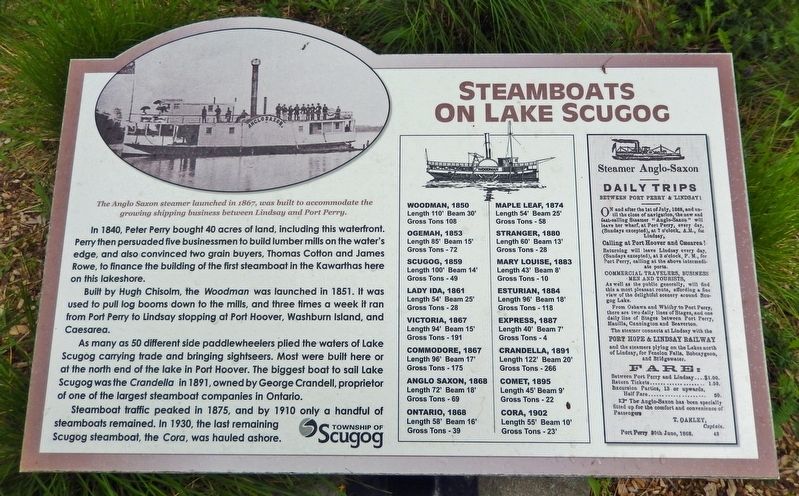
In 1840, Peter Perry bought 40 acres of land, including this waterfront. Perry then persuaded five businessmen to build lumber mills on the water's edge, and also convinced two grain buyers, Thomas Cotton and James Rowe, to finance the building of the first steamboat in the Kawarthas here on this lakeshore.
Built by Hugh Chisolm, the Woodman was launched in 1851. It was used to pull log booms down to the mills, and three times a week it ran from Port Perry to Lindsay stopping at Port Hoover, Washburn Island, and Caesarea.
As many as 50 different side paddlewheelers plied the waters of Lake Scugog carrying trade and bringing sightseers. Most were built here or at the north end of the lake in Port Hoover. The biggest boat to sail Lake Scugog was the Crandella in 1891, owned by George Crandell, proprietor of one of the largest steamboat companies in Ontario.
Steamboat traffic peaked in 1875, and by 1910 only a handful of steamboats remained. In 1930, the last remaining Scugog steamboat, the Cora, was hauled ashore.
WOODMAN, 1850 • Length 110' Beam 30' Gross Tons 108
OGEMAH, 1853 • Length 85' Beam 15' Gross Tons - 72
SCUGOG,
this page online
LADY IDA, 1861 • Length 54'. Beam 25' Gross Tons – 28
VICTORIA, 1867 • Length 94' Beam 15' Gross Tons – 191
COMMODORE, 1867 • Length 96' Beam 17' Gross Tons – 175
ANGLO SAXON, 1868 • Length 72' Beam 18' Gross Tons – 69
ONTARIO, 1868 • Length 58' Beam 16' Gross Tons – 39
MAPLE LEAF, 1874 • Length 54' Beam 25' Gross Tons – 58
STRANGER, 1880 • Length 60' Beam 13' Gross Tons – 28
MARY LOUISE, 1883 • Length 43' Beam 8' Gross Tons – 10
ESTURIAN, 1884 • Length 96' Beam 18' Gross Tons – 118
EXPRESS, 1887 • Length 40' Beam 7' Gross Tons – 4
CRANDELLA, 1891 • Length 122' Beam 20' Gross Tons – 266
COMET, 1895 • Length 45' Beam 9' Gross Tons – 22
CORA, 1902 • Length 55' Beam 10' Gross Tons – 23
Erected by Township of Scugog.
Topics. This historical marker is listed in these topic lists: Industry & Commerce • Settlements & Settlers • Waterways & Vessels. A significant historical year for this entry is 1851.
Location. 44° 6.34′ N, 78° 56.485′ W. Marker is in Port Perry, Ontario, in Durham Region. It can be reached from Queen Street just east of Water Street, on the right when traveling east. The marker

2. Marker detail: The Anglo Saxon
The Anglo Saxon steamer launched in 1867, was built to accommodate the growing shipping business between Lindsay and Port Perry.

Regionally, this marker is in Greater Toronto, specifically on the Golden Horseshoe, in the York, Durham and Headwaters Area, and in the Toronto Metropolitan Area. It is also in Central Canada. Globally, it is in North America, on the Great Lakes, in the Western Hemisphere, in the Western World, and in the Anglosphere. Historically, it finds itself in what was once a British colony, the Viceroyalty of New France, the Haudenosaunee (Iroquois) Confederacy, and Rupert’s Land.
Other nearby markers. At least 8 other markers are within walking distance of this marker: Lake Scugog (within shouting distance of this marker); The Port Perry Grain Elevator (within shouting distance of this marker); Harvey Lillard (within shouting distance of this marker); Daniel David Palmer (within shouting distance of this marker); a different marker also named Daniel David Palmer (within shouting distance of this marker); The Currie Grain Elevator

June 2, 2024
3. Marker detail: Steamer Anglo Saxon
between
Port Perry & Lindsay!
Also see . . . Steamboat Era.
Excerpt: Beginning with the launch of the Woodman in 1850, Lake Scugog enjoyed over a half century of romance with the steamboat. It began purely as a need to transport people and goods around the lake. The main commodity being logs from various sites, particularly in Victoria County. They were towed in booms down to the mills at Port Perry.(Submitted on November 25, 2024, by Cosmos Mariner of Cape Canaveral, Florida.)By the early 1860s, Port Perry was becoming a sizeable settlement. Although there were two main roads linking the settlement to the outside world, mud, swamps, fallen trees and the discomfort of the corduroy surface, made any journey a challenging experience. Port Perry's only reliable and comfortable link with the outside world was by the steamboat.

Photographed by Cosmos Mariner, June 2, 2024
4. Steamboats on Lake Scugog Marker
Looking northeast across the Palmer Park waterfront toward Lake Scugog.
Credits. This page was last revised on November 25, 2024. It was originally submitted on November 24, 2024, by Cosmos Mariner of Cape Canaveral, Florida. This page has been viewed 199 times since then and 45 times this year. Photos: 1, 2, 3, 4. submitted on November 25, 2024, by Cosmos Mariner of Cape Canaveral, Florida.
