Downtown Los Angeles in Los Angeles County, California — The American West (Pacific Coastal)
Pio Pico
Zanja Madre
| — | Chinese Settlers | — |

Photographed by Craig Baker, September 10, 2023
1. Pio Pico
Pio Pico
Mexico‘s Last California Governor
The importance of Afro-Mexicans in Los Angeles is best represented by Pío de Jesús Pico (1801-1894), who was the last governor of California under Mexican rule. Born at the San Gabriel Mission, Pico was an owner of huge rancho properties and built the Pico House hotel as the city's grandest hotel in 1870, which still stands today. A two-time governor, Pico was fond of politics, gambling and horse racing. Pico and his brother Andrés Pico receiver a massive land grant estimated at 33.441 acres in what is now San Diego County. After California joined the Union in 1850, Pico lost all his properties and died penniless at age 93. His "summer home" is now Pío Pico State Historic Park, located in the City of Pico Rivera, the city named after the former governor.
Zanja Madre
The Zanja Madre, or Mother Ditch, tapped directly into the Los Angeles River, bringing water directly to the growing pueblo. It later brought water from a dirt and brush dam built across the Rio Porciúncula through a series of waterwheels and reservoirs. The watercourse was
this page online
Chinese Settlers
The Gold Rush of 1848 brought many Chinese to Norther California to work in the mines. The first Chinese to come to Los Angeles were two male house servants, who arrived in the 1850's. By 1870, a community of 200 Chinese had settled in the area east of the Plaza in what is now Union Station. The racism, exploi- tation, and violence that the Chinese experienced in the gold fields and in San Francisco during the 1850s and 1860s eventually came to the Chinese of Los Angeles. In October, 1871, a mob of more than 500 people responding to the shooting of a white man-possibly by accident-took part in a bloody racially-motivated assault on Chinatown, during which 19 Chinese men and boys were lynched, shot and stabbed to death, including the community's respected doctor, Chin Lee A Chinese Kindergarten class, 1900 Los Angeles Public

Photographed by Craig Baker, September 10, 2023
2. Zanja Madre
Fort Moore
The Fort Moore Memorial is the original site of the Post of Los Angeles, a barricade constructed by American Army troops in 1846 at the onset of the United States and Mexico War. The post was enlarged in 1847 during the occupation of the pueblo and designated as Fort Moore. By 1848 the fort was only partially completed. The garr- ison was withdrawn and the site was abandoned. In 1958, the site was rebuilt as a memorial commemorating the first raising of the U.S. flag on the site in 1848. After several decades of decay, the memorial was renovated and the landmark waterfall repaired in 2019 by the County of Los Angeles.
Erected by County of Los Angeles.
Topics. This historical marker is listed in these topic lists: Asian Americans

Photographed by Craig Baker, September 10, 2023
3. Chinese Settlers
Location. 34° 3.426′ N, 118° 14.4′ W. Marker is in Los Angeles, California, in Los Angeles County. It is in Downtown Los Angeles. It can be reached from Spring Street north of U.S. 101. Touch for map. Marker is at or near this postal address: 524 N Spring St, Los Angeles CA 90012, United States of America. Touch for directions.

Regionally, this marker is in California’s Transverse Ranges. It is also on the American Pacific Coast. Globally, it is in North America, on the Ring of Fire, on the Pacific Rim, in the Western Hemisphere, in the Western World, and in the Anglosphere. Historically, it finds itself in what was once New Spain and also Mexico’s Alta California.
Other nearby markers. At least 8 other markers are within walking distance of this marker: Los Angeles History (here, next to this marker); Los Angeles Settlers (here, next to this marker); Forced Removal of Mexican Americans (a few steps from this marker); Land of the Tongva (within shouting distance of this marker); The Aliso Tree

Photographed by Craig Baker, September 10, 2023
4. Fort Moore
More about this marker. This marker has a dozen panels about local history, in random order. See nearby markers for more.
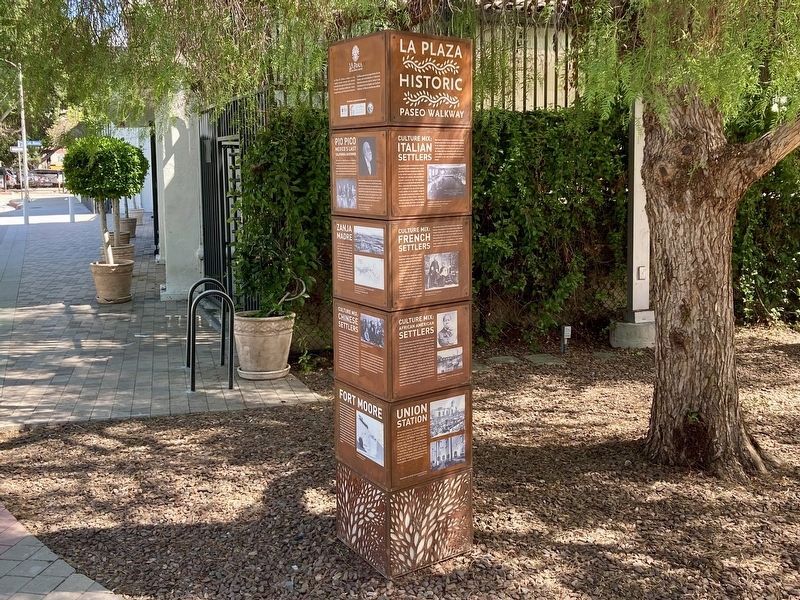
Photographed by Craig Baker, September 10, 2023
5. Historical Marker
Credits. This page was last revised on November 26, 2024. It was originally submitted on November 26, 2024, by Craig Baker of Sylmar, California. This page has been viewed 371 times since then and 61 times this year. Photos: 1, 2, 3, 4, 5. submitted on November 26, 2024, by Craig Baker of Sylmar, California.
