Downtown Los Angeles in Los Angeles County, California — The American West (Pacific Coastal)
Los Angeles Settlers
Italian, French, African American Settlers
Photographed by Craig Baker, September 10, 2023
1. Italian Settlers
Italian Settlers
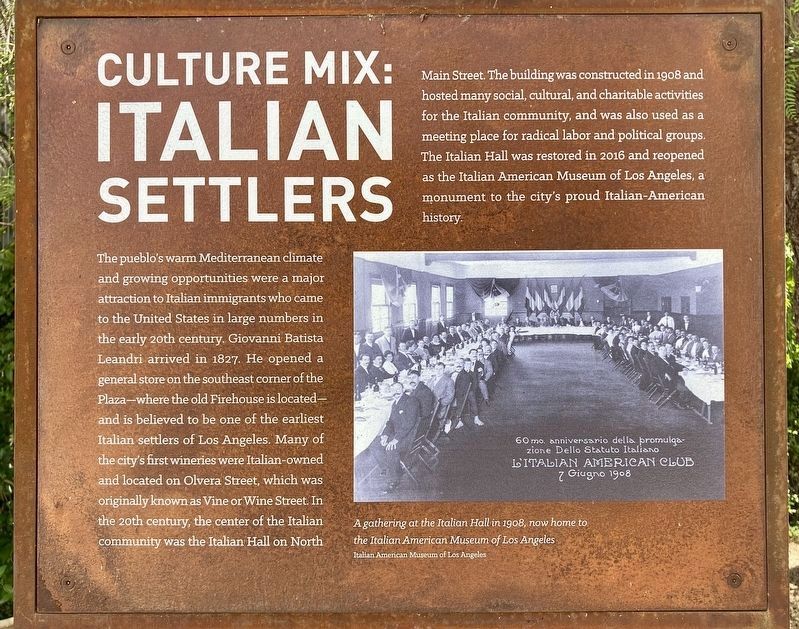
The pueblo's warm Mediterranean climate and growing opportunities were a major attraction to Italian immigrants who came to the United States in large numbers in the early 20th century. Giovanni Batista Leandri arrived in 1827. He opened a general store on the southeast corner of the Plaza-where the old Firehouse is located- and is believed to be one of the earliest Italian settlers of Los Angeles. Many of the city's first wineries were Italian-owned and located on Olvera Street, which was originally known as Vine or Wine Street. In the 20th century, the center of the Italian community was the Italian Hall on North Main Street. The building was constructed in 1908 and hosted many social, cultural, and charitable activities for the Italian community, and was also used as a meeting place for radical labor and political groups. The Italian Hall was restored in 2016 and reopened as the Italian American Museum of Los Angeles, a monument to the city's proud Italian-American history.
French Settlers
The French were among the earliest European settlers in El Pueblo
this page online
African American Settlers
Of the 44 pobladores who founded Los Angeles in 1781, 26 were of African descent, or Afro-Mexicans. Many of their descendants became large land owners and prominent citizens

Photographed by Craig Baker, September 10, 2023
2. French Settlers
Union Station
Union Station Passenger Terminal is located on the site that served as the city's first Chinatown. Completed in 1939, it is the largest passenger train station in the Western United States. The building was designed by architects Parkin- son and Parkinson, who designed Los Angeles City Hall. The station's architecture is a mix of Streamline, Mission Revival and Spanish Colonial Revival

Photographed by Craig Baker, September 10, 2023
3. African American Settlers
Erected by County of Los Angeles.
Topics. This historical marker is listed in these topic lists: Immigration • Settlements & Settlers.
Location. 34° 3.429′ N, 118° 14.399′ W. Marker is in Los Angeles, California, in Los Angeles County. It is in Downtown Los Angeles. It can be reached from Spring Street north of U.S. 101. Touch for map. Marker is at or near this postal address: 524 N Spring St, Los Angeles CA 90012, United States of America. Touch for directions.

Regionally, this marker is in the Transverse Ranges. It is also on the American Pacific Coast. Globally, it is in North America, on the Ring of Fire, on the Pacific Rim, in the Western Hemisphere, in the Western World, and in the Anglosphere. Historically, it finds itself in what was once New Spain and also Mexico’s Alta California.
Other nearby markers. At least 8 other markers are within walking distance of this marker: Los Angeles History

Photographed by Craig Baker, September 10, 2023
4. Union Station
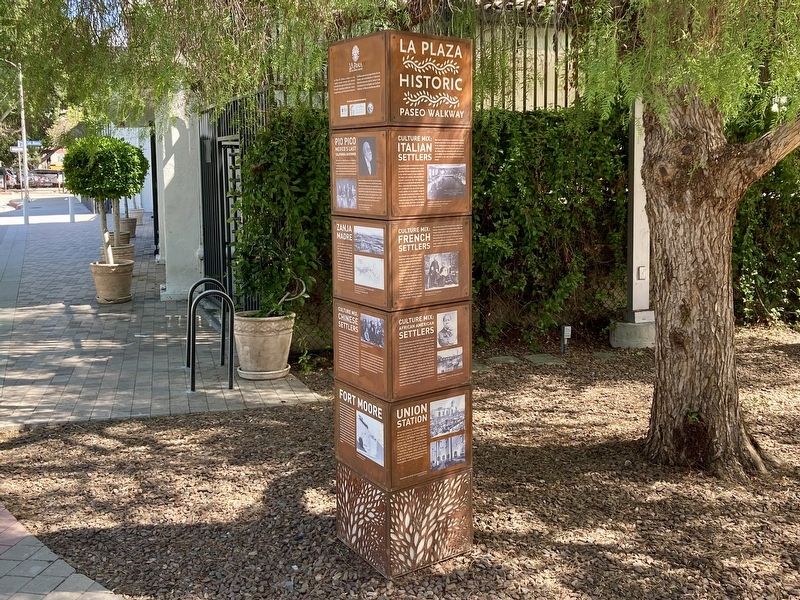
More about this marker. This marker has a dozen panels about local history, in random order. See nearby markers for more.
Photographed by Craig Baker, September 10, 2023
5. Historical Marker
Credits. This page was last revised on November 26, 2024. It was originally submitted on November 26, 2024, by Craig Baker of Sylmar, California. This page has been viewed 185 times since then and 27 times this year. Photos: 1, 2, 3, 4, 5. submitted on November 26, 2024, by Craig Baker of Sylmar, California.
