
Thunder Bay in Thunder Bay District, Ontario — Central Canada (North America)
The Robinson Superior Treaty
Photographed by Cosmos Mariner, June 15, 2024
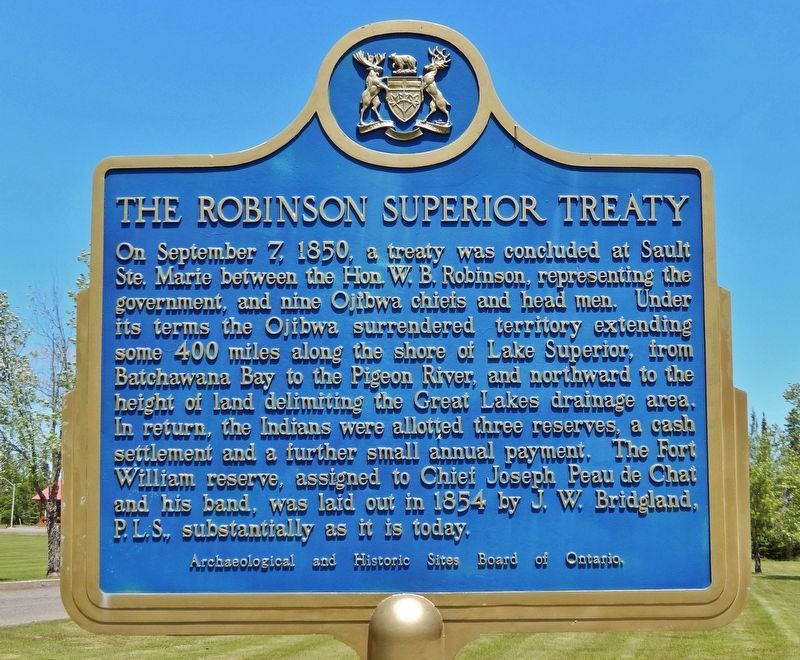
1. The Robinson Superior Treaty Marker
On September 7, 1850, a treaty was concluded at Sault Ste. Marie between the Hon. W.B. Robinson, representing the government, and nine Ojibwa chiefs and head men. Under its terms, the Ojibwa surrendered territory extending some 400 miles along the shore of Lake Superior, from Batchawana Bay to the Pigeon River, and northward to the height of land delimiting the Great Lakes drainage area. In return, the Indians were allotted three reserves, a cash settlement and a further small annual payment. The Fort William reserve, assigned to Chief Joseph Peau de Chat and his band, was laid out in 1854 by J.W. Bridgeland, P.L.S., substantially as it is today.
Erected by Archaeological and Historic Sites Board of Ontario.
Topics and series. This historical marker is listed in these topic lists: Indigenous Peoples and Communities • Peace • Settlements & Settlers. In addition, it is included in the Canada, Ontario Heritage Trust series list. A significant historical date for this entry is September 7, 1850.
Location. 48° 20.061′ N, 89° 12.887′ W. Marker is in Thunder Bay, Ontario, in Thunder Bay District. It is on City Road (Sandy Beach
this page online

Regionally, this marker is in Northern Ontario and specifically in Northwest Ontario. It is also in Central Canada. Globally, it is in North America, in the Great North Woods, on the Great Lakes, on Lake Superior’s North Shore, in the Western Hemisphere, in the Western World, and in the Anglosphere. Historically, it finds itself in what was once a British colony, the Viceroyalty of New France, the Haudenosaunee (Iroquois) Confederacy, and Rupert’s Land.
Other nearby markers. At least 8 other markers are within 6 kilometers of this marker, measured as the crow flies: The Mission of the Immaculate Conception 1849 (approx. 4.3 kilometers away); The Western Route of the C.P.R. (approx. 5.5 kilometers away); Thunder Bay Public Library (approx. 5.8 kilometers away); 10-Mile Road Race (approx. 5.8 kilometers away); City Hall
Photographed by Cosmos Mariner, June 15, 2024
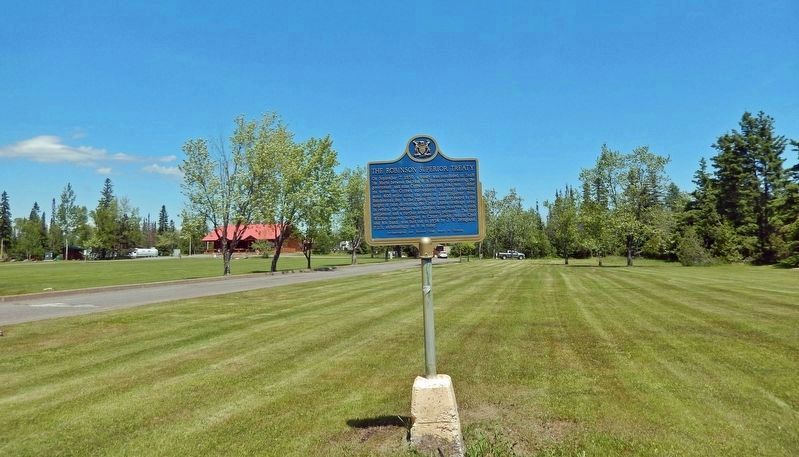
2. The Robinson Superior Treaty Marker
Looking northeast from City Road, Chippewa Park Tourist Camp is in the background.
More about this marker. Both sides of this marker have the same English inscription.
Also see . . .
1. Robinson Superior Treaty (Wikipedia).
Excerpt: The Schedule of Reservations created as a result of the Robinson Huron Treaty and signed by the subscribing Chiefs and Principal Men are as follows:(Submitted on November 29, 2024, by Cosmos Mariner of Cape Canaveral, Florida.)FIRST—Joseph Pean-de-chat and his Tribe, the reserve to commence about two miles from Fort William (inland), on the right bank of the River Kiminitiquia ; thence westerly six miles, parallel to the shores of the lake ; thence northerly five miles, thence easterly to the right bank of the said river, so as not to interfere with any acquired rights of the Honorable Hudson's Bay Company.SECOND—Four miles square at Gros Cap, being a valley near the Honorable Hudson's Bay Company's post of Michipicoton, for Totominai and Tribe.
THIRD—Four miles square on Gull River, near Lake Nipigon,
on both sides of said river, for the Chief Mishimuckqua and Tribe.
2. Fort William First Nation (Wikipedia).
Excerpt: The Fort William Reserve, located on the western end of Lake Superior adjacent to the city of Thunder Bay was set aside under the provisions of the Robinson-Superior Treaty in 1850. The Chief and Headmen who signed the Treaty intended that the Reserve would provide not just for their children, but for their grandchildren’s grandchildren. Since the treaty of 1850, Fort William has developed an excellent track record in its dealings with government and private industry in its efforts to become self-sustaining and the hub to Northwestern Ontario aboriginal business and communities. Most homes on the First Nation are located in a village on Mission Road. A trailer park is located on reserve land near Chippewa Park, and many cottages are located along Sandy Beach Road.(Submitted on November 29, 2024, by Cosmos Mariner of Cape Canaveral, Florida.)
Credits. This page was last revised on November 29, 2024. It was originally submitted on November 26, 2024, by Cosmos Mariner of Cape Canaveral, Florida. This page has been viewed 341 times since then and 104 times this year. Photos: 1, 2. submitted on November 29, 2024, by Cosmos Mariner of Cape Canaveral, Florida.
